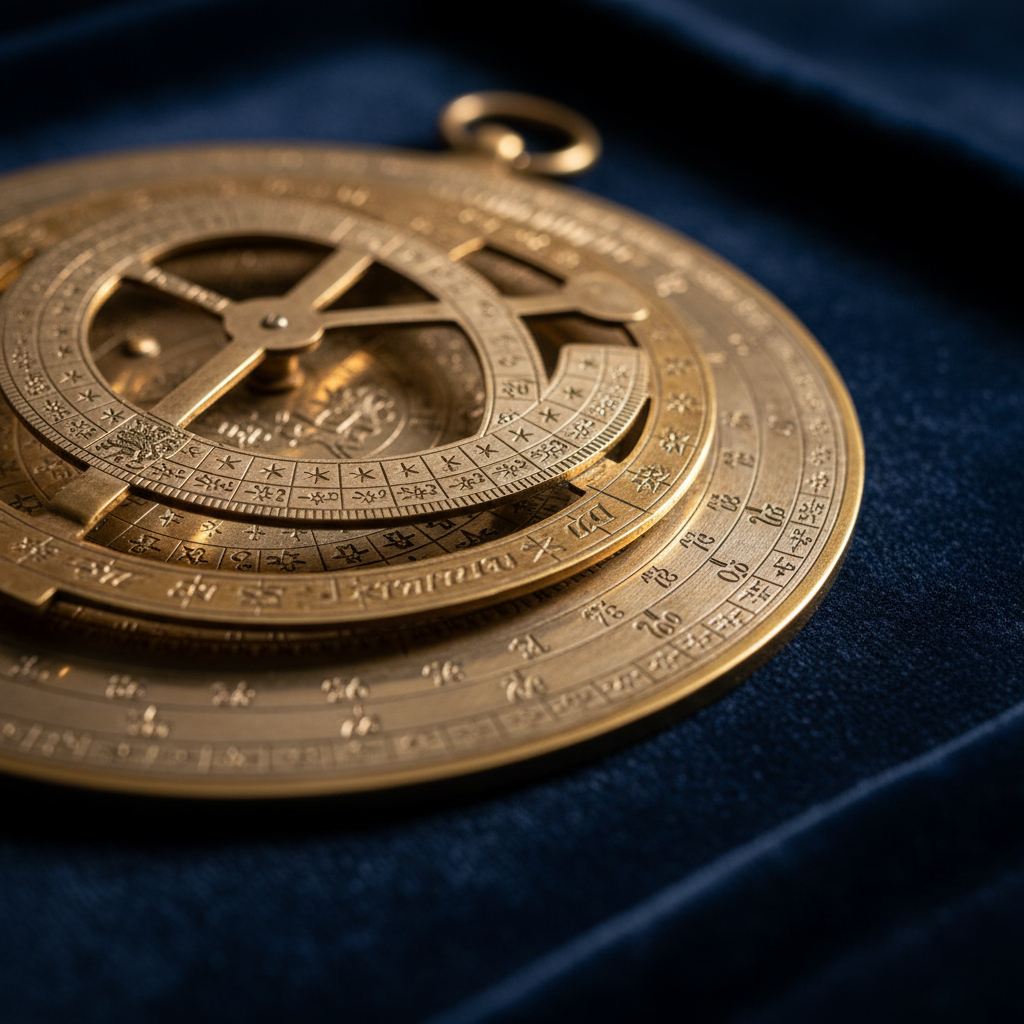
Some instruments don't just tell time — they tell history. A rare medieval astrolabe with documented royal provenance has sold at auction for a record-breaking price, reaffirming that the market for early scientific instruments remains one of the most quietly ferocious corners of the antiques world.
The piece, described by auction specialists as a monumental example of pre-modern astronomical computing, achieved a hammer price that set a new global benchmark for the category. Astrolabes of this caliber — finely engraved, mathematically precise, and surviving intact across centuries — surface at major auction perhaps once a decade. When they do, serious bidders show up.
The Instrument That Ran the Medieval World
To understand why this sale matters, you need to understand what an astrolabe actually is. These weren't decorative curiosities. For roughly a thousand years — from the Islamic Golden Age through the European Renaissance — the astrolabe was the most sophisticated portable computing device on earth. A skilled user could determine local time, latitude, the positions of stars, and the date of religious festivals from a single handheld brass disc. Navigators relied on them. Astronomers built careers around them. Royalty commissioned them as symbols of intellectual power.
The finest surviving examples are objects of staggering craftsmanship. Intricate rete work — the open lattice overlay that maps the fixed stars — required metalworking precision that rivaled anything produced in Europe before the Industrial Revolution. A well-preserved royal-commission astrolabe isn't just an antique. It's a primary historical document, a feat of engineering, and a work of art compressed into a single object.
That combination of attributes is exactly what drives price. Collectors competing for instruments like this aren't choosing between a nice piece and a nicer piece. They're competing for something genuinely irreplaceable.
What the Record Signals for Scientific Instrument Collecting
The market for antique scientific instruments has been building momentum for years, largely beneath the radar of mainstream collectibles coverage. While sports cards and vintage comics dominate the headlines, a focused group of institutional buyers, private collectors, and museum acquisition funds has been steadily pushing prices upward on astrolabes, armillary spheres, orreries, and early navigational tools.
Comparable sales tell the story. A 16th-century Persian astrolabe sold through Christie's London in 2019 for over £280,000. A Flemish brass astrolabe with original case cleared $340,000 at Sotheby's in 2021. The trajectory has been consistently upward, and the new record extends that line significantly.
Royal provenance is the multiplier. An instrument with documented ownership by a named monarch or high court official doesn't just carry historical interest — it carries verifiable scarcity. You cannot manufacture a better ownership chain. That paper trail, when it holds up to scholarly scrutiny, is worth more than the object's intrinsic rarity alone.
Condition compounds everything. Astrolabes that survive with original engraving crisp, rete work intact, and all plates present are vanishingly rare. Centuries of use, storage, and the occasional well-meaning restoration have compromised most surviving examples in some way. A complete, unrestored instrument in exceptional condition is the kind of thing that stops a room.
A Category That Rewards Deep Knowledge
For collectors considering entry into early scientific instruments, the learning curve is steep — and that's precisely what protects the market. Unlike trading cards, where PSA population reports and recent auction comps are publicly accessible in minutes, authenticating a medieval astrolabe requires genuine scholarly expertise. Provenance research, metallurgical analysis, and comparison against catalogued museum holdings are standard due diligence. The Museum of the History of Science in Oxford and the Adler Planetarium in Chicago maintain reference collections that serious buyers consult as benchmarks.
That friction keeps casual flippers out. It also means that when a genuinely extraordinary piece surfaces, the buyers in the room have done their homework and priced accordingly.
This sale won't spark a wave of astrolabe flipping. The supply is simply too constrained and the expertise barrier too high for that kind of speculative frenzy. What it will do is reset the ceiling — and remind the broader antiques market that the instruments that once guided ships across unknown oceans are still capable of commanding a room.