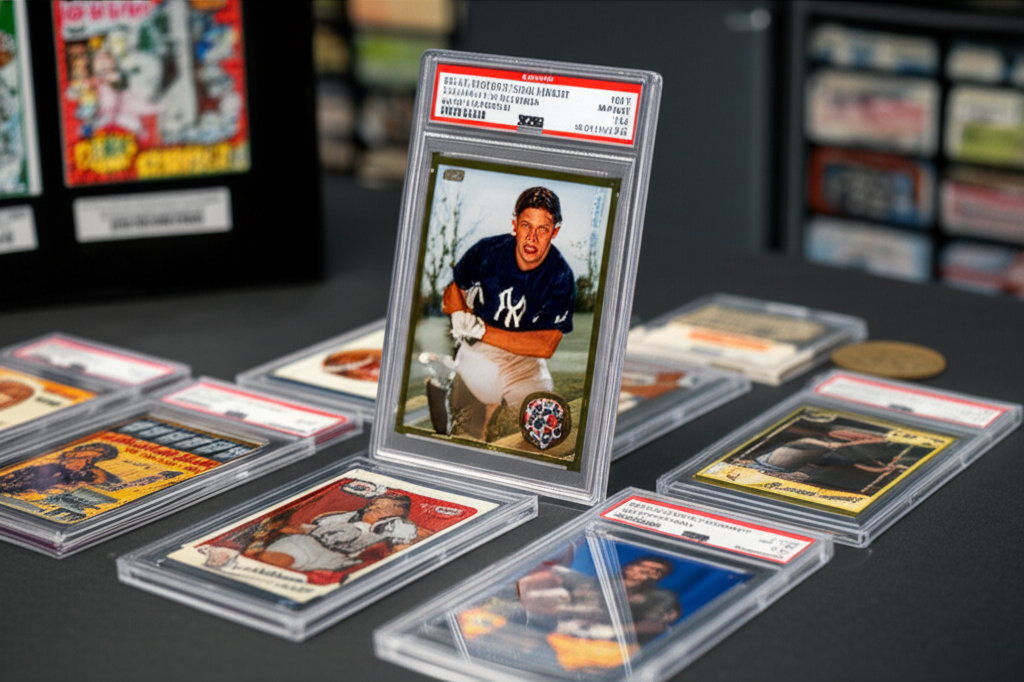
Two cards crossed the seven-figure threshold over the weekend, headlining an auction that also delivered a record price for a graded magazine. A Babe Ruth rookie card and a 1-of-1 Steph Curry each surpassed $1 million, while a slabbed Sports Illustrated featuring Michael Jordan sold for a six-figure sum — setting a new benchmark for graded periodicals in the process.
The results land at a moment when the high end of the hobby is showing real resilience. Blue-chip vintage and true 1/1 modern cards have largely held their ground through the broader market correction that has squeezed mid-tier product since 2022. This weekend's numbers are a data point in that argument, not an anomaly.
The Headliners
Ruth's rookie appearance comes from the 1916 M101-5 Sporting News set, one of the most historically significant issues in American sports card history. Ruth was a pitcher for the Boston Red Sox when the card was printed — years before his transformation into the most recognizable athlete of the 20th century. PSA has graded fewer than 200 examples across all grades, and high-grade copies are genuinely scarce. A seven-figure result for a strong specimen is defensible on fundamentals alone.
The Curry 1/1 is a different kind of trophy. Modern 1/1 parallels occupy a complicated place in the market — their value is entirely dependent on the player's trajectory, the set's prestige, and the grade. For Curry, a two-time scoring champion, three-time champion, and the player who structurally changed how basketball is played and valued, demand has only deepened since his 2022 title run with Golden State. A million-dollar result for the right Curry 1/1 is not a surprise. It is, however, a confirmation that his card market has matured into genuine investment-grade territory.
The Record That Deserves More Attention
The Jordan Sports Illustrated result may be the most structurally interesting sale of the weekend. Graded magazines — slabbed by CGC, which has expanded its magazine grading program significantly over the past three years — are still a nascent category. A six-figure price for a single slabbed periodical is, by any reasonable measure, a record for the format.
The Jordan angle is obvious. His February 1984 Sports Illustrated cover — his first national magazine cover as a professional — has become one of the most recognized images in sports publishing. CGC's grading scale for magazines mirrors its comics approach: condition, spine integrity, staple rust, and page quality all factor into the final grade. High-grade copies of the Jordan SI are genuinely hard to find; most newsstand copies were read, folded, and discarded. The population of CGC-graded examples in 9.8 or 9.6 condition is small enough that a single strong copy commands real scarcity premium.
What makes this sale significant beyond the number itself is what it signals for the graded magazine category broadly. CGC entered the space knowing that Jordan, Ruth, and Ali covers would anchor early demand — but a six-figure result starts to legitimize the category as a parallel track to cards and comics, not a novelty. Dealers who have been sitting on high-grade newsstand copies of key issues should be paying close attention.
What the Weekend Actually Tells Us
Three results. Two asset classes. One clear throughline: condition and scarcity still command a premium that no market cycle has been able to erode at the very top.
The mid-market remains under pressure. Raw cards, low-pop commons, and speculative modern rookies are still correcting. But a Ruth rookie in strong grade, a true 1/1 of an all-time great, and a record-setting slabbed magazine? Those aren't trading on hype. They're trading on the same logic that moves a Honus Wagner or a first-edition Action Comics — irreplaceable objects attached to irreplaceable names.
The auction house hasn't been specified in available reporting, but the results will circulate through Heritage, Goldin, and PWCC comp databases immediately, resetting price expectations for comparable pieces. Sellers holding similar inventory now have fresh ceiling data. Buyers chasing similar pieces now know what the market will bear.
For the graded magazine record specifically, the more interesting number isn't the price paid this weekend. It's the price the next one brings.