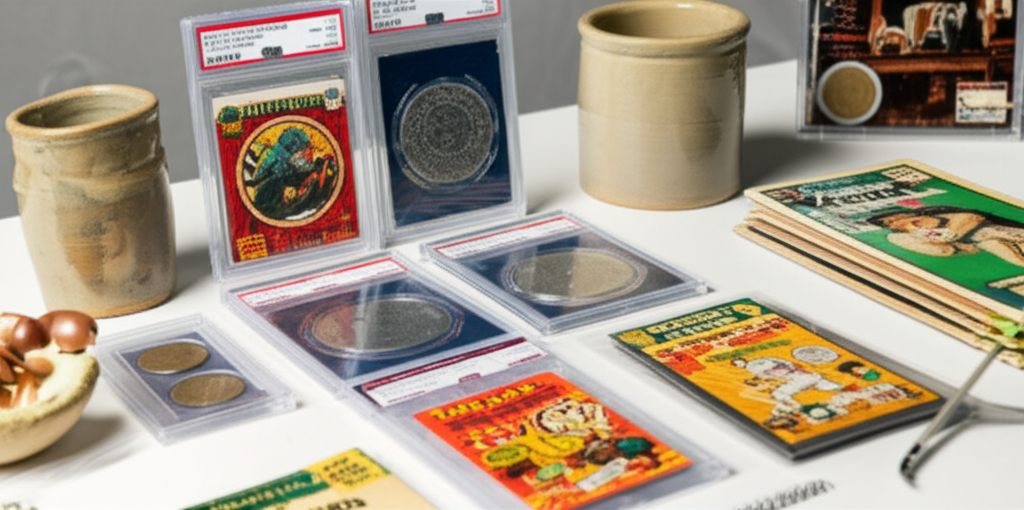
Before refrigeration, before plastic, before anyone thought to slap a brand logo on a container, there was stoneware. Dense, durable, and fired at temperatures that fused salt vapor directly into the clay surface, American salt-glazed stoneware was the utilitarian backbone of 18th and 19th century domestic life — and it has quietly become one of the most compelling categories in American folk art collecting.
The market doesn't roar the way it once did for mid-century modern or vintage sneakers. But for collectors who do their homework, that's precisely the point.
From Westerwald to the American Frontier
The technique itself predates the United States by centuries. German potters in the Westerwald region were producing blue-and-grey salt-glazed relief wares as early as the late 1500s, decorating jugs and tankards with cobalt-blue motifs and stamped medallions that still command strong prices at European auction houses today. When German immigrant potters crossed the Atlantic in the 17th and 18th centuries, they brought the technique with them — and American stoneware was born.
By the early 1800s, potteries had spread from New York and New Jersey down through Pennsylvania, Ohio, and into the Deep South. Each regional tradition developed its own aesthetic fingerprint. New York potters — particularly those operating out of Bennington, Vermont and the Hudson Valley — favored elaborate brushed cobalt decorations: birds, flowers, deer, and folk scenes rendered freehand on grey stoneware bodies. Southern potteries, especially those in the Catawba Valley of North Carolina, leaned toward alkaline glazes and more austere forms.
That regional specificity is a big part of what drives collector interest today. A signed piece from a documented pottery carries significantly more value than an unsigned equivalent. A two-gallon crock stamped with the mark of Whites Utica — one of the most prolific New York stoneware producers of the mid-19th century — can fetch anywhere from $200 to over $2,000 depending on the quality and complexity of its cobalt decoration. A comparable unsigned piece might bring a tenth of that.
What the Market Actually Looks Like
Salt-glazed stoneware doesn't have a PSA population report or a Beckett price guide. That's both its challenge and its opportunity. Pricing is driven by condition, decoration, provenance, and — increasingly — the depth of the buyer pool at any given auction.
At Crocker Farm, the Maryland-based auction house that has become the definitive venue for American stoneware, decorated pieces with exceptional folk art imagery routinely exceed five figures. A large presentation-grade jug with a fully rendered cobalt eagle or a multi-figure scene can push past $20,000 to $50,000 at the top of the market. These aren't anomalies — they're the benchmark for the category's ceiling.
The floor, meanwhile, is remarkably accessible. Undecorated or lightly decorated utilitarian crocks in the one- to three-gallon range regularly sell at regional estate auctions for $30 to $150. For a new collector, that's a low-cost entry point into a category with genuine art historical depth.
Condition grading in stoneware follows conventions that will feel familiar to any serious antiques collector, even if they're not codified by a third-party service. Hairline cracks, chips to the rim or base, and significant crazing all reduce value substantially. The cobalt decoration itself matters enormously — faded or washed-out blue commands far less than bold, deeply saturated pigment that survived the kiln intact. And size matters: larger pieces, particularly those over four gallons, are rarer and typically more desirable.
The Folk Art Premium
What separates the serious stoneware market from general antiques is the folk art premium — the recognition that the best decorated pieces aren't just old pots, they're original American paintings on clay. A potter who spent ten minutes brushing a stylized bluebird onto a crock before it went into the kiln was making an aesthetic decision, not just filling an order. Those decisions, made anonymously in regional potteries across two centuries, are now the primary driver of value.
Figural decorations command the highest premiums: roosters, eagles, deer, horses, fish, and human figures all outperform floral motifs, which outperform simple brushed lines or stamps. A piece with a rare or unusually complex scene — a hunter with a dog, a sailing ship, a full farmstead — can be worth multiples of a comparable piece with a generic flower spray.
Collector communities have organized around this category with real sophistication. The American Ceramic Circle and regional folk art societies maintain scholarship on pottery marks and regional traditions that rivals the documentation work done in any other collectibles vertical. That institutional knowledge base is part of what gives serious buyers the confidence to pay strong prices for the right pieces.
Stoneware will never be a liquid market. You can't flip a crock the way you flip a graded rookie card. But for collectors drawn to objects that carry genuine American history — functional, handmade, regionally specific, and visually arresting — the category offers something that most of the collectibles world simply can't replicate. The glaze is still there, fused into the clay by fire, exactly as it was the day it came out of the kiln two hundred years ago.