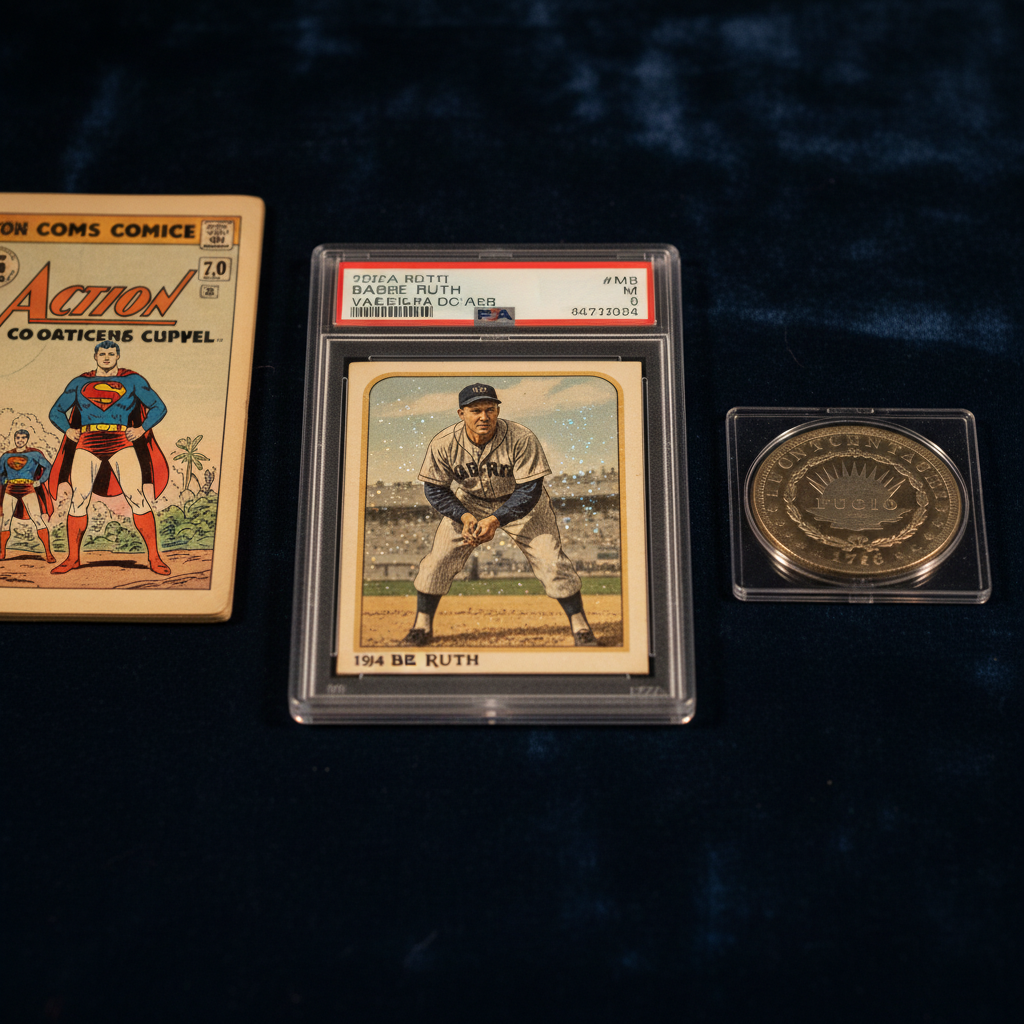
Timing is everything in the art market, and Schoelkopf Gallery has found a moment that money can't manufacture. As the United States approaches its Semiquincentennial in 2026 — 250 years since the Declaration of Independence — the New York gallery is leveraging both a personal milestone and a national one to mount what may be the most culturally resonant exhibition of its kind this decade.
The show, framed around American art as a mirror of a changing nation, arrives at an inflection point for the fine art collectibles market. After a turbulent 2023 that saw auction house revenues contract across the board — Christie's, Sotheby's, and Phillips all reported year-over-year declines in their contemporary and American art categories — the market for historically grounded American works has quietly held its footing. Patriotic themes, regionalist painting, and narrative Americana have found a floor that purely speculative contemporary art has not.
A Gallery Milestone Meets a National One
Schoelkopf has operated as one of the more serious stewards of American art in the secondary market, with a program that has historically favored craft over spectacle. The gallery's decision to align its own institutional anniversary with the nation's 250th birthday isn't mere marketing opportunism — it reflects a genuine collecting thesis: that American art, viewed chronologically, tells the story of a country still in argument with itself.
That thesis has real market legs right now. Works by 19th- and early 20th-century American painters — Hudson River School, Ashcan School, American Impressionists — have seen sustained collector demand at auction. Heritage Auctions' American Art category posted consistent results through 2023 and into 2024, with mid-tier works in the $20,000–$150,000 range finding buyers faster than comparable contemporary lots. Collectors who were burned by the NFT and ultra-contemporary bubble have rotated toward works with provenance, historical context, and demonstrable longevity.
Schoelkopf's programming speaks directly to that appetite.
What the Semiquincentennial Means for the Market
Major national anniversaries have historically catalyzed collecting cycles in Americana broadly — not just fine art, but coins, ephemera, stamps, and decorative arts. The U.S. Bicentennial in 1976 triggered a documented surge in American antiques collecting that reshaped the market for the following decade. Dealers who positioned early captured that wave; those who didn't were left chasing inventory.
The 2026 Semiquincentennial is shaping up similarly. The U.S. Mint has already announced commemorative coin programs tied to the anniversary, and major auction houses are quietly building Americana-themed sale calendars for 2025 and 2026. Stack's Bowers, which handles some of the most significant early American numismatic material, has flagged the anniversary cycle as a meaningful demand driver for colonial-era and early Federal period coins.
Fine art is a natural extension of that cycle. Paintings, prints, and works on paper that depict American history, landscape, or social life carry a different kind of resonance in an anniversary year — and sophisticated collectors know that resonance translates to liquidity. A work that moves emotionally in 2026 moves financially too.
Schoelkopf's exhibition, by centering the conversation on how art has reflected the nation's evolution, positions the gallery as a curatorial authority at exactly the right moment. That's not a small thing. In a market where institutional credibility increasingly drives collector confidence — especially post-pandemic, when gallery relationships became more selective — being seen as the gallery that framed the Semiquincentennial conversation carries lasting value.
The Collector's Calculus
For serious buyers, the question isn't whether American art matters right now. It clearly does. The question is where within the category the opportunity sits.
Blue-chip American modernists — Georgia O'Keeffe, Edward Hopper, Andrew Wyeth — remain priced for institutions and the ultra-high-net-worth tier. But the secondary market beneath that level is genuinely interesting. Artists who documented American life across the 19th and 20th centuries, whose work is historically significant but hasn't yet achieved household-name status, represent the kind of asymmetric opportunity that anniversary cycles tend to unlock.
Galleries like Schoelkopf, which operate at the intersection of scholarship and commerce, are often the first place that material surfaces before it hits the major auction rooms. That's where the edge is.
Two hundred and fifty years is a long time to build a national mythology. The art market, at its best, is where that mythology gets priced.