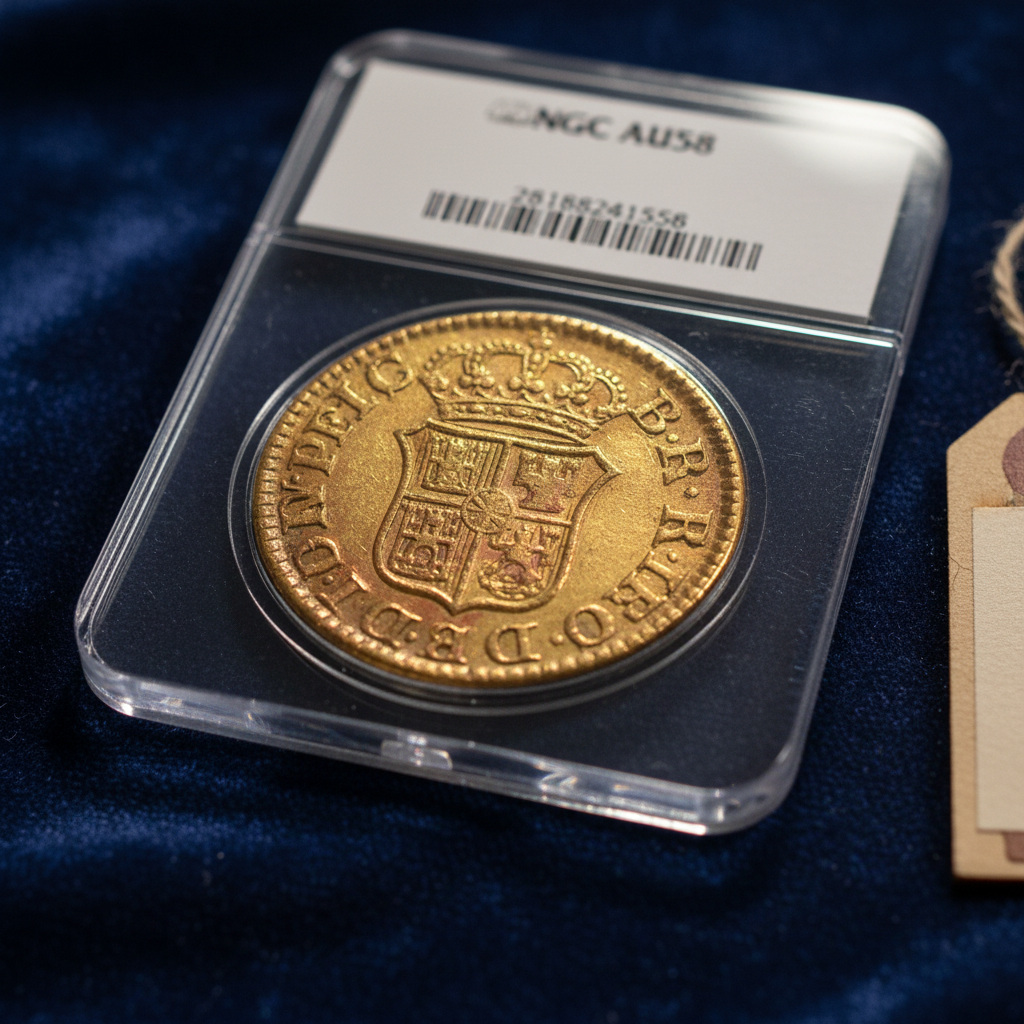
Sedwick Coins has built a reputation as the go-to house for serious treasure coin collectors, and Auction 39 looks like one of the most substantive sales the Florida-based firm has assembled in years. The offering spans dated gold cobs, certified shipwreck material, and curated single-owner collections — a combination that rarely surfaces in a single sale outside of the major Heritage or Stack's Bowers flagship events.
For collectors who operate in the specialized world of Spanish colonial coinage, this is the kind of sale that gets circled on the calendar months in advance.
Dated Gold Cobs and Why They Command Premiums
Dated gold cobs — crudely struck colonial-era coins bearing a legible year — occupy a distinct tier in the numismatic market. An undated cob is a historical artifact. A dated cob is a historical document. That distinction drives meaningful price separation at auction, and the gap has been widening.
The mechanics are straightforward: gold cob production in mints like Potosí and Cartagena was notoriously inconsistent. Full dates were struck infrequently, and survival rates for clearly dated examples are low. When a dated specimen also carries a full assayer's mark and clean surfaces, the population of comparable coins can shrink to single digits — sometimes zero. That's not hyperbole. It's why a dated 8 escudos from a recognized mint can clear multiples of what an undated equivalent fetches, even when the undated coin is technically finer.
Sedwick's consignment pipeline for this category is among the strongest in the business. The firm's principals have decades of direct field experience with colonial material, which translates into better provenance documentation and tighter attribution than you typically see from generalist auction houses handling the same coins.
Shipwreck Treasure: Certified, Storied, and Increasingly Scarce
Shipwreck coins certified by NGC with specific wreck attributions — Atocha, Buen Jesús y Nuestra Señora del Rosario, 1715 Fleet — have developed a secondary market dynamic that operates almost independently of the broader numismatic market. The coins aren't just graded; they're tied to a narrative, a recovery operation, a specific ocean floor. That provenance is essentially unreplicable.
Supply is genuinely finite. The major recoveries happened decades ago. Mel Fisher's Atocha operation, which ran through the 1970s and 1980s, produced the bulk of certified Atocha material now in circulation. New certified Atocha coins don't appear from fresh recoveries — they appear when estates are settled, collections are dispersed, or longtime holders decide to liquidate. Auction 39 benefits from exactly that dynamic.
Shipwreck silver has also proven more resilient to market softness than many modern numismatic categories. When the broader rare coin market saw pressure in 2022 and into 2023, certified treasure coins held their floor more consistently than, say, high-grade Morgan dollars or early American copper. The collector base is passionate, geographically diverse, and not heavily correlated with the investor-grade registry coin crowd.
Single-Owner Collections and the Depth Factor
The inclusion of landmark single-owner collections elevates Auction 39 beyond a standard consignment sale. When a focused collection comes to market intact — assembled over years or decades by a specialist — it creates bidding dynamics that benefit sellers and create genuine discovery opportunities for buyers.
Depth matters here. A collector who spent thirty years acquiring, say, Colombian colonial coinage will have made acquisitions across different market cycles, different dealer relationships, and different geographic sources. The result is often a collection with provenance trails and variety coverage that no single buyer could replicate by shopping the open market today.
Sedwick has handled several landmark collection dispersals over the past decade, and the firm's expertise in Spanish colonial material means attribution quality tends to be higher than what generalist houses produce. Misattributed cobs are a real problem in this category — mint marks misread, assayers confused, dates partially interpreted. Getting that right matters, both for accuracy and for realized prices.
The momentum in specialized numismatic categories — treasure coins, colonial gold, shipwreck material — reflects a broader shift among advanced collectors moving away from registry-set competition toward historically significant, genuinely scarce material. Auction 39 lands at exactly the right moment to capture that energy. Whether it converts into record realizations will depend on the room. But the raw material is there.