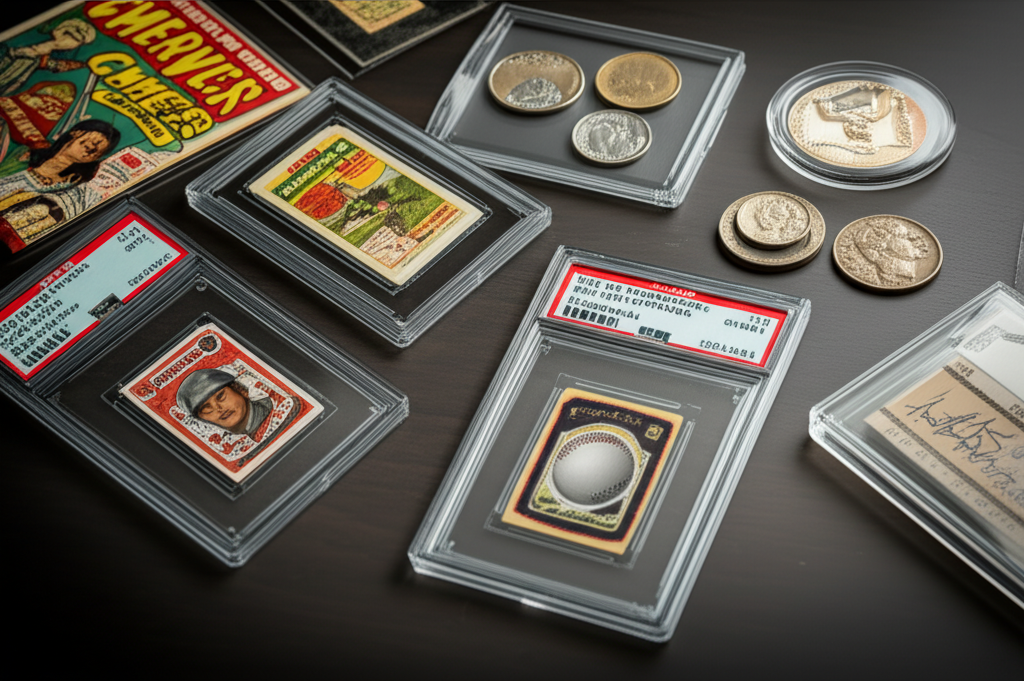
Baseball cards have been printed continuously for roughly 140 years. That's not a metaphor — it's a logistical miracle that spans tobacco premiums, the Great Depression, wartime paper shortages, the junk wax flood, and the modern graded-slab era. The cleanest way to appreciate that span isn't a timeline. It's a chain: seven players whose careers and cardboard overlap, linking the 1880s to the present in one unbroken line.
The Chain, Link by Link
Start with Cap Anson. The Chicago White Stockings first baseman appears on the N172 Old Judge cabinet cards issued by Goodwin & Company beginning in 1887 — among the earliest mass-produced baseball cards in existence. PSA has graded fewer than 50 Anson examples across all variations, and authenticated copies in PSA 2 or better routinely clear $2,000–$5,000 at Heritage Auctions. Anson played until 1897, his career overlapping with a young pitcher who would become the sport's next link.
Cy Young broke into the majors in 1890 and pitched until 1911. His earliest cardboard appears in the N300 Mayo Cut Plug set of 1895, a tobacco issue so scarce that a PSA-graded example of virtually any player commands four figures. Young's career bridged the dead-ball era and crossed paths with a hard-throwing Georgia outfielder named Ty Cobb, who debuted in 1905.
Cobb's cards are among the most valuable in the hobby. His T206 White Border — issued between 1909 and 1911 by the American Tobacco Company — exists in multiple poses and back variations. A PSA 8 Cobb portrait recently fetched over $25,000 at Goldin. Cobb played until 1928, long enough to share the field with a young Yankees outfielder who would become the hobby's most iconic name.
Babe Ruth debuted in 1914. His first widely collected card is the 1916 M101-5 Sporting News Supplement, a rookie-year blank-back issue where PSA 5s have sold north of $100,000. Ruth retired in 1935, but his career overlapped substantially with a young Cardinals center fielder who would carry the torch into the postwar era.
Stan Musial broke in with St. Louis in 1941 and played until 1963. His 1948 Bowman rookie — card #36 in that landmark set, the first major postwar issue — grades well in PSA 8 at roughly $800–$1,200, though PSA 9s have cleared $4,000. Musial's career ran long enough to share a league with a young San Francisco outfielder who would chase and break his NL records.
Willie Mays debuted in 1951 and played until 1973. His 1952 Topps card — #261 in that foundational set — is one of the hobby's essential pieces. PSA has graded over 1,300 examples, with just 14 earning a PSA 9 and zero confirmed PSA 10s. A PSA 9 sold for $216,000 at Goldin in 2022. Mays's Giants career overlapped with a young Padres outfielder who would eventually become the sport's all-time hits leader.
Tony Gwynn debuted in 1982 and retired in 2001. His 1983 Topps rookie — card #482, shared with no one — sits in a sweet spot of the market: PSA 10s trade in the $150–$300 range, accessible enough for new collectors but with a genuine ceiling if Gwynn's Hall of Fame legacy continues to resonate. And Gwynn's career crossed directly into the era of a current active player who still holds a roster spot today, completing the chain.
What the Chain Actually Tells Us
The exercise isn't just a party trick. It reveals something structurally important about the hobby: the market for baseball cards is not seven separate eras. It's one continuous conversation between generations of collectors, with prices and demand at each link influenced by the health of the whole.
When the T206 market surges — as it did following the $6.6 million sale of the Honus Wagner at Goldin in 2021 — it pulls attention toward all pre-war tobacco issues, which elevates the perceived prestige of early Bowman, which in turn reinforces the foundational status of 1952 Topps, which validates the entire vintage-to-modern spectrum. The chain isn't metaphorical. It's mechanical.
The grading population data underscores the scarcity gradient. An N172 Old Judge with single-digit PSA population sits at the extreme scarcity end. A 1983 Topps Gwynn PSA 10 — with a pop count in the hundreds — sits at the accessible end. Between them lies every major watershed moment in the hobby: the Goudey era, the war years, the 1952 Topps watershed, the Fleer/Donruss explosion, and the modern graded era that began in earnest when PSA was founded in 1991.
Seven players. Seven cards. One hundred and forty years of uninterrupted American obsession. The hobby didn't start with a 1952 Topps Mantle and it won't end with whatever comes next — but every card in between is a link in the same chain, and serious collectors would do well to understand where their piece fits in it.