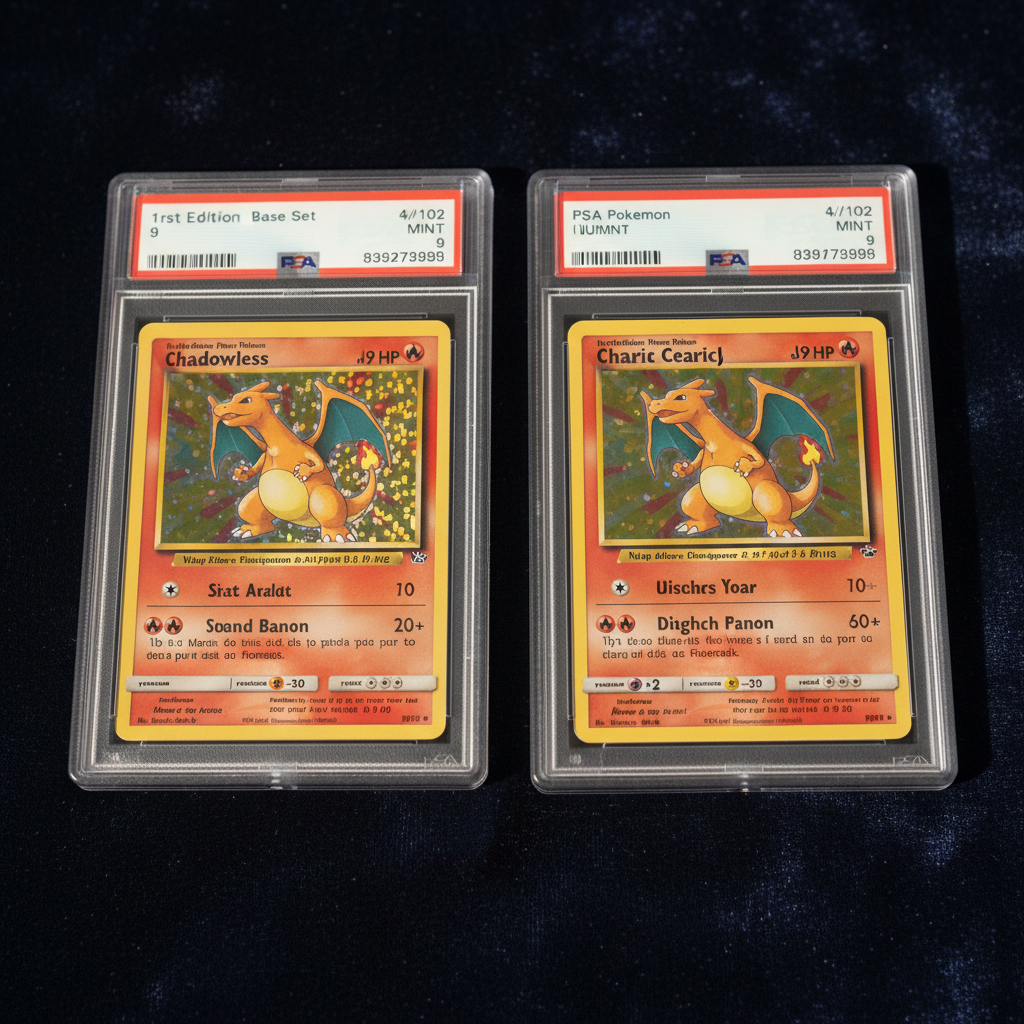
Most collectors know the First Edition stamp. Far fewer understand what sits directly beneath it in the Base Set hierarchy — and that gap in knowledge is costing people real money at auction.
The Pokémon Base Set was printed in three distinct waves: First Edition, Shadowless, and Unlimited. First Edition gets all the headlines, but the Shadowless print run is where serious collectors are quietly building position, and the spread between a Shadowless and an Unlimited copy of the same card — same grade, same holo — can exceed 400% at the top of the market.
What Separates the Three Prints
The differences are subtle to the untrained eye and enormous to a grader's loupe. First Edition cards carry the unmistakable stamp on the left side of the card's art box. Shadowless cards, printed in the same early production window, lack that stamp — but they also lack the drop shadow along the right side and bottom of the illustration box that would appear on all subsequent Unlimited printings. That shadow is the tell.
Unlimited cards, which flooded hobby shops and big-box retailers through the late 1990s and into the early 2000s, are the versions most collectors actually owned as kids. They're abundant. PSA has graded well over 20,000 Unlimited Charizard Holos across all grades. The Shadowless population is a fraction of that — and the First Edition population is smaller still, with PSA 10 examples numbering in the dozens.
The Shadowless Charizard in PSA 10 has traded north of $10,000 in recent Heritage and Goldin auctions, while a PSA 10 Unlimited Charizard — a legitimately difficult grade to achieve — typically clears in the $500–$900 range depending on timing and platform. That's not a small premium. That's a different asset class wearing the same name.
Why Shadowless Is the Collector's Sweet Spot
First Edition is the trophy. Everyone understands its scarcity. A PSA 10 First Edition Charizard sold for $369,000 through PWCC in 2022, a number that put Pokémon cards on the front page of publications that had never covered the hobby. But that ceiling price has also priced most serious collectors out of the market for high-grade First Edition holos entirely.
Shadowless fills the gap in a way that makes genuine collecting sense. The print run was short — Wizards of the Coast corrected the shadow omission quickly — and the cards share the same early-production cardstock and ink characteristics that make First Edition copies so visually distinct from the Unlimited sea. Graders at PSA and BGS treat the two early prints differently in population reports, and the market has followed that logic.
A BGS 9.5 Shadowless Charizard — a Gem Mint equivalent with subgrades intact — represents a legitimate store of value that remains accessible compared to its First Edition counterpart, while still sitting in a population thin enough to matter. That's a collector's argument and an investor's argument simultaneously.
The grading premium for Shadowless over Unlimited holds across the entire Base Set holo rare checklist, not just Charizard. Shadowless Blastoise, Venusaur, and Ninetales all command meaningful premiums at equivalent grades. The Charizard gets the attention, but the pattern is consistent.
How to Identify and Grade Shadowless Cards
Authentication starts before submission. To confirm a Shadowless print, examine the illustration box closely: there should be no shadow effect on the right and bottom edges. The HP font on early prints also runs slightly thinner than Unlimited, and the card backs tend toward a slightly darker blue — though back coloration alone is not a reliable sole indicator.
For grading, PSA explicitly notates Shadowless in its label descriptor, which matters enormously for resale. A raw card identified as Shadowless but submitted without that notation on the holder is worth less in a transaction, full stop. BGS similarly differentiates in its registry. Submit to either major grader with the correct set designation selected, and verify the label reflects the variant before accepting the return.
Centering is the grade-killer on Base Set holos across all three print runs. The cards were cut with inconsistent tolerances, and a Shadowless Charizard with 60/40 centering that grades PSA 7 or BGS 7 trades at a meaningful discount to a well-centered PSA 8. The population of PSA 9 and above Shadowless Charizards is tight enough that condition sensitivity is extreme at the top — a single subgrade point on a BGS label can represent a four-figure difference in realized value.
Twenty-five years after these cards were printed, the ones that came off the press first are still the ones that matter most. The market figured that out a long time ago. The collectors who understand why — not just which variant to buy, but what makes the Shadowless print physically and historically distinct — are the ones positioned to act when the right copy surfaces.