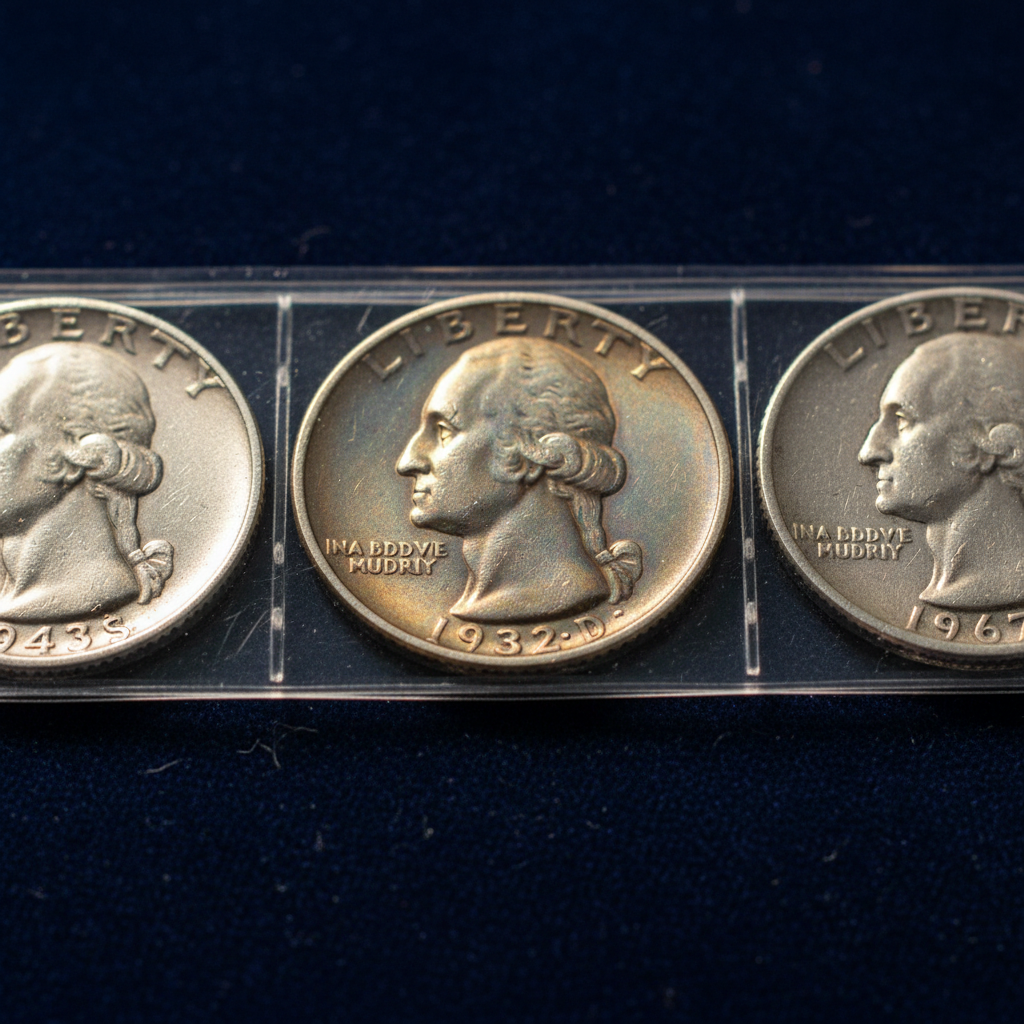
Few American coins occupy the strange dual identity of the silver Washington quarter — a workhorse of everyday commerce for three decades that quietly became one of the most actively traded series in U.S. numismatics. Struck from 90% silver from 1932 through 1964, the series spans 33 years of American history, two mints at peak output, and a collector market that ranges from bargain-bin circulated examples to five-figure registry-grade specimens.
The series was born out of crisis. The early 1930s depression gutted consumer confidence and federal revenues alike, yet the Treasury pressed forward with a long-discussed redesign of the quarter. John Flanagan's portrait of George Washington — adapted from a Jean-Antoine Houdon bust — was chosen over sculptor Laura Gardin Fraser's competing design in a decision that remains controversial among numismatic historians to this day. Fraser's design was considered by many to be the stronger work. It didn't matter. Washington's profile debuted on the quarter in 1932, and it hasn't left since.
The Key Dates That Drive the Market
The 1932 launch year produced two coins that still anchor the series at auction. The 1932-D and 1932-S — minted in Denver and San Francisco respectively — had mintages of just 436,800 and 408,000, making them the lowest-production issues in the entire run. In circulated grades, both trade regularly in the $100–$200 range. Push into MS-65 territory and the calculus changes fast: a PCGS MS-65 example of either issue can command $1,500 to over $3,000 depending on eye appeal and surface quality. A PCGS MS-67 1932-S — population in the single digits — is a legitimately rare coin by any standard.
Beyond the '32 keys, the series has a handful of semi-key dates that sophisticated collectors target. The 1936-D, 1937-S, and 1938-S all carry meaningful premiums in gem grades. The 1942-D overdate — struck with a misaligned die that left a visible ghost of the underlying date — is one of the series' most dramatic varieties and trades at strong multiples over its non-variety counterpart.
Then there's the 1950-D/S and 1950-S/D overmintmark varieties, which attract a dedicated subset of variety collectors willing to pay sharply for attribution. This is a series where knowing your varieties separates the serious buyers from the casual accumulators.
Grading Dynamics and Registry Competition
PCGS and NGC have collectively graded hundreds of thousands of Washington silver quarters, and the population data tells an interesting story. Common-date issues from the late 1950s and early 1960s — coins that were saved in rolls by the millions when silver coinage began disappearing from circulation — show enormous populations in MS-63 and MS-64 but thin out sharply at MS-67 and above. Strike quality and bag marks are the twin enemies of gem grades in this series; a fully struck, mark-free example with original luster is rarer than mintage figures suggest.
Proof issues, struck at Philadelphia from 1936 through 1942 and then again from 1950 through 1964, represent a parallel collecting track. The pre-war proofs — particularly the 1936 and 1937 issues — are scarce in absolute terms, with original mintages under 4,000 pieces. A PR-67 Cameo example from this era is a genuinely difficult coin to source. Post-1950 proofs are far more available, but Deep Cameo designations from NGC or the DCAM label from PCGS still carry meaningful premiums in the top grades.
Heritage Auctions and Stack's Bowers both move significant Washington quarter material at their major sales. Goldin has been less active in classic U.S. coinage, but the broader auction market for this series is liquid and consistent — which is more than you can say for many numismatic specialties.
Silver Value as the Floor
One dynamic unique to pre-1965 U.S. coinage is the silver melt floor. At current silver spot prices hovering around $30 per troy ounce, each Washington silver quarter contains roughly 0.1808 troy ounces of silver — putting the melt value near $5.40 per coin. That floor matters. It means even the most common, heavily worn examples from the 1950s and early '60s carry intrinsic value that no sports card or comic book can claim. The melt floor doesn't make every coin a great investment, but it does set a rational lower bound that collectors appreciate.
For dealers, this creates a bifurcated market: bullion buyers who stack circulated silver quarters by the roll or bag, and numismatic collectors chasing grades, varieties, and registry points. Both markets are active. Both have different price sensitivities. And occasionally — in the key dates and top-pop gems — they overlap in ways that push realized prices well above what either camp alone would support.
The silver Washington quarter series is, in the end, one of the most accessible entry points in all of U.S. numismatics. You can build a complete date-and-mint set in circulated grades for under $1,000. You can spend $10,000 chasing MS-67 registry coins and still not be done. That range — from approachable to obsessive — is exactly why the series has retained collector interest for nearly a century and shows no sign of losing it.