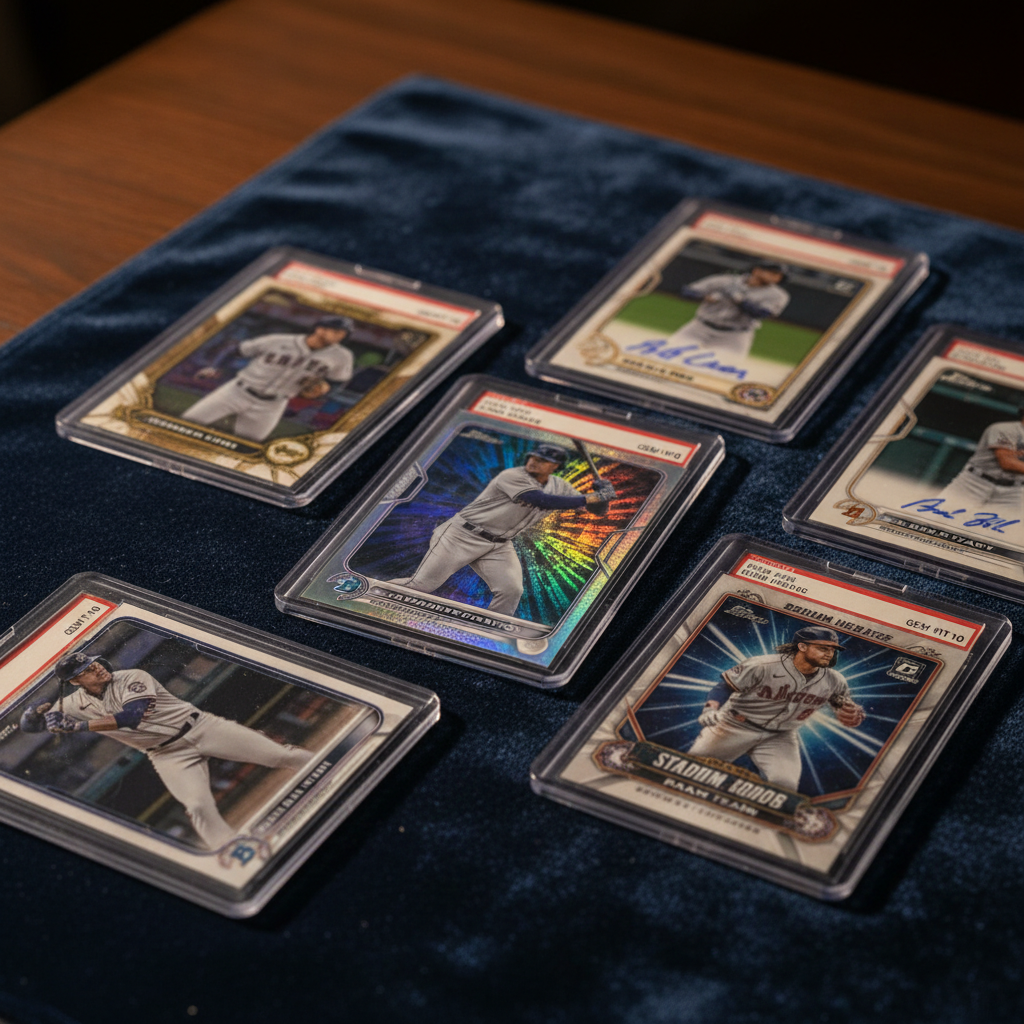
One month into the 2026 MLB season and the rookie card market is already sorting itself out. The names generating the most buzz at the hobby shop are the same ones lighting up box scores, and for collectors who've been through a few of these cycles, that convergence is exactly when you move.
The early-season window matters more than casual observers realize. First-year player cards released in flagship sets — Topps Series 1, Bowman Chrome, and the various parallels that follow — tend to see their sharpest price appreciation before the All-Star break, when mainstream sports media catches up to what the hobby already knows. By August, the arbitrage is largely gone.
The Prospect Pipeline Is Deeper Than Usual
This class is arriving with unusual pedigree. Several of the top names debuting in April were consensus top-10 prospects entering the year, and the early performance data is backing up the hype. That's not always how it goes — prospect rankings and MLB production diverge more often than they align — but when they do align, the card market responds fast and hard.
For context, look at what happened with the 2022 rookie class. Julio Rodríguez Bowman Chrome autos were moving in the $300–$500 range in April of that year before his Rookie of the Year campaign pushed PSA 10 copies past $1,200 by October. Collectors who waited for certainty paid a steep premium for it. The 2026 class has at least two or three names with comparable upside profiles.
Short-prints and photo variations are already appearing in the secondary market at multiples of base card prices — a pattern that signals genuine collector demand, not just speculator churn. When hobbyists are pulling cards and holding them rather than immediately flipping, that's a healthier foundation for sustained value.
What to Target and How to Grade the Risk
Not every hot rookie is worth the same level of commitment. The calculus shifts depending on whether you're building a position for a long hold or looking to move product before the market gets crowded.
For long-term holds, Bowman Chrome autographs in BGS 9.5 or PSA 10 remain the standard. Population counts on early-season rookies are still thin in April and May — grading turnaround times mean the flood of submitted cards hasn't hit yet. That thin pop creates a temporary scarcity premium that experienced collectors exploit before the masses catch on. Once a player's PSA 10 pop crosses into the hundreds, the ceiling compresses.
For shorter holds, raw cards and ungraded parallels offer faster liquidity. The Topps Gold parallel and Chrome Refractor variations are the sweet spot — enough visual appeal to drive demand, enough supply to find buyers quickly. Numbered-to-25 and below cards are a different animal; those trade more like art than commodity, and pricing can be erratic.
The six names generating the most traction through Month 1 span multiple positions and organizations, which matters for durability. A class concentrated in one or two franchises is vulnerable to team-level narrative shifts. This year's spread across market sizes and playing styles gives the rookie card ecosystem more structural support than it had in, say, 2023, when the conversation was almost entirely dominated by a single shortstop.
The Long Game vs. the Quick Flip
There's a version of this market that rewards patience and a version that rewards speed, and the honest answer is both are viable right now — but they require different cards.
If the Hall of Fame is the destination, you need autographs, you need high grades, and you need to be comfortable sitting on inventory for a decade or more. The 2001 Topps Bowman Chrome Albert Pujols auto is the canonical example: collectors who paid $50–$100 for raw copies in 2001 and held through his career arc saw those same cards sell at Heritage Auctions and Goldin for $10,000–$40,000 in certified grades. The math on a generational talent is extraordinary. The risk is identifying the generational talent correctly in Year 1.
For the flip, the window is measured in weeks, not years. A strong May performance can push a rookie card 40% higher. A slump in June can erase those gains just as fast. Treat it like a trade, not an investment — set a target exit price before you buy, and stick to it.
The 2026 rookie class is giving the hobby something it genuinely needed after a relatively quiet offseason: reasons to open packs and reasons to care about what's inside them. Whether any of these six names are still relevant conversations in 2036 depends on factors nobody can fully model right now. But the opportunity cost of waiting for certainty has historically been high. The collectors who built the most valuable rookie card portfolios didn't wait for the Hall of Fame announcement — they were there on Opening Day.