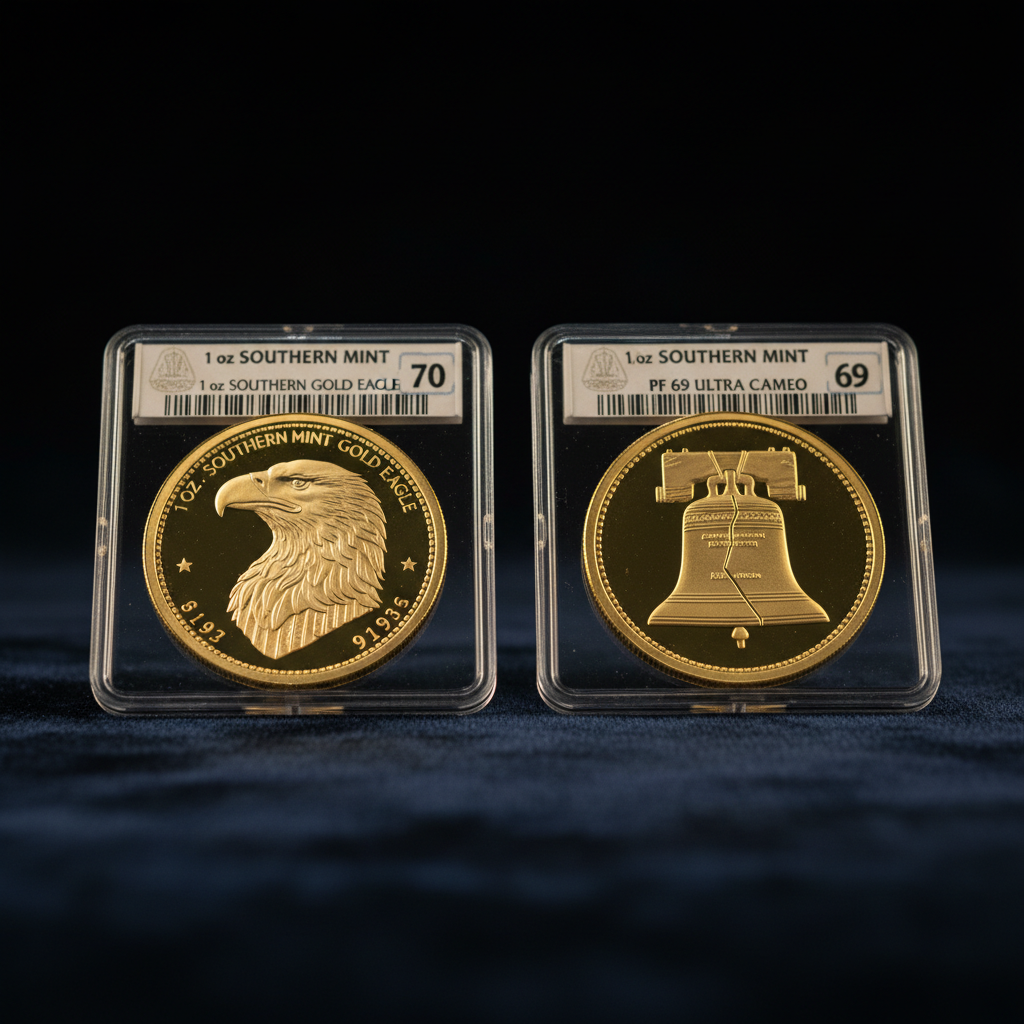
Prices for Charlotte, Dahlonega, and New Orleans gold coins have more than doubled in many cases over the past several years, and the market shows no sign of cooling. What was once a specialized niche within U.S. coinage has become one of the most competitive segments at major auction houses — Heritage, Stack's Bowers, and Goldberg among them — with even problem-free circulated examples routinely clearing multiples of their catalog values.
This isn't a speculative bubble. It's a structural shift driven by genuine scarcity, deep historical resonance, and a collector base that understands exactly what it's buying.
Three Mints, One Defining Era
The Charlotte Mint (C), Dahlonega Mint (D), and New Orleans Mint (O) operated during a remarkably compressed window of American history. Charlotte and Dahlonega opened in 1838 to process gold from the Southern Appalachian rushes — the first major domestic gold discoveries before California changed everything in 1848. New Orleans, also opened in 1838, served the Gulf Coast economy with both gold and silver coinage. All three were seized by Confederate forces in 1861 and never returned to federal coinage production.
That compressed operating window is the key to understanding the market. Charlotte struck gold coins for just 23 years. Dahlonega for the same. Every piece that survives is a product of a mint that no longer exists, from a region that fought a war over its identity, during a period of American economic expansion that reads like mythology now. Collectors aren't just buying metal — they're buying a specific, unrepeatable moment in U.S. history.
Mintages were small even by 19th-century standards. The 1842-C Small Date half eagle, for instance, had a mintage of just 27,432 pieces. The 1861-D gold dollar — struck by Confederate-controlled workers in the final days of the Dahlonega Mint's federal operation — saw a mintage of approximately 1,861 coins, and PCGS has certified fewer than 60 examples across all grades. A circulated VF-20 example sold at Heritage in 2023 for over $18,000. A problem-free AU specimen would be a major event.
Why Circulated Examples Are Driving the Market Right Now
The surge in auction results isn't concentrated at the top of the grade spectrum. That's what makes this market cycle unusual and, frankly, more sustainable than most.
Attractive circulated pieces — think PCGS or NGC VF-35 through EF-45 — have seen the sharpest percentage gains. These are coins that spent time in actual commerce, that passed through hands in antebellum Georgia or Louisiana, and that carry original surfaces and honest wear. For a segment defined by historical weight, that authenticity matters enormously to buyers.
Even coins with minor problems — old cleanings, small rim bumps, environmental damage — are bringing strong money because the supply of problem-free examples is simply exhausted at accessible price points. When a collector can't find a clean EF-40 Dahlonega quarter eagle at any price, a net-graded VF-details coin starts looking like a reasonable alternative. That dynamic has pushed money down the quality ladder in a way that benefits the entire category.
New Orleans gold presents a slightly different profile. The O-mint produced higher volumes than Charlotte or Dahlonega, particularly in half eagles and eagles, which means more survivors and more accessible entry points. But the finest-known examples — MS-63 and above — are just as rare, and auction results at Heritage and Stack's Bowers over the past 18 months confirm that high-grade New Orleans gold is being revalued aggressively upward. A 1847-O eagle graded MS-62 by NGC brought $34,000 at Stack's Bowers in early 2024, well above its prior auction history.
The Collector Base Is Getting Younger — and More Sophisticated
One underappreciated driver of this market is generational. A cohort of collectors in their 30s and 40s, many of whom came up through sports cards and modern numismatics, have discovered Southern gold as a category that offers genuine scarcity, historical depth, and — relative to their auction results — still-reasonable entry prices for mid-grade material.
These buyers do their homework. They understand population reports. They know that PCGS has certified only 11 examples of the 1855-C gold dollar in MS-60 or better, and they price accordingly. They're not buying on nostalgia. They're buying on data, and the data keeps pointing the same direction.
Dealers who specialize in early American gold — John Dannreuther, David Akers' legacy material, the major firms at the Florida United Numismatists show — have noted tighter inventory and faster turnover at nearly every price tier. When inventory tightens and demand accelerates simultaneously, the math is straightforward.
Southern gold coins were always important. The market is just finally pricing them that way.