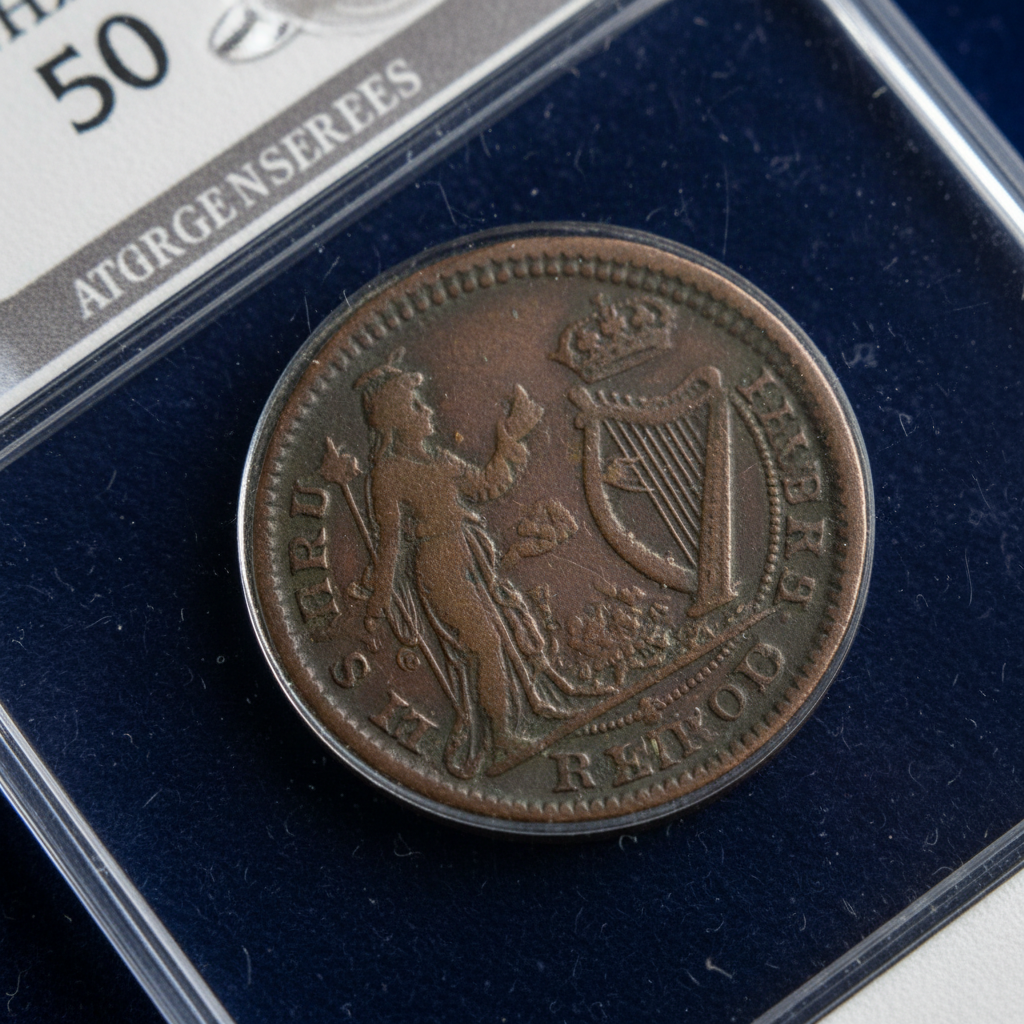
Before the United States had a mint, before the Continental dollar collapsed into infamy, and long before anyone thought to call it numismatics, a small copper coin struck in 17th-century Ireland was quietly doing the impossible — holding together the fractured monetary system of early colonial America. The St. Patrick Farthing is one of the most historically loaded coins in the entire canon of early American collecting, and it remains criminally underappreciated outside specialist circles.
The story starts in Ireland. The coins were struck sometime around 1663–1672, almost certainly in Dublin, and bear imagery tied directly to the legend of St. Patrick: the saint himself on the obverse, a harp-playing David on the reverse, with the Latin inscription Floreat Rex — may the king flourish. They circulated in Ireland first, but Ireland's loss became the colonies' gain.
A Currency Crisis and an Unlikely Solution
Colonial America had a money problem that modern collectors tend to underestimate. The English Crown actively restricted the export of silver and gold coinage to the colonies, leaving settlers to improvise with everything from wampum to tobacco to Spanish pieces of eight. Small change — the kind needed for everyday market transactions — was especially scarce. Farthings and halfpennies were desperately needed and almost nowhere to be found through official channels.
Enter Mark Newby, an Irish Quaker who emigrated to New Jersey in 1681 and brought a substantial quantity of St. Patrick coins with him. Whether this was a speculative play or simply practical preparation is lost to history, but the outcome was remarkable: in May 1682, the New Jersey General Assembly authorized the St. Patrick Farthing as legal tender — making it the first coin to receive that designation from any legislative body in American colonial history. That's not a footnote. That's a founding moment.
The coins circulated primarily in New Jersey and parts of the broader mid-Atlantic region. Because copper was soft and the coins saw heavy use, well-preserved examples are genuinely scarce today. Most survivors show significant wear, which makes high-grade specimens legitimately rare rather than artificially so.
What Collectors Are Actually Dealing With
The St. Patrick coinage comes in two primary denominations: the farthing and the halfpenny. The farthing is far more commonly encountered, though common is relative. Both types are catalogued in the Standard Catalog of World Coins and more specifically in Whitman's reference works on early American coinage, where they appear under the Colonial section alongside Massachusetts Pine Tree shillings and Maryland Lord Baltimore pieces.
PCGS and NGC both certify St. Patrick Farthings, and population data tells the story of their survival clearly. Circulated examples grading VG-8 through Fine-15 represent the bulk of certified specimens. Anything reaching VF-20 or above commands serious attention at auction. A PCGS VF-35 example sold through Stack's Bowers in recent years for over $3,000, and a particularly sharp NGC EF-40 specimen has crossed $7,500 at Heritage. The handful of coins that retain significant original brass or copper luster — there is a gilt variety with gold wash on the obverse — can push well past five figures in top condition.
The gilt farthing is its own conversation entirely. These pieces, distinguished by a gold-washed obverse, are considerably rarer than standard copper strikes and are considered among the more desirable type coins in the entire colonial American series. If one surfaces at a major auction in AU condition, expect the room to pay attention.
- Type: St. Patrick Farthing (copper) and Halfpenny
- Struck: circa 1663–1672, Ireland
- Legal tender designation: New Jersey, May 1682
- Key variety: Gilt (gold-washed obverse) Farthing — significantly rarer
- Grading services: PCGS, NGC
- Auction comps: VF-35 examples $3,000+; EF-40 examples $7,500+; gilt specimens in top grades $15,000+
The Broader Market Context
Colonial American coinage has had a quietly strong decade. While the broader rare coin market has swung with gold spot prices and the speculative energy around Morgan and Peace dollars, the colonial series has attracted a different kind of buyer — patient, research-driven, and increasingly institutional. The Eric P. Newman collection sales at Stack's Bowers between 2013 and 2016 reset price expectations across the entire early American series, and the St. Patrick coinage benefited accordingly.
For collectors building a type set of colonial American coinage, the St. Patrick Farthing is essentially mandatory. It sits alongside the Higley Copper, the Elephant Token, and the Sommer Islands Hogge Money as one of the coins that actually meant something in the daily economic life of early settlers — not just a curiosity struck for a wealthy patron, but a coin that changed hands at markets and ferry crossings and general stores across New Jersey for decades.
Three hundred and forty years after Mark Newby convinced a colonial legislature to make his Irish pocket change into legal money, the St. Patrick Farthing is still making the case for itself. Some coins just have that kind of staying power.