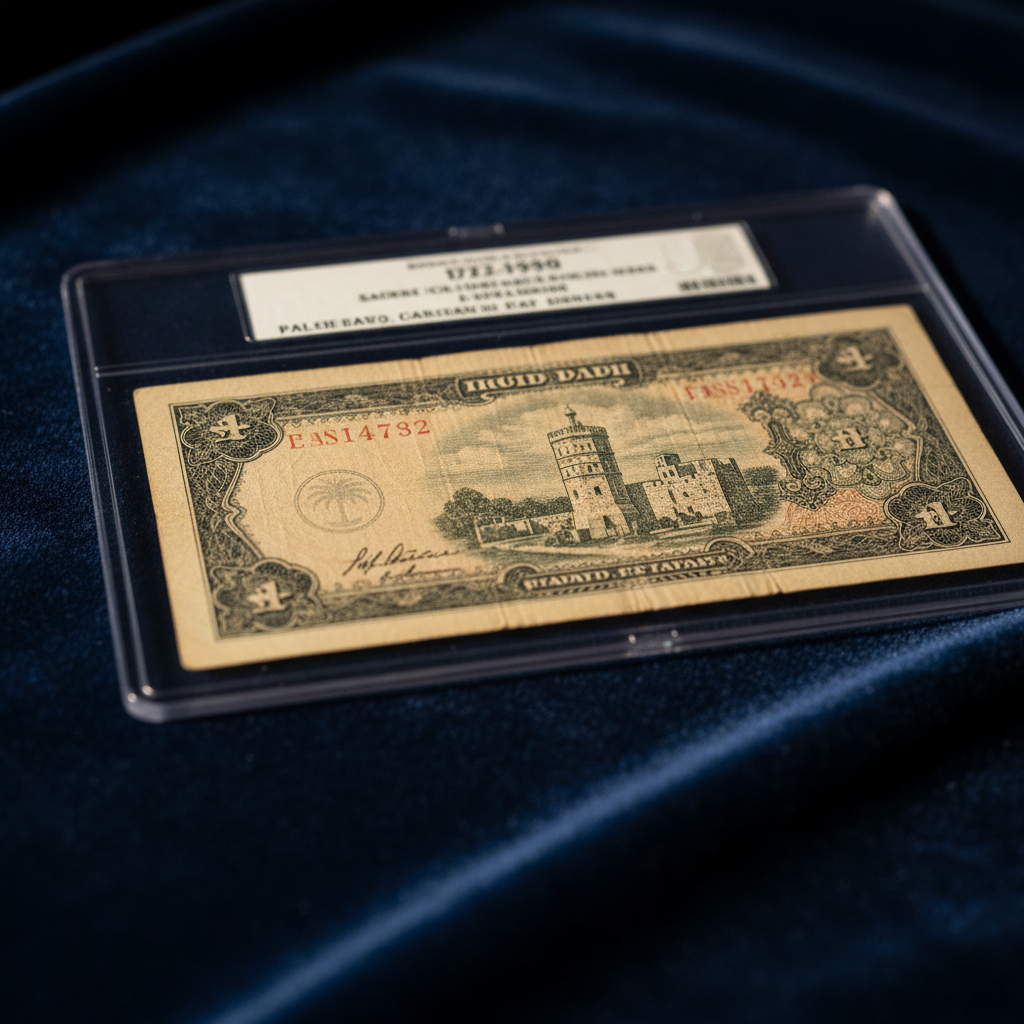
Sixty-three notes. Nearly two decades of colonial monetary history. And a seven-figure estimate that makes the Olive Sprig Collection one of the most significant paper money consignments of 2026.
Stack's Bowers Galleries has announced it will offer the Olive Sprig Collection of Palestine Mandate paper money at its Spring 2026 Maastricht Auction, scheduled for early May immediately following the MIF World Paper Money Show. The collection spans issues from 1927 to 1945 — the full arc of the Palestine Currency Board's note-issuing authority — and carries a total estimate exceeding $1 million.
That number deserves context. Palestine Mandate currency is among the most historically charged paper money in existence. Issued under British administration between the two World Wars and through the end of the Mandate period, these notes circulated during one of the most consequential stretches of 20th-century geopolitical history. They predate the State of Israel, the Nakba, and the 1948 Arab-Israeli War — yet they were the currency in the pockets of everyone living through the lead-up to all of it. Collectors don't just buy the paper. They buy the era.
What the Collection Represents
The Palestine Currency Board operated from 1927 until the Mandate's end, issuing notes denominated in pounds, mils, and piastres. The board's notes are distinguished by their bilingual text in English, Arabic, and Hebrew — a design choice that now reads as a kind of frozen diplomatic artifact. High-grade survivors are genuinely scarce. Unlike American or European currency of the same period, Palestine Mandate notes weren't hoarded en masse by collectors or institutions. Many were destroyed, lost to conflict, or simply never preserved.
The Olive Sprig Collection — named, presumably, for the branch of peace that never quite took root in the region — represents a focused, curated effort to assemble the full range of these issues across denominations and dates. Sixty-three notes covering an 18-year issuance window suggests this isn't a bulk lot of duplicates. It reads like a type set built with serious intent: someone who understood both the numismatic and historical weight of what they were assembling.
For comparison, individual high-grade Palestine Mandate notes have realized five figures at auction in recent years. A complete or near-complete run of high-quality survivors, offered together under a single collection banner, creates a premium that exceeds the sum of its parts. The $1 million estimate feels conservative if condition reports hold up under scrutiny.
Why Maastricht, and Why Now
The venue is deliberate. Stack's Bowers has increasingly used its Maastricht platform — timed to coincide with the MIF World Paper Money Show — to target the international collector base that drives the top end of the world banknote market. European and Middle Eastern collectors, in particular, have shown sustained appetite for British colonial and Mandate-era currency. Placing the Olive Sprig Collection in that room, in front of that audience, is smart salesmanship.
The timing also reflects a broader market dynamic. World paper money has quietly outperformed expectations over the past several auction cycles, with British colonial issues drawing competitive bidding from multiple continents. Heritage Auctions and Stack's Bowers have both reported strong results in the category, and Goldin's occasional forays into world currency have confirmed that the buyer pool is wider than it was a decade ago.
Sixty-three lots with a collective estimate north of $1 million averages out to roughly $15,900 per note — though that math almost certainly undersells the top pieces and oversells the supporting material. Expect the high-denomination, early-date, and finest-known examples to do the heavy lifting, with some individual notes potentially clearing $50,000 to $100,000 depending on grade and provenance.
The Collector Calculus
Palestine Mandate paper money occupies a peculiar position in the hobby. It's numismatically serious — graded by PMG and PCGS Currency, with a documented population of survivors — but it also carries a cultural and historical resonance that transcends the usual collector demographics. Historians, institutions, and diaspora collectors from multiple communities have all shown interest in these notes. That cross-demographic demand is a stabilizing force for values.
The risk, as with any specialized world currency collection, is liquidity. The buyer pool for complete Mandate-era runs is narrower than it is for, say, Federal Reserve Notes or pre-war European issues. Whoever acquires the Olive Sprig Collection whole — if it goes that route — will be taking on a long-term hold with limited exit options outside of major auction platforms.
But that's a problem for the buyer. For Stack's Bowers, this is exactly the kind of consignment that cements a house's reputation in a category. Land it, sell it well, and the next great world currency collection comes to you first.
The Spring 2026 Maastricht Auction catalog is expected to be released in the weeks ahead. Serious bidders should be watching the population reports and doing their homework now — because when the room opens in May, the Olive Sprig Collection will not last long.