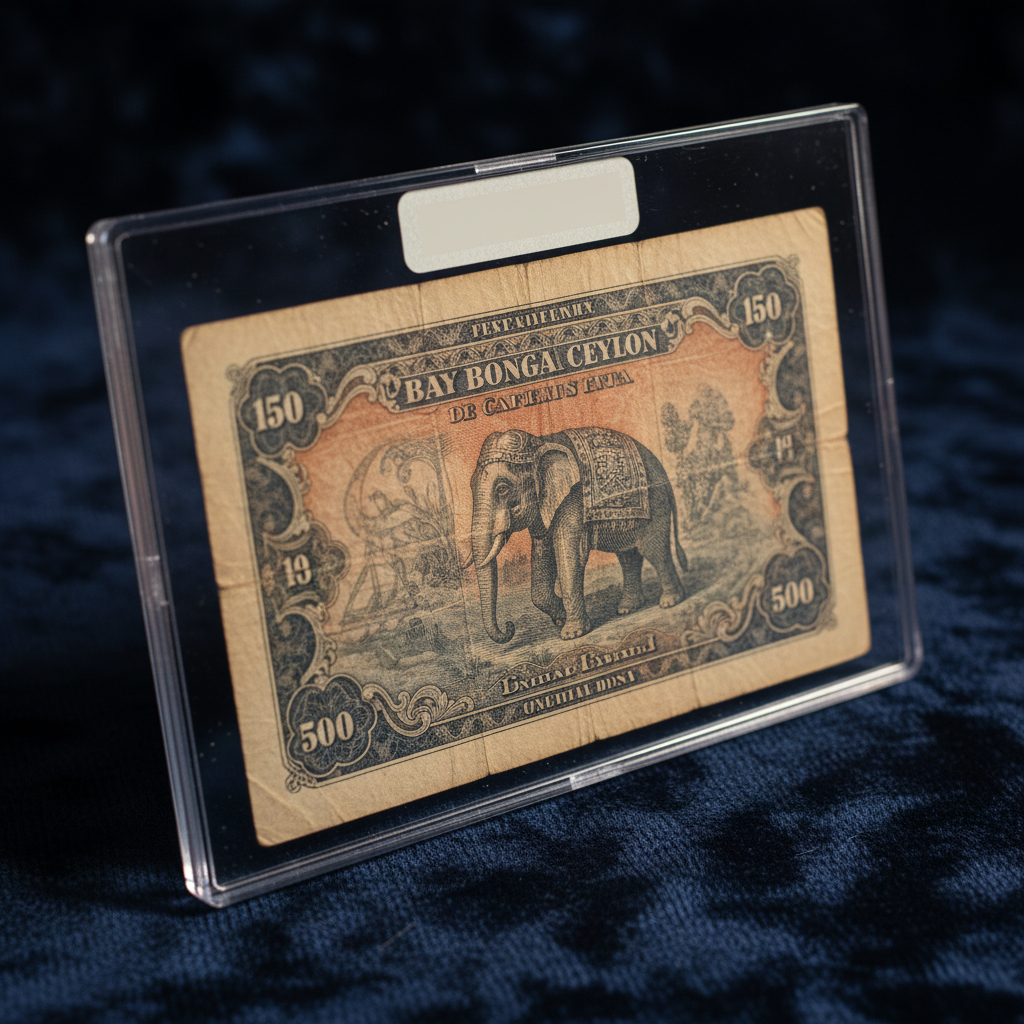
Some of the most elusive Ceylon banknotes ever assembled in private hands are coming to market. Stack's Bowers Galleries has announced the upcoming auction of the Bay of Bengal Collection, a singular offering of rare paper money from Ceylon — the island nation now known as Sri Lanka — that hasn't been seen publicly in decades by many collectors who've spent careers chasing these notes.
This isn't a routine currency auction. The Bay of Bengal Collection represents the kind of generational accumulation that surfaces once, maybe twice, in a collector's lifetime. Ceylon paper money occupies a genuinely underserved corner of the world banknote market, which makes an offering of this depth all the more significant.
Why Ceylon Paper Money Is So Hard to Find
Ceylon's monetary history is layered and complex. The island passed through Portuguese, Dutch, and British colonial administration before independence in 1948, and its paper currency reflects each era with distinct design languages, issuing authorities, and printing standards. Early notes from the Government of Ceylon and the Ceylon Currency Board — particularly issues from the late 19th and early 20th centuries — are extraordinarily scarce in any grade. High-denomination survivors in collectible condition are rarer still.
The challenge isn't just age. Ceylon notes suffered from tropical climate conditions that accelerated paper degradation, compounding the natural attrition of circulation. What survived in presentable condition largely ended up in institutional collections or with a small network of specialist collectors who rarely sold. The secondary market for Ceylon currency has historically been thin — Heritage, Spink, and Stacks themselves have catalogued notable individual pieces over the years, but a cohesive, deep collection of this caliber reaching the block at once is genuinely unusual.
Population data from PMG and PCGS Currency reflects the scarcity. Many of the key Ceylon colonial-era issues carry single-digit certified populations, and several high-denomination types have never appeared in a major auction house's certified currency sale at all. When the market is that illiquid, a collection sale sets the price benchmarks — there are no reliable comps to anchor bidder expectations, which cuts both ways.
Stack's Bowers and the World Paper Money Market
Stack's Bowers has steadily expanded its world paper money footprint over the past decade, positioning itself alongside traditional currency powerhouses like Spink and Auctioneers of the World. The Bay of Bengal Collection is a statement consignment — the kind that attracts international bidders who might otherwise default to London or Hong Kong for material of this provenance.
The auction house's global reach matters here. Ceylon paper money has a natural collector base spread across Sri Lanka, the broader South Asian diaspora, and specialist world note collectors in Europe and North America. A Stack's Bowers platform, with its established bidder network and catalog production, gives this material maximum exposure at exactly the right moment.
Demand for world colonial paper money has been building quietly but persistently. British colonial issues from India, Malaya, and East Africa have seen sustained price appreciation at auction over the past five years, driven partly by diaspora collectors with both the financial means and the cultural motivation to repatriate important pieces. Ceylon fits squarely in that narrative.
The timing is deliberate. With the broader collectibles market sorting itself out after the pandemic-era surge and subsequent correction, world paper money — particularly material with genuine scarcity and historical significance — has held its value better than many mass-market categories. Sophisticated buyers are rotating toward depth and provenance, and the Bay of Bengal Collection has both.
What Collectors Should Watch
The lots to watch will almost certainly be the earliest Government of Ceylon issues and any surviving high-denomination Currency Board notes in PMG 60 or above. In a market with no established comp, a single strong result on a key type can reset expectations for the entire series — and a weak result can do the opposite. Bidders coming in cold should do their homework on certified populations before the sale, not after.
For specialist collectors who have been building Ceylon holdings over years, this auction is both an opportunity and a test. The Bay of Bengal Collection will almost certainly establish the most comprehensive set of public auction records the series has ever had. Those benchmarks will define the market for the next decade.
Stack's Bowers has not yet released a full lot listing or individual estimates for the Bay of Bengal Collection. VaultCollect will update coverage as catalog details become available.