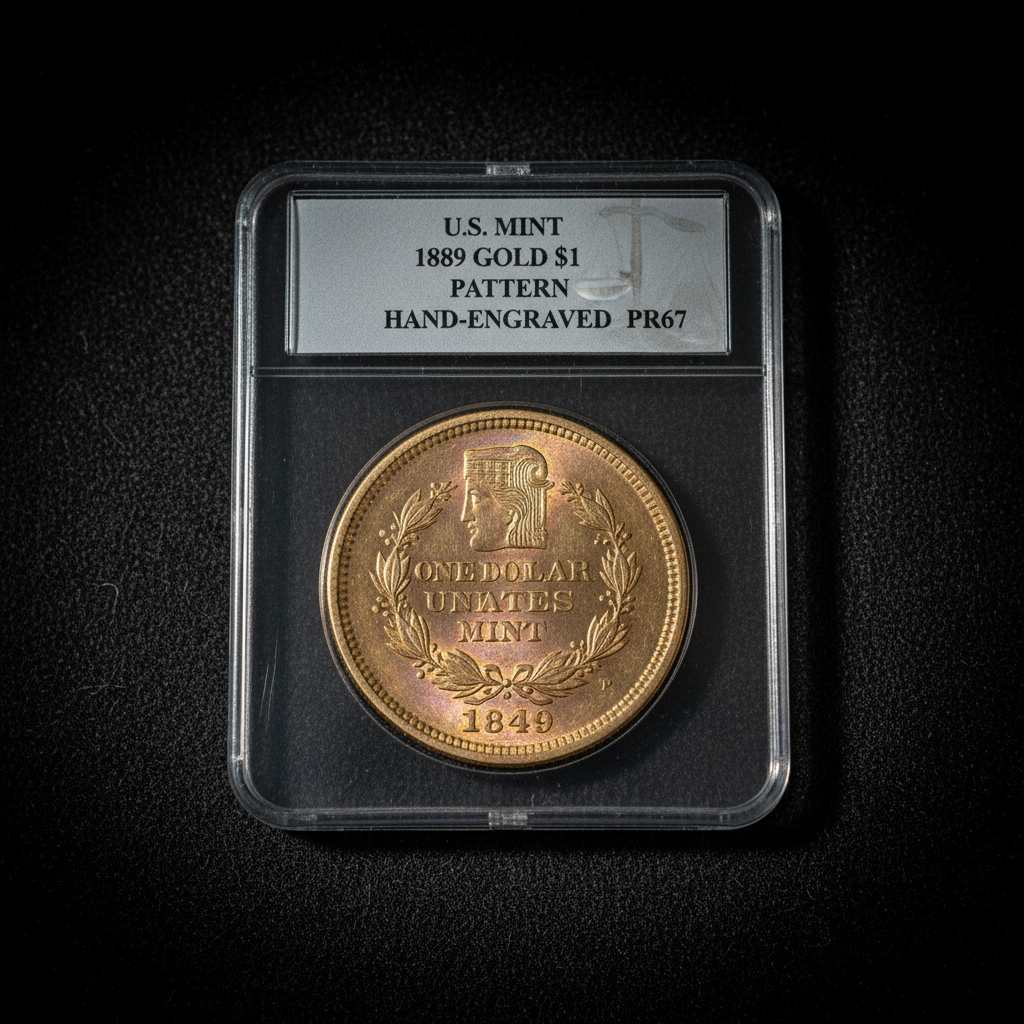
There is exactly one of them. The 1849 Gold Dollar pattern designated Judd-115 is not a proof struck from a mechanically hubbed die, not a die trial pulled from standard Mint production equipment — it is, by all contemporary accounts, a coin whose design was cut entirely by hand at the United States Mint. That distinction alone places it in a category occupied by almost nothing else in American numismatics.
The mid-nineteenth century was a period of genuine experimentation at the Philadelphia Mint. Congress had authorized the gold dollar denomination in 1849, and Mint engravers were working through competing design concepts before the familiar Liberty Head type entered circulation. Most pattern coins from this era were produced using conventional hub-and-die technology — a reduction lathe transfers an artist's model to a working die, ensuring uniformity across strikes. Judd-115 bypassed that process entirely. The design was engraved directly, freehand, into the die itself.
What Hand Engraving Actually Means for a Coin
The practical consequence of hand engraving is a piece that cannot be exactly replicated. Every cut, every serif, every element of the portrait and lettering reflects the engraver's hand in real time — pressure variations, tool angle, the accumulated decisions of a craftsman working without the safety net of a mechanical model. The resulting coin carries a tactile and visual character that hubbed coinage, by design, eliminates.
For numismatists, this matters enormously. Pattern coins are already a specialized corner of U.S. coinage — the Judd reference catalog, compiled by Dr. J. Hewitt Judd and updated through subsequent editions, documents hundreds of experimental pieces from the nineteenth century. Most are rare. Many exist in populations of fewer than a dozen. But a pattern that is simultaneously unique and hand-engraved occupies a different tier of historical significance. You are not looking at a coin that happened to survive in small numbers. You are looking at an object that could only ever have existed once.
The 1849 date adds further weight. The California Gold Rush was transforming the American economy in real time, flooding the Mint with raw gold and creating urgent political pressure to produce smaller-denomination gold coinage accessible to ordinary commerce. The gold dollar was the Mint's answer to that pressure. Judd-115 was made during the months when that answer was still being worked out.
Market Context: What Unique U.S. Patterns Command
Pricing a unique coin is, by definition, an exercise in comparable analysis rather than population-based valuation. There is no registry to consult, no PSA or NGC population report to anchor expectations. The market for major U.S. patterns has been defined in recent years by a handful of landmark auction results.
Heritage Auctions has handled the majority of significant pattern sales over the past two decades. Unique or near-unique nineteenth-century patterns in top preservation — particularly those with strong provenance or historical narratives — have routinely cleared six figures, with the most significant pieces pushing well past $500,000. The 1792 half disme, another hand-produced early American rarity, has traded above $1 million at auction. Judd-115 does not carry the same constitutional founding mythology, but its combination of uniqueness, the hand-engraving distinction, and the historically charged 1849 date makes it a serious trophy piece by any measure.
Grading services treat patterns carefully. NGC and PCGS both encapsulate and authenticate pattern coins, and their holders carry meaningful weight at auction. For a piece like Judd-115, the grade on the holder matters less than the authentication and the story — though surface preservation will obviously influence where a serious bidder anchors their number.
- Denomination: Gold Dollar (pattern, not issued for circulation)
- Catalog Reference: Judd-115
- Production Method: Hand-engraved die, United States Mint, Philadelphia
- Date: 1849
- Known Population: 1 (unique)
A Relic From the Moment the Gold Dollar Was Born
The broader gold dollar series — spanning 1849 to 1889 across three distinct types — is a well-collected area with a deep collector base. Type 1 Liberty Head dollars are accessible at the entry level and genuinely scarce at the top of the grading scale. But Judd-115 exists entirely outside that conversation. It is not a collectible within the series. It is an artifact from the process that created the series.
That framing is not hyperbole. When Mint engravers were cutting dies by hand in 1849, they were deciding what American gold coinage would look like for the next four decades. Judd-115 is a surviving record of that decision-making — a working object from the design room, not the coin cabinet.
Unique coins have a way of surfacing at the right moment. When this one does, the bidding room will be paying for more than metal and craftsmanship. It will be paying for the only surviving proof that the gold dollar could have looked different.