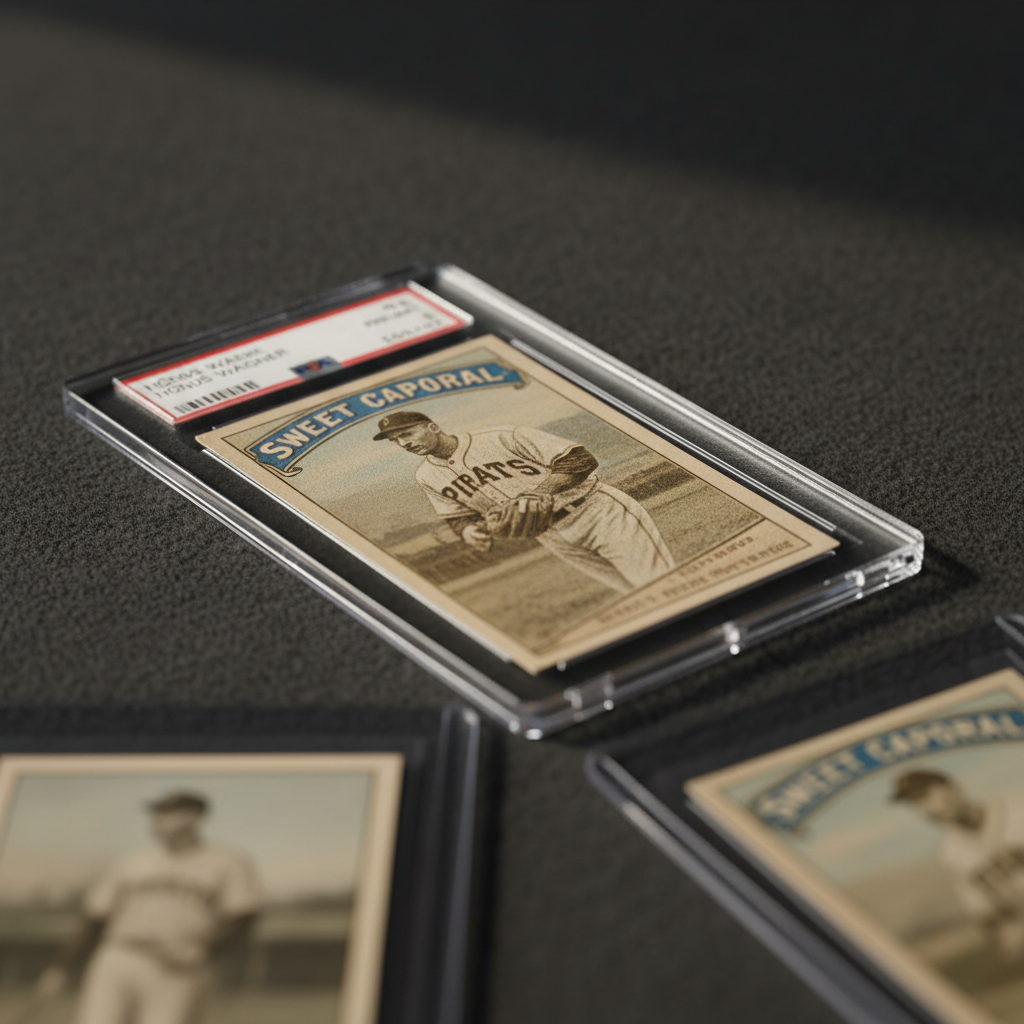
In the spring of 2021, a piece of cardboard measuring roughly 1.5 by 2.625 inches sold for $6.606 million at Heritage Auctions. It was a record at the time. The buyer was anonymous. The card was 112 years old. And the story of how it got there — from a tobacco factory in the early 1900s to the most storied auction block in the hobby — is stranger, sadder, and more human than any price tag can capture.
Tobacco, Tin Lithography, and the Birth of the Modern Trading Card
To understand the T206 series, you have to understand what cigarettes meant to American commerce in 1909. The American Tobacco Company — the trust that controlled roughly 90 percent of U.S. tobacco production before the Supreme Court broke it up in 1911 — was engaged in a brutal war for market share. Their weapon of choice wasn't advertising in the modern sense. It was cardboard.
The practice of inserting stiffening cards into cigarette packs had existed since the 1880s, but by the early 1900s those stiffeners had become a full-blown collectible phenomenon. The T206 series, produced between 1909 and 1911 and distributed across sixteen different tobacco brands including Sweet Caporal, Piedmont, and Old Mill, was the most ambitious set ever attempted. Over 520 different subjects across baseball, featuring players from the major and minor leagues, printed in vibrant chromolithography on thin stock. Kids collected them. Adults collected them. The cards were everywhere.
The printing process itself was remarkable for the era. Each card was hand-painted by artists working from photographs, then transferred to lithographic stones. The result was a consistent aesthetic — warm, slightly impressionistic portraits against pastel backgrounds — that still looks extraordinary today. The T206 set wasn't just a promotional tool. It was the first mass-produced visual catalog of American professional baseball, and it arrived at the precise moment the sport was cementing its identity as the national pastime.
Among the 520-plus subjects, there were rare variations, short-printed poses, and regional distribution quirks that still drive collectors mad. The Sherry Magee error card, which misspelled his name as Magie, is one of the most coveted mistakes in the hobby. The four Southern Leaguers — Joe Doyle, Cy Seymour, Eddie Plank, and Rube Waddell — each command premiums for their relative scarcity. But none of them come close to the one that was pulled almost immediately after it was printed.
The Wagner Problem: Why He Said No
Here is where history gets murky in the most delicious way.
The conventional story — repeated in every auction catalog, every hobby publication, every breathless news segment about the card — is that Honus Wagner demanded the American Tobacco Company halt production of his card because he didn't want to be associated with tobacco products. He was a man of principle, the story goes. He didn't want to endorse cigarettes to children.
It's a good story. It might even be partially true.
The complication is that Wagner had already appeared in at least two other tobacco-related card sets before the T206 series went to press. He wasn't exactly a man who had drawn a hard line in the sand against the tobacco industry prior to 1909. Some hobby historians, most notably researcher Joe Gonsowski, have spent decades arguing that the more likely explanation involves money — specifically, that Wagner wanted compensation for the use of his likeness and the American Tobacco Company refused to pay it.
Wagner was, by all accounts, a savvy businessman who understood his own market value. He was also, in 1909, arguably the greatest player in the National League — a five-time batting champion who would finish his career with 3,420 hits and a lifetime .328 average. He knew what his name was worth. The idea that he simply walked away from a licensing arrangement out of pure moral rectitude strains credulity.
Whatever the real reason, the practical effect was the same: production on the Wagner card was stopped almost immediately after it began. Estimates vary, but most researchers believe somewhere between 50 and 200 cards made it into circulation before the print run was halted. Some were pulled from packs. Some were never distributed. The actual surviving population, according to PSA's registry, stands at approximately 60 known examples as of 2024 — though several of those are disputed as the same card having been graded multiple times across different eras, or cards that have since been damaged or lost.
Of those 60, only a handful exist in conditions that collectors would consider genuinely collectible. Most are heavily worn, trimmed, or altered. The grade distribution is brutal: the vast majority of authenticated Wagners sit in the PSA 1 through PSA 3 range. A PSA 5 is considered exceptional. Anything above that is the stuff of legend.
There is exactly one PSA 9 in existence.
The Gretzky Card and the Moment Everything Changed
For most of the twentieth century, the T206 Wagner existed primarily as a rumor. Serious collectors knew it existed. A handful of people owned examples. But the card had no public market, no auction history, no cultural footprint outside a small community of vintage baseball enthusiasts.
That changed in 1991.
A dealer named Alan Ray had acquired a Wagner in remarkable condition — sharp corners, vibrant color, minimal wear. He sold it to collector Bill Mastro, who sold it to hockey legend Wayne Gretzky and Los Angeles Kings owner Bruce McNall for a reported $451,000. The sale made international news. Sports Illustrated ran a feature. The Tonight Show did a segment. Suddenly, a 82-year-old piece of cardboard was front-page news across North America.
The Gretzky card didn't just create a market. It created a mythology. Here was the greatest hockey player in history — a man who understood athletic greatness at a cellular level — paying nearly half a million dollars for a baseball card. That signal was impossible to ignore. If Wayne Gretzky thought it was worth that, what did that say about the hobby itself?
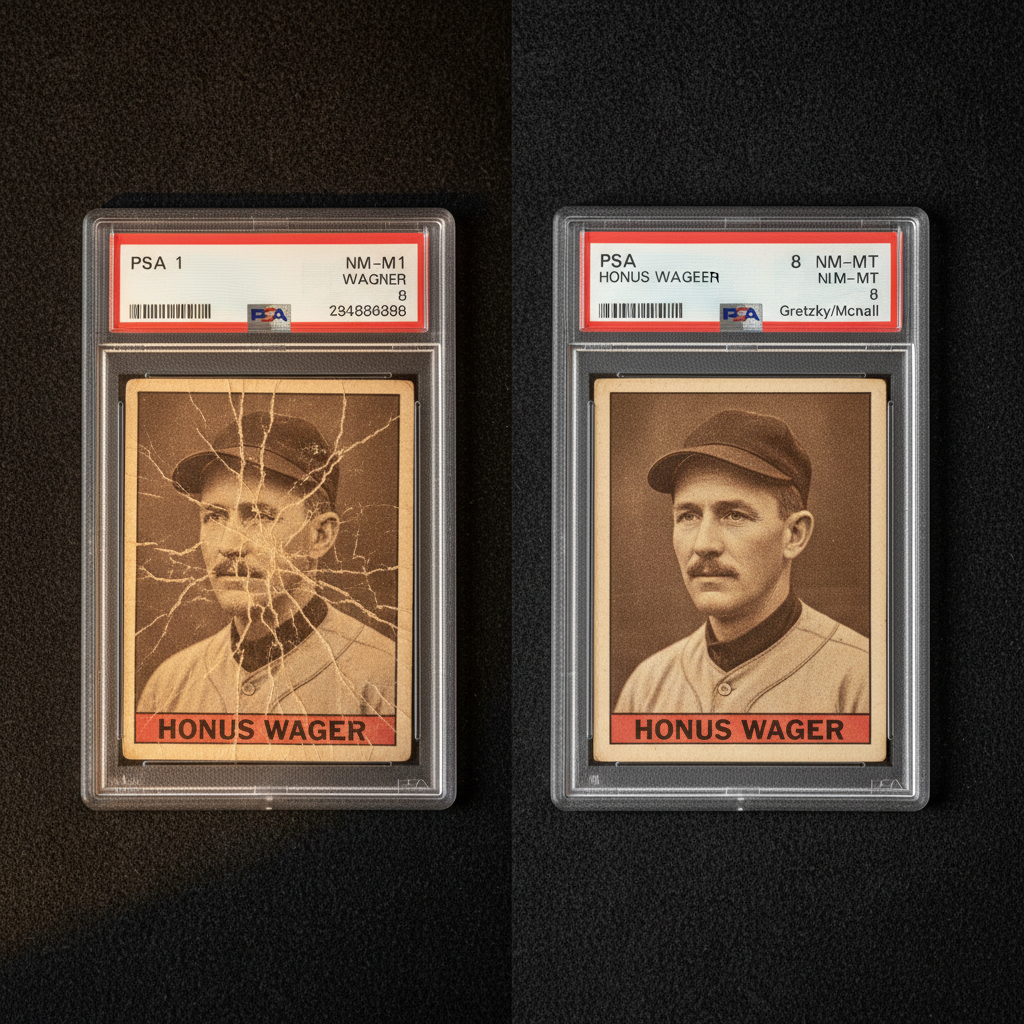
Gretzky and McNall eventually sold the card at a Sotheby's auction in 1995 for $500,000 to collector Michael Gidwitz. Then came the PSA submission that would rewrite everything. When the card was graded, PSA assigned it a PSA NM-MT 8 — a grade that was later controversially upgraded to a PSA EX-MT 6 after questions emerged about possible trimming. The downgrade didn't kill the card's value. Nothing could.
The ownership chain reads like a who's-who of sports collectibles royalty. Gidwitz sold it to collector Brian Seigel for $1.265 million in 2000 — the first time any sports card had crossed the million-dollar threshold. Seigel sold it to Halper, then it passed through several hands before Robert Edward Auctions sold it for $2.35 million in 2007. Goldin Auctions pushed it to $3.12 million in 2016. Then Heritage Auctions brought the hammer down at $6.606 million in 2021.
Each sale set a new record. Each record generated new press. Each round of press brought new collectors into the hobby. The T206 Wagner became a perpetual motion machine of cultural attention.
The PSA 9 — the only one in existence, graded from a card that surfaced in a find of old tobacco cards in the mid-2010s — has never come to public auction. Its owner, who acquired it through a private sale, has been offered sums that would make the 2021 Heritage result look modest. They haven't sold. When a single card has that kind of scarcity profile and that kind of grade advantage over every other known example, rational valuation becomes almost impossible. You're not pricing a card anymore. You're pricing a category.
The Anatomy of a $6 Million Market
Let's talk about what the Wagner market actually looks like from a collector's perspective, because the headline numbers obscure a more nuanced reality.
The population of known examples breaks down roughly like this: around a dozen cards exist in conditions that PSA or SGC would grade at a 4 or above. Another twenty-odd examples sit in the 1–3 range. The remainder are either heavily compromised, disputed, or ungraded. This isn't a market with dozens of liquid comparables. It's a market where each individual card is essentially its own asset class, priced by condition, provenance, and the specific appetite of whoever happens to be buying that week.
The 2021 Heritage sale — Lot 80027, if you want to look it up — involved a card graded PSA VG-EX+ 4.5. Not a pristine example. Not even close to the best known copy. A mid-grade card with honest wear, sold into a market that had been supercharged by pandemic-era liquidity, the sports card boom of 2020–2021, and a wave of celebrity buyers who had discovered the hobby through social media.
That context matters enormously. The $6.606 million wasn't purely a reflection of the card's intrinsic condition. It was a reflection of the moment — a specific collision of money, attention, and scarcity that may or may not repeat itself. The broader sports card market has cooled significantly since its 2021 peak. Modern cards that were selling for multiples of their book value in early 2021 have given back 40–70 percent of those gains. The hype-driven tier of the hobby has been humbled.
The Wagner has not.
Vintage cards at this level — true one-of-a-kind or near-one-of-a-kind artifacts — don't follow the same correction curves as modern cards. They're not correlated to print runs or population explosions. Nobody is cracking open a fresh box of T206 packs. The supply is permanently fixed, and the demand side keeps expanding as the hobby grows globally and generational wealth looks for tangible, story-rich assets. A Wagner in any condition is still the single most recognizable sports card on earth. That brand recognition is worth something independent of grade.
For context, even the most heavily worn examples — cards that PSA would grade as Authentic (meaning they can't assign a numerical grade due to alterations) — have sold for over $100,000 in recent years. A genuine PSA 2 or 3 can command $300,000 to $600,000 depending on provenance and the specific sale environment. The gap between a PSA 4 and a PSA 6 on this card isn't measured in tens of thousands. It's measured in millions.
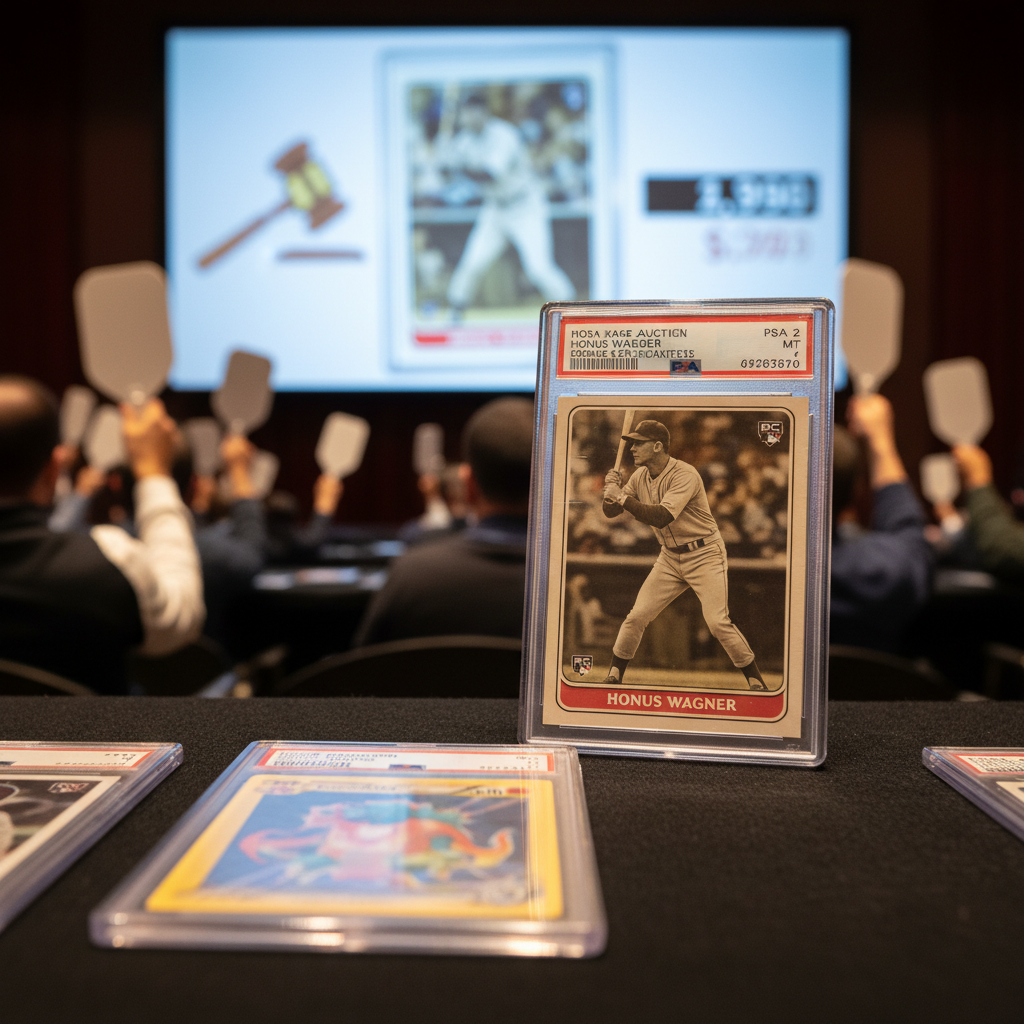
Stack's Bowers, Heritage, Goldin, and PWCC have all handled Wagner examples in the past decade. Each auction has been an event. Each has attracted buyers who don't normally participate in the sports card market — art collectors, hedge fund managers, legacy sports collectors who have been waiting years for the right example at the right moment. The Wagner doesn't just sell. It performs.
Beyond the Price: What the Wagner Actually Means
There's a version of this story that's purely about money, and it's the version most people know. Record sale. New record. Another record. The number goes up, the headlines get written, and the card retreats back into a climate-controlled vault somewhere.
But the T206 Wagner carries something heavier than its price tag.
Honus Wagner himself was a figure of genuine complexity. The son of German immigrants, raised in a coal mining town in Pennsylvania, he played the game with a physical recklessness that left his body broken long before his career ended. He was bowlegged, barrel-chested, and described by contemporaries as almost comically unathletic in appearance — and then he'd field a grounder barehanded and throw a rifle shot to first, or line a double into the gap on a pitch that should have been unhittable. John McGraw called him the greatest player he ever saw. Babe Ruth said the same. He played in an era without film cameras, without radio broadcasts, without any of the documentation machinery we take for granted, and yet his reputation has survived intact for over a century.
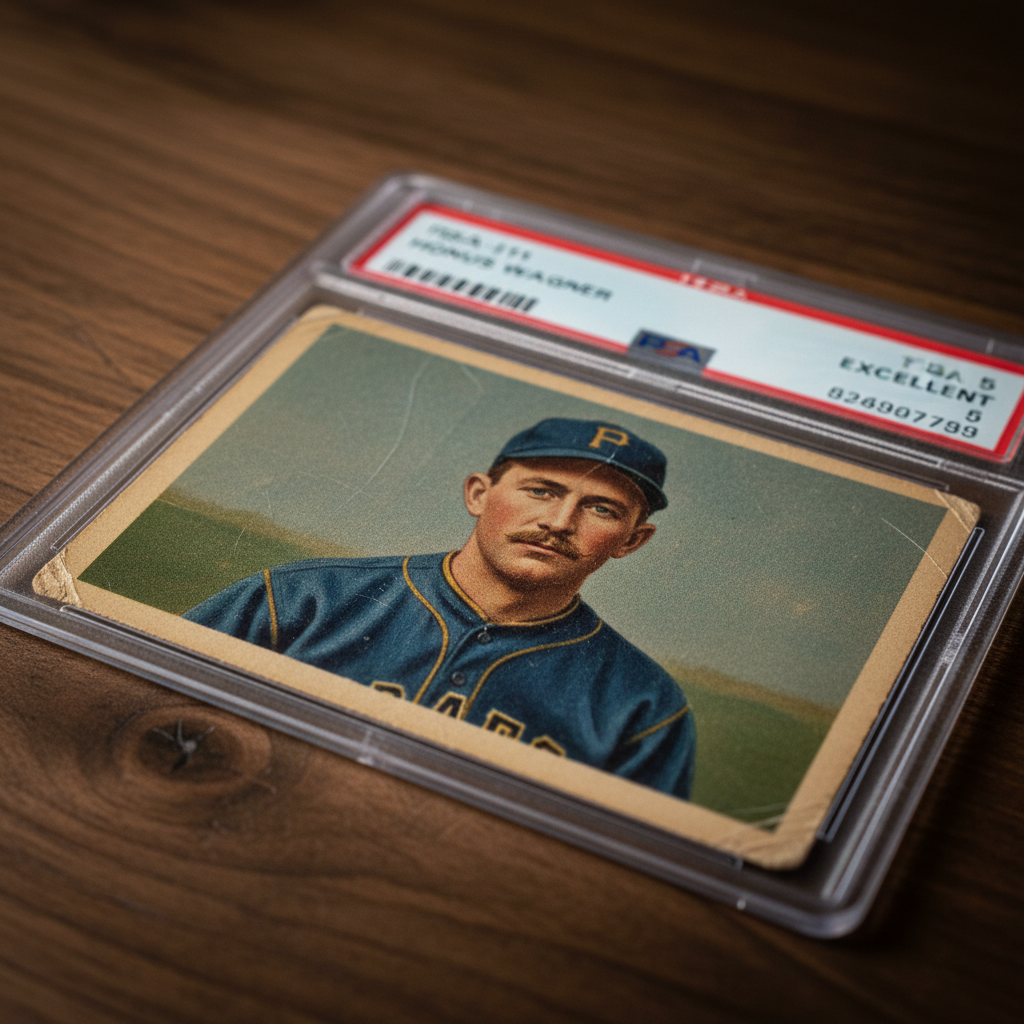
The card is, in a strange way, the only mass-produced visual artifact of his peak years that most people will ever encounter. Photographs of Wagner exist, but they're few and often formal — posed studio shots that don't capture the man in motion. The T206 portrait, painted by an anonymous artist from a photograph that no longer exists, shows him in a blue uniform, slightly off-center, with the kind of direct gaze that feels almost confrontational. It's not a glamour shot. It looks like a man who worked for a living.
That image became, through the strange alchemy of scarcity and time, the most valuable sports card ever created. Not because Wagner was the greatest player — arguments can be made for Ruth, Mays, Aaron, and a dozen others. But because of the combination of his stature, the accident of the card's limited production, and the century of stories that accumulated around both.
The hobby has a phrase for cards that transcend their category: the holy grail. It's overused to the point of meaninglessness. People call PSA 10 Jordan rookies holy grails. They call 1952 Topps Mantles holy grails. They're wrong, or at least they're imprecise. The Wagner is the only card in the hobby that has held that status, without serious challenge, for over thirty years. Every other card that's been anointed with the phrase eventually gets superseded, or the population expands, or the cultural moment passes.
The Wagner just keeps going.
- The T206 Honus Wagner was produced between 1909 and 1911 as part of a 520-plus card set distributed across sixteen tobacco brands by the American Tobacco Company.
- Production was halted almost immediately — likely due to a licensing dispute, not purely moral objection to tobacco — leaving an estimated 50 to 200 cards in circulation. Approximately 60 authenticated examples are known today.
- The 1991 sale to Wayne Gretzky and Bruce McNall for $451,000 was the moment that transformed the card from hobby artifact to cultural phenomenon.
- The card has sold for $500,000 (1995), $1.265 million (2000), $2.35 million (2007), $3.12 million (2016), and $6.606 million (2021), with each sale setting a new sports card record at the time.
- A single PSA 9 example exists and has never come to public auction. Its value is effectively incalculable under current market conditions.
- Unlike the modern card market — which has seen significant corrections since 2021 — high-grade vintage Wagners have maintained their value due to permanently fixed supply and expanding global collector demand.
- Even heavily worn or authenticated-only examples command six-figure prices. A PSA 2 or 3 regularly sells for $300,000 to $600,000 depending on provenance.
The next time a Wagner comes to auction — and one will, because they always do — the room will go quiet in a particular way. Not the silence of uncertainty. The silence of people watching something singular happen. A piece of cardboard, printed by a tobacco company to sell cigarettes to workers in 1909, carrying the face of a man who died in 1955, changing hands for a sum that would have been unimaginable to everyone involved in its creation.
Honus Wagner never wanted to be on that card. More than a century later, it's the most famous thing with his name on it.