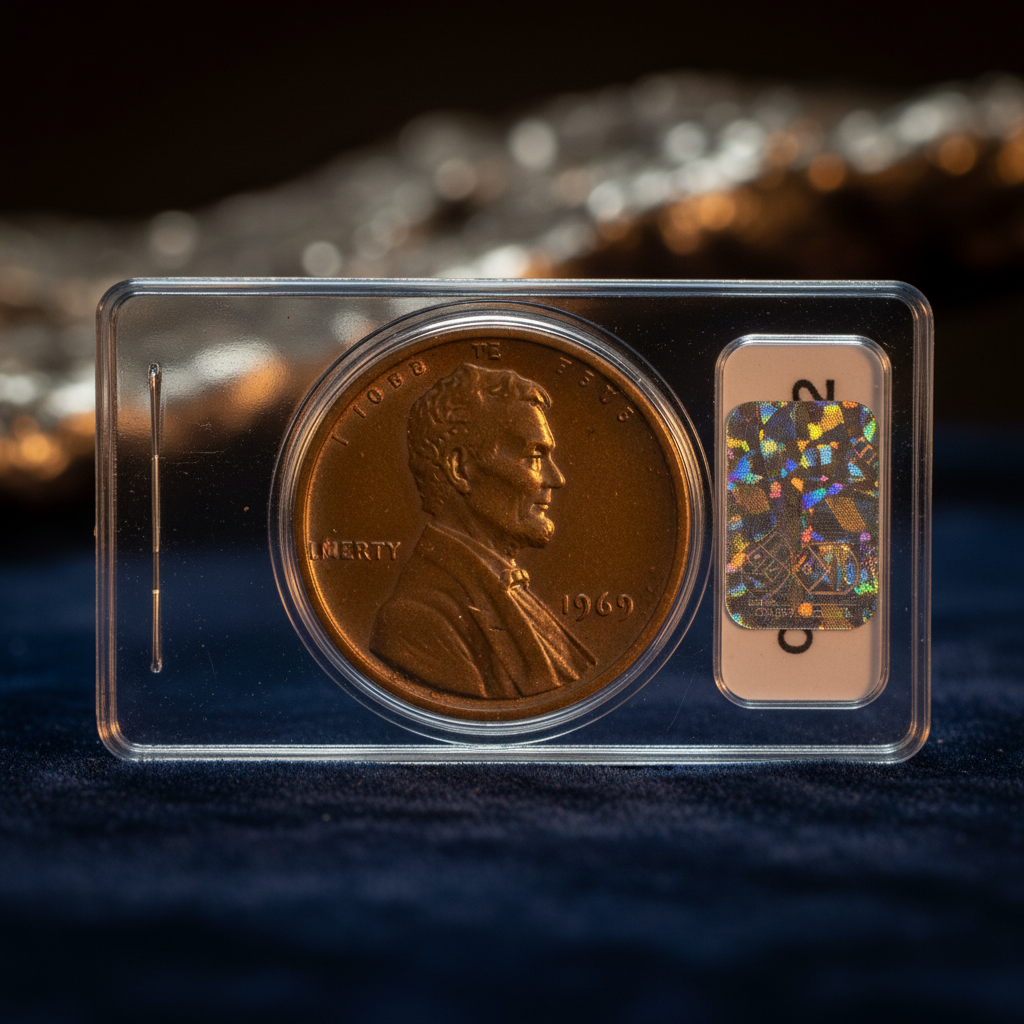
There is a 1909 V.D.B. Lincoln Wheat Penny on Mars right now. Not a replica. Not a commemorative. A genuine first-year Lincoln cent — one of the most storied coins in American numismatics — resting somewhere on the Martian surface, carried there deliberately as part of a NASA mission calibration package. For a hobby that obsesses over provenance, this is provenance of an entirely different order.
How a 112-Year-Old Coin Left the Solar System's Third Rock
The coin traveled aboard NASA's Curiosity rover, which landed in Gale Crater on August 6, 2012. It wasn't a publicity stunt. The penny was included as a calibration target for the rover's Mars Hand Lens Imager — MAHLI — a close-up camera designed to photograph rock textures and surface details. Engineers needed a known object with fine surface detail and established scale to verify the camera's focus and resolution. A Lincoln cent, with its precisely minted relief and familiar dimensions, was a logical choice.
The specific coin selected was a 1909 V.D.B. — the inaugural year of the Lincoln cent series, bearing the initials of sculptor Victor David Brenner on the reverse. Those initials sparked immediate public controversy upon release, and the Mint removed them after only a few months of production. That short window makes the 1909 VDB a foundational rarity in U.S. coinage, with the Philadelphia issue numbering approximately 27.9 million pieces and the San Francisco issue — the 1909-S VDB — produced at just 484,000 coins, making it one of the most coveted 20th-century American coins in existence.
The Mars coin is the Philadelphia issue, not the S-mint. Still, context matters enormously here. This is not a random cent. The 1909 VDB is the coin that launched the Lincoln series — a series now over a century old and still in production. Placing it on Mars is, whether NASA intended it symbolically or not, a statement.
What This Means for the Coin's Numismatic Legacy
In terrestrial terms, the 1909 VDB Philadelphia issue is accessible. A circulated example in VG-8 trades for roughly $15–$25. A PSA 65 or NGC MS-65 Red example can command $500 to $1,500 depending on eye appeal and population. The NGC census lists hundreds of Mint State examples across grades, with the finest known pieces — MS-67 Red and above — occasionally surfacing at Heritage or Stack's Bowers for $5,000 to $20,000+. The coin is common enough for new collectors to own, rare enough at the top end to anchor serious type sets.
The 1909-S VDB, by contrast, is a different animal entirely. In VG-8, expect to pay $700–$900. A PSA 65 will run well north of $10,000. A PCGS MS-66 Red example sold at Heritage for over $100,000. That coin stays in vaults. The one on Mars is its humbler Philadelphia cousin — but the shared DNA matters to collectors who understand the series.
What the Mars mission does is immeasurable in one specific way: it permanently elevates the cultural weight of the 1909 VDB. Every coin in the series now carries a footnote that no other American coin series can claim. The Lincoln cent went to Mars. That's not a metaphor.
The Calibration Coin as Collectible Artifact
The MAHLI penny itself is, of course, unrecoverable — at least for the foreseeable future. It sits in Gale Crater, exposed to Martian dust storms and ultraviolet radiation, doing its job. NASA has released high-resolution images of the coin taken by Curiosity, showing surface detail sharp enough to read the date and Brenner's initials. Those images are publicly archived and freely available, which has made them a minor phenomenon in numismatic circles.
For collectors, the story creates a compelling secondary market angle. Presentation sets pairing a genuine 1909 VDB cent with printed NASA imagery have appeared at shows and on secondary platforms. More seriously, the coin's story has pushed renewed interest in high-grade examples of the Philadelphia issue — particularly early strikes with strong VDB detail and full Red designation, which photograph the closest to what NASA's engineers would have wanted from a calibration standard.
Whether that translates to sustained price appreciation at auction is debatable. The 1909 VDB Philadelphia has never needed a Mars story to justify its place in a collection. But for a hobby that sometimes struggles to capture the imagination of younger audiences, a Lincoln cent orbiting the Martian surface in a rover's camera rig is exactly the kind of origin story that sticks.
The coin that started an American numismatic dynasty in 1909 is now part of interplanetary exploration history. Some coins earn their legend at auction. This one earned it 140 million miles from the nearest coin show.