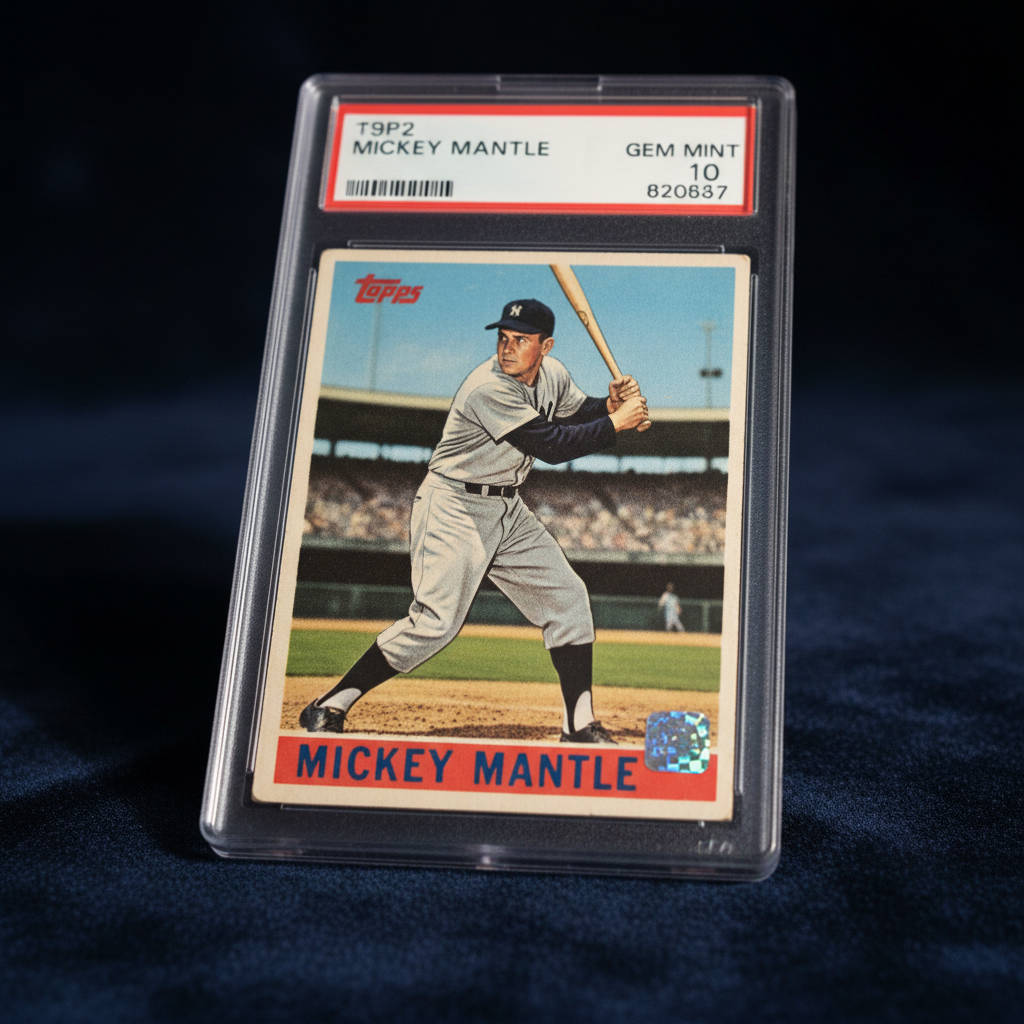
On a January morning in 1960, a Topps Chewing Gum Company employee opened a warehouse in Brooklyn and faced a problem. Thousands upon thousands of unsold 1952 Topps baseball cards — the final high-number series, cards #311 through #407 — had been sitting in storage for nearly eight years, taking up space, collecting dust, and generating exactly zero revenue. The decision made that morning was pragmatic, unsentimental, and catastrophic in retrospect: dump the whole lot into the Atlantic Ocean.
Card #311 went into the water that day. So did hundreds of thousands of others. But the ones that didn't — the ones that survived in attic shoeboxes, tobacco tins, and the occasional obsessive collection — would eventually reshape what it means to own a piece of American sports history. Card #311 was Mickey Mantle's sophomore Topps entry, and it is now, by nearly every measure, the most valuable mass-produced baseball card ever printed.
The Card That Almost Wasn't
To understand why the 1952 Topps Mickey Mantle became a legend, you have to understand what Topps was trying to do in 1952 — and how spectacularly they underestimated their own ambition.
Topps had entered the baseball card business in 1951 with a pair of odd, awkward sets that didn't quite click with kids or collectors. The 1952 set was their real swing for the fences. At 407 cards, it was the largest baseball card set ever produced at that point, featuring full-color photography, player statistics on the back, and a card size — 2⅝ by 3¾ inches — that became the industry standard for decades. Sy Berger, a 26-year-old Topps marketing man who reportedly designed the set on his kitchen table in Coney Island, later called it the card that built the hobby. He wasn't being modest. He was being accurate.
The set was issued in series, a deliberate marketing strategy designed to keep kids buying packs all summer. The first series dropped in the spring. The high-number series — cards #311 through #407 — arrived late in the season, when kids were heading back to school and parents were closing their wallets. Distribution was thin. Retail interest was minimal. The high numbers never moved the way the early series did, and the warehouses filled up with product that nobody wanted.
Mickey Mantle was 20 years old in 1952. He had played his first full Major League season the year prior, arriving in New York as Joe DiMaggio's handpicked successor in center field — a burden that would define and haunt him in equal measure. He was fast, left-handed and right-handed, and capable of hitting a baseball distances that made scouts question their measuring equipment. He was also deeply anxious, deeply young, and not yet the mythological figure he would become.
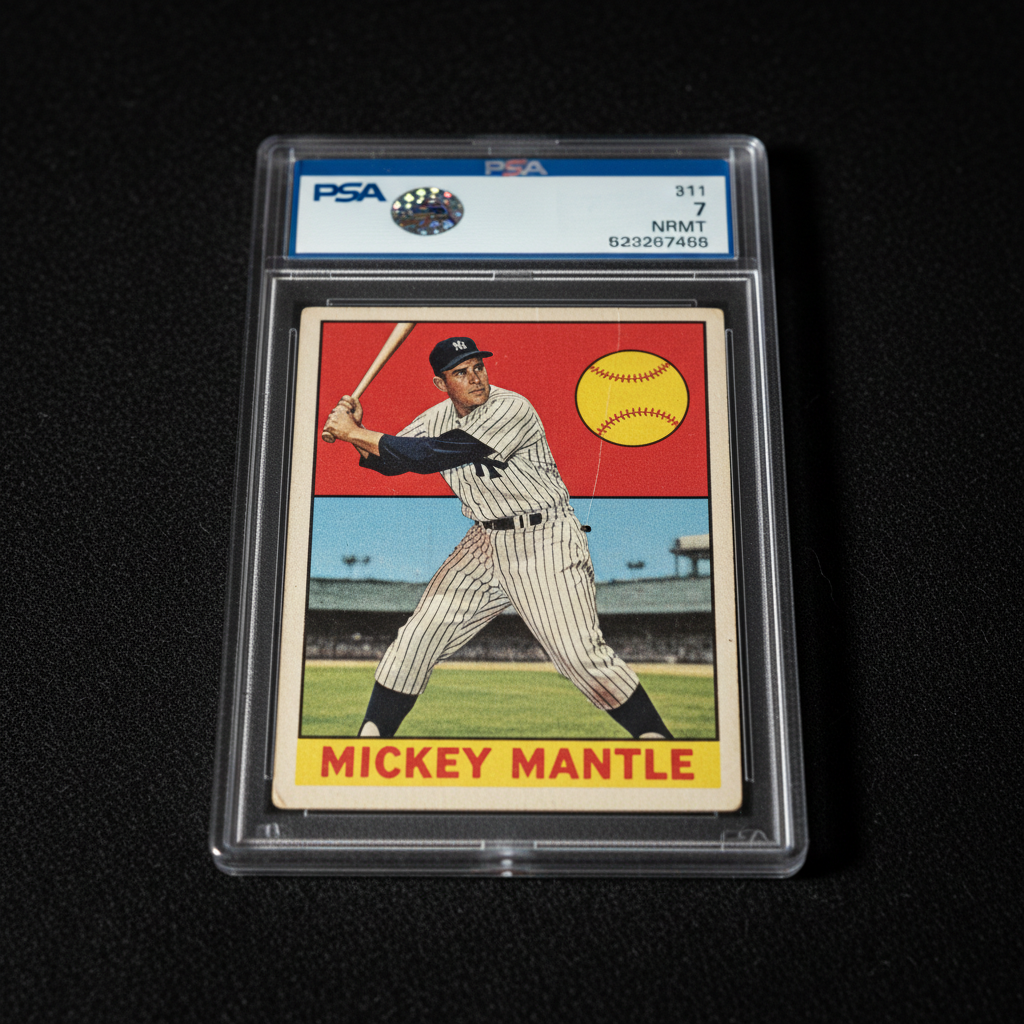
Card #311 captured him mid-swing, wearing his road gray Yankees uniform, against a vivid red background. His name is printed in bold block letters. His stats from 1951 — a .267 average, 13 home runs in 96 games — are modest, a footnote to what was coming. The design is clean, iconic, and deceptively simple. Sy Berger and his colleagues had no idea they were designing the Mona Lisa of American sports collectibles. They were trying to sell bubble gum.
The Ocean Dump That Created a Market
The Brooklyn warehouse dump is one of those moments in collectibles history that feels almost designed for maximum dramatic irony. Topps wasn't destroying the Mantle card specifically — they were destroying inventory. The entire high-number series went into the water, including cards of Willie Mays (#261 had already appeared in the lower series, but the high numbers included names like Eddie Mathews and Hoyt Wilhelm). But because Mantle appeared in the high-number run, his card took the biggest hit in terms of surviving supply.
The exact number of cards destroyed has never been confirmed. Sy Berger, who passed away in 2014, gave interviews over the years that suggested the dump involved a significant portion of the remaining print run but stopped short of giving precise figures. What we do know is the downstream effect: the PSA population report for the 1952 Topps Mantle currently shows fewer than 3,700 graded examples across all grades, with just nine cards graded PSA 9 and exactly one card graded PSA 10 — a copy that Heritage Auctions sold in August 2022 for $12.6 million.
For context: the 1952 Topps set has over 400 cards. Many of the lower-series commons from that same set — cards that weren't dumped — appear in PSA populations of 500 or more in grades of 7 and above. The ocean effectively performed the function that a grading company's scarcity tier would later manufacture artificially. It made the Mantle card genuinely, irreversibly rare.
But scarcity alone doesn't create a $12 million card. What the ocean dump did was set the stage. The actual legend-building took decades and required a specific kind of American nostalgia to fully ignite.
Through the 1960s and 1970s, the 1952 Topps Mantle existed mostly as a rumor in collector circles — something serious hobbyists knew about, traded in raw condition for prices that seem laughable now, and occasionally found in estate sales or childhood collections. There was no standardized grading. There was no internet. There was no Heritage Auctions. There was just word of mouth, price guides like Beckett Baseball Card Monthly, and a loose network of dealers and show operators who understood what they had but had no mechanism to extract its full value from the market.
Rediscovery, Grading, and the PSA Revolution
Professional Sports Authenticator — PSA — launched in 1991. Before PSA, buying a vintage card meant trusting the seller's description of condition, which is roughly equivalent to buying a used car based on the seller's description of its engine. The hobby had fraud problems, condition disputes, and a fundamental trust deficit that kept serious money on the sidelines.
PSA changed the equation by introducing a 10-point grading scale, tamper-evident holders (slabs), and a population registry that tracked every card they'd ever graded. Suddenly, a PSA 8 meant something specific and verifiable. A PSA 9 meant something rare. And a PSA 10 — a Gem Mint copy — was the holy grail, the kind of grade that transformed a collectible into an asset class.
The 1952 Topps Mantle was one of the first cards to demonstrate what that infrastructure could do to price discovery. In the early 1990s, a high-grade raw example might trade for $10,000 to $20,000 among dealers who knew what they were looking at. Once PSA began grading them and the population reports revealed just how few high-grade copies existed, prices began climbing with a logic that felt almost mathematical.
The card's cultural moment arrived in earnest in 1991, the same year PSA launched, when Mantle himself — aging, warm, and aware of his own mythology — began appearing at card shows and signings. His autograph on a 1952 Topps card became a specific kind of treasure, a bridge between the object and the man. Mantle signed thousands of cards before his death in August 1995, but the unsigned, high-grade raw examples were already building toward something the market hadn't seen before.
The first major auction benchmark came in 1996, when a PSA 8 copy sold for $55,000 at a Mastro Auctions sale — a figure that made national sports news at the time. A cardboard rectangle, slightly larger than a playing card, worth fifty-five thousand dollars. The story wrote itself, and it kept writing.
Robert Edward Auctions, Heritage Auctions, and later Goldin Auctions each contributed to the price ladder over the following decades. By 2018, a PSA 9 copy sold through Goldin for $2.88 million, crossing the seven-figure threshold that had once seemed fantastical. The card had become something different by then — not just a collectible but a benchmark, the standard against which every other sports card sale was measured.
The Auction Wars: $50,000 to $12.6 Million
The auction history of the 1952 Topps Mantle reads like a fever chart — steady, then steep, then nearly vertical.
Here is the abbreviated record:
- 1996 — PSA 8, Mastro Auctions: $55,000
- 2005 — PSA 9, Mastro Auctions: $282,000
- 2018 — PSA 9, Goldin Auctions: $2.88 million
- 2021 — PSA 9, Heritage Auctions: $5.2 million
- August 2022 — PSA 10, Heritage Auctions: $12.6 million
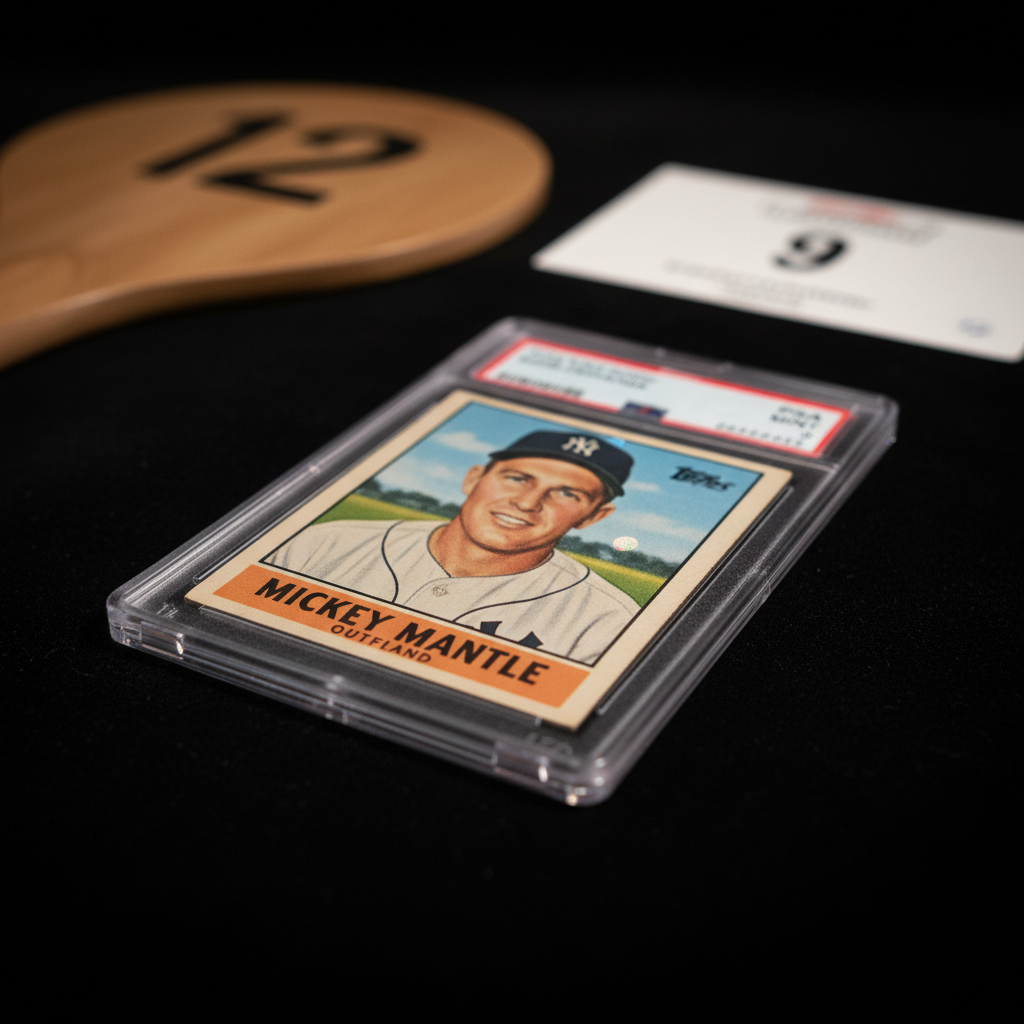
That PSA 10 sale deserves its own paragraph. The buyer was Anthony Giordano, a private collector, and the sale was conducted at Heritage Auctions' August 2022 Platinum Night Sports Auction in Dallas. The hammer fell at $12,600,000, making it the most expensive baseball card ever sold at public auction at that time. The PSA 10 had previously sold in 1991 — the very year PSA launched — for $50,000. In 31 years, it appreciated by a factor of 252.
The lone PSA 10 copy has a provenance story of its own. It was found in an estate collection in the mid-1980s by Alan Rosen, the New Jersey dealer known in the hobby as Mr. Mint, who had developed a reputation for knocking on doors and buying childhood collections from parents who had no idea what their kids had left behind in the attic. Rosen reportedly paid somewhere in the range of $25,000 for a collection that included the card. He sold it, it moved through several hands, and eventually it found its way to PSA, where it received the only 10 the company has ever assigned to this card. One card. One perfect grade. In the entire documented history of the hobby.
The 2021 market surge — driven by pandemic boredom, stimulus money, and a wave of new collectors who discovered the hobby through YouTube and social media — pushed every tier of Mantle pricing to new levels. PSA 5 copies that had sold for $40,000 in 2019 were trading for $150,000 or more by mid-2021. PSA 7 examples crossed $500,000. Even severely trimmed or altered copies — cards that PSA grades as Authentic with no numeric grade because their dimensions have been manipulated — were selling for $20,000 to $40,000, which tells you everything about the demand pressure on this card.
The broader sports card market cooled significantly through 2022 and 2023, with modern cards taking the hardest corrections. But the 1952 Topps Mantle barely flinched. This is the defining characteristic of truly blue-chip vintage: it doesn't behave like the speculative tier of the market. It behaves like a Picasso.
The comparison isn't hyperbole. Christie's and Sotheby's have quietly begun courting serious sports memorabilia consignments. The infrastructure that once separated fine art from collectibles — authentication, provenance tracking, institutional buyers, insurance products — has migrated fully into the top tier of the card market. The 1952 Topps Mantle is the card that made that migration feel inevitable.
What the Mantle Means Now
In August 2024, a PSA 9 copy sold through Goldin for $4.2 million — down from the 2021 peak of $5.2 million, but still nearly double what the same grade fetched in 2018. The market has corrected and stabilized, which is exactly what healthy blue-chip assets do. The floor has risen. The ceiling keeps getting tested.
There are currently nine PSA 9 copies documented in the population report. Nine. That's the entire global supply of near-perfect examples of the most iconic mass-produced baseball card in existence. For comparison, there are more authenticated Picasso paintings in private hands. The scarcity is real, structural, and permanent — the ocean saw to that in 1960.
What makes the 1952 Topps Mantle something more than an investment vehicle is the story it carries. Mickey Mantle was the last great player of the pre-television-saturation era — a man who played in New York, in the media capital of the world, before cable and internet and highlight reels meant that every at-bat was archived forever. His legacy lives in memory and myth more than in footage. The card is a physical artifact from a moment before the complete documentation of everything, which gives it a quality that no modern card can replicate regardless of grade.
Sy Berger's kitchen table design. The Brooklyn warehouse. A January morning in 1960 and a decision made for purely practical reasons. A 20-year-old from Commerce, Oklahoma, who would become the defining symbol of mid-century American baseball. The PSA 10 that surfaced in a New Jersey estate. The hammer falling in Dallas for $12.6 million.
Every one of those moments had to happen exactly as it did for this card to be what it is. Change any single variable — Mantle stays in the low-number series, the warehouse sells through, Mr. Mint knocks on a different door — and the story collapses. The hobby has other icons. It has the T206 Honus Wagner, the 1986 Fleer Jordan, the 1979 O-Pee-Chee Wayne Gretzky. But none of them carry quite this combination of mid-century nostalgia, manufactured scarcity, and pure visual perfection.
The 1952 Topps Mickey Mantle is what happens when history makes a mistake, and the market spends seventy years turning it into something irreplaceable.
- The 1952 Topps set was Topps' first major production, designed by Sy Berger and featuring 407 cards — the largest baseball card set of its era.
- Mantle's card #311 appeared in the high-number series, which was largely destroyed in a 1960 ocean dump of unsold inventory, creating permanent scarcity.
- PSA has graded fewer than 3,700 total examples, with just nine PSA 9s and one PSA 10 in the entire population report.
- The sole PSA 10 copy sold for $12.6 million at Heritage Auctions in August 2022 — up from $50,000 in 1991, a 252x appreciation over 31 years.
- A PSA 9 copy sold for $4.2 million at Goldin in August 2024, showing the card has stabilized after the 2021-era peak rather than collapsed like modern speculative cards.
- The card's value is anchored by three irreversible factors: genuine supply destruction, the cultural weight of Mantle's legacy, and its status as the hobby's primary blue-chip benchmark.
- Even low-grade and altered (PSA Authentic) copies regularly sell for $20,000+, reflecting demand pressure that no modern card replicates at scale.
The next time a PSA 9 surfaces at auction — and one will, eventually — the number that appears on the final bid will tell us something about where the hobby stands, how much nostalgia is worth, and whether the market has truly internalized what irreplaceable means. My expectation is that the number will be higher than $4.2 million. My stronger expectation is that nobody will be surprised when it is.