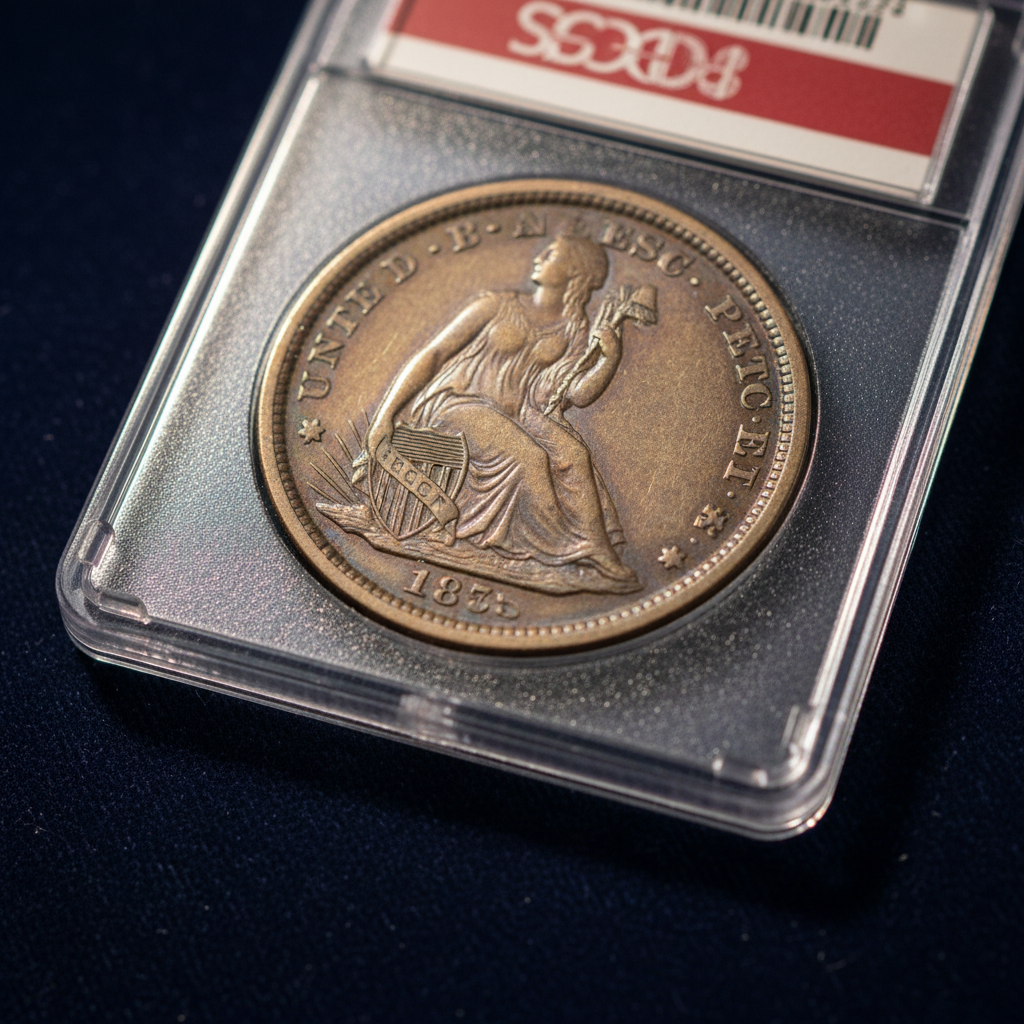
Few coins in American history failed as quickly, as publicly, or as completely as the twenty-cent piece. Authorized in 1875 and dead as a circulating denomination by 1876, it lasted less than two years in commerce — a monetary misfire so severe that Congress pulled the plug while the Mint was still striking them.
The denomination never had a real constituency. It was a solution to a problem that didn't quite exist, and the market rejected it almost on contact.
How a Coin No One Asked For Got Made
The twenty-cent piece was championed primarily by Nevada Senator John P. Jones, who argued that the West Coast — where Spanish-era two-real coins had long circulated — needed a coin that bridged the gap between the dime and the quarter. The logic wasn't entirely without merit. Making change in regions where the quarter-dollar was the dominant small coin could be frustrating, and a twenty-cent piece theoretically smoothed that friction.
Congress authorized the coin on March 3, 1875. The Mint moved quickly. That same year, Philadelphia struck 1,155,000 pieces for circulation, Carson City produced 133,290, and San Francisco added 1,200,000 more. New Orleans struck just 10 — all proofs, none released to commerce. The total mintage across all facilities in 1875 reached roughly 2.5 million coins, a respectable figure for a new denomination.
The problem was immediately obvious to anyone who handled one: the twenty-cent piece looked almost exactly like a quarter. Both were silver. Both were roughly the same size. The only meaningful visual distinction was a plain edge on the twenty-cent piece versus the reeded edge on the quarter — a difference invisible in a coat pocket and easy to miss across a shop counter. Merchants hated it. The public was confused by it. By the end of 1876, circulation strikes had ceased entirely.
The Rarity Hierarchy That Emerged From the Wreckage
What the twenty-cent piece lacked in commercial success, it compensates for handsomely in numismatic complexity. The series spans just four years — 1875 through 1878 — but the rarity spectrum within those four dates is dramatic enough to keep serious collectors engaged for a long time.
The 1875-S is the workhorse of the series. With 1.2 million struck, it's the most available date and the logical entry point for a type set. In circulated grades, examples trade regularly through Heritage and Stack's Bowers in the $150–$400 range depending on eye appeal and strike quality. PCGS and NGC MS-64 examples have brought $1,500–$2,500 at auction, while the rare MS-66 population — PCGS lists fewer than a dozen — commands multiples of that.
The 1875-CC is the sleeper of the circulation strikes. Carson City coins from this era tend to show weak strikes and heavy wear, and the twenty-cent piece is no exception. Finding a sharply struck, problem-free example in Mint State is genuinely difficult. That scarcity isn't always reflected in published price guides, which makes condition-census pieces undervalued relative to their actual availability.
Then there are the proof-only dates: 1876, 1877, and 1878. After circulation strikes ended, the Mint continued producing proofs for collectors — a common practice of the era. Mintages were tiny. The 1877 and 1878 proofs were struck in quantities of approximately 350 and 600, respectively. These are not coins you stumble across. They are deliberate acquisitions requiring patience and budget. PR-64 and PR-65 examples of the 1877 have sold at Heritage for $4,000–$8,000, with cameo designations pushing prices considerably higher.
The 1876-CC occupies a category of its own. With a mintage of just 10,000 business strikes and survival rates gutted by decades of heavy circulation, it is the key date of the series by a wide margin. PCGS has graded fewer than 200 examples across all circulated grades combined. An NGC MS-62 example hammered for over $14,000 at a Stack's Bowers sale in recent years. For a coin that saw only a single year of real commerce, the 1876-CC punches well above its weight in the market.
Where This Series Sits in Today's Market
The twenty-cent piece occupies an interesting niche in 19th-century U.S. coinage. It's short enough to complete — four dates, six major varieties if you count mint marks — that a determined collector can assemble a full set without decades of searching. But the proof-only dates and the 1876-CC provide genuine challenge and real money at the top end.
Type collectors have long favored the 1875-S as a single-coin representation of the series, and that demand keeps the common date liquid. The broader market for 19th-century silver has been steady rather than spectacular over the past several years — not the explosive appreciation seen in key-date Morgan dollars or early American coinage, but consistent demand from a collector base that values historical significance and series completeness.
The irony is that the twenty-cent piece's commercial failure is precisely what makes it interesting. It exists as a numismatic artifact of governmental overreach and market reality colliding in real time — a reminder that even the U.S. Mint occasionally misjudged what Americans actually wanted in their pockets. The coins that survive today are the physical record of that miscalculation, and for collectors who appreciate that kind of story, the series delivers something most others can't: a complete narrative in four dates.