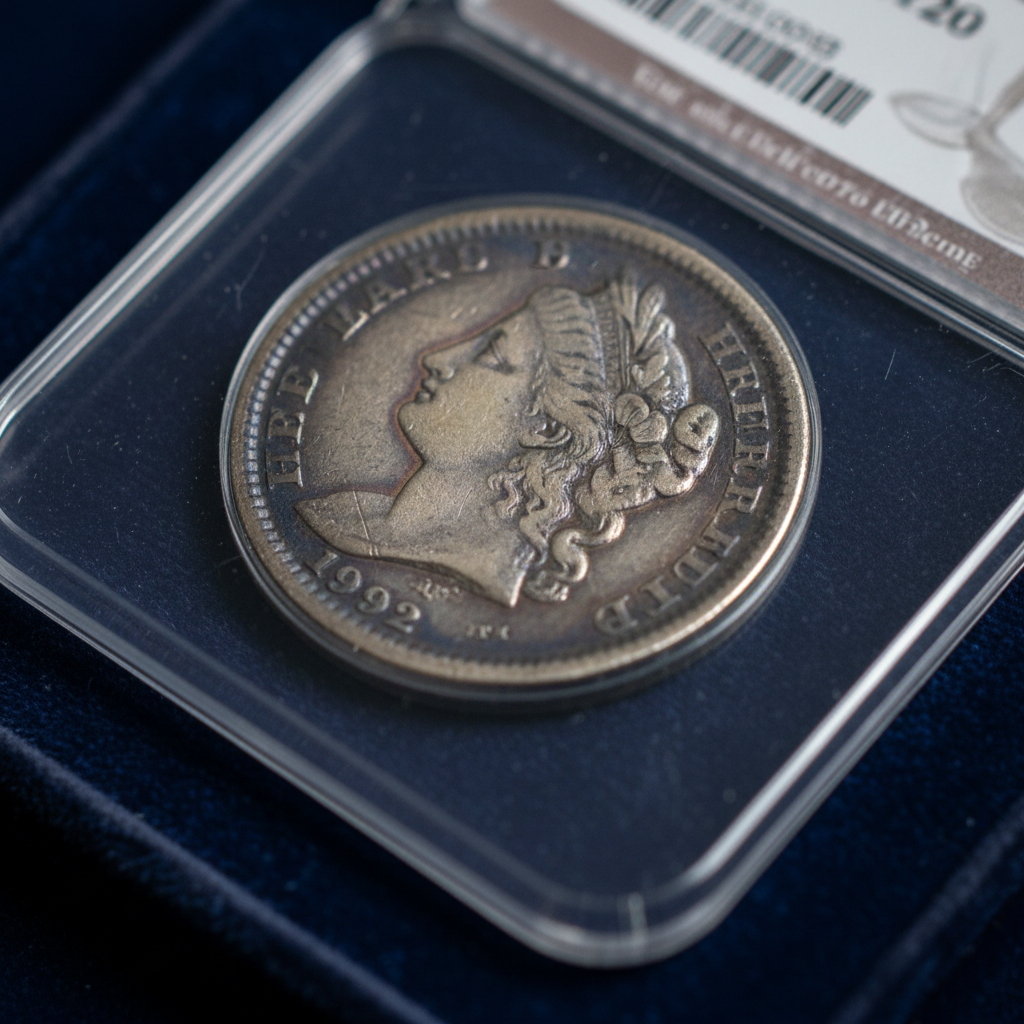
One coin. One verified specimen in private hands. A price tag of $3.12 million. The 1870-S Liberty Seated Half Dime isn't just rare — it's the kind of rare that rewrites the definition of the word.
The story begins not at an auction block, but inside a cornerstone. When the San Francisco Mint laid its new building's foundation stone in 1870, mint officials reportedly placed a small collection of coins inside as a time capsule of sorts. The 1870-S Half Dime was believed to be among them — struck for the ceremony, never formally released into circulation, and sealed inside masonry for decades. The problem? No one could prove another example existed outside that cornerstone. Then one did.
The Coin That Shouldn't Exist
The discovery of a second specimen — the one now graded PCGS MS64 with CAC approval — sent shockwaves through American numismatics when it surfaced. Its very existence raises questions that have never been fully answered. How did it leave the mint? Was it a presentation piece, a die trial, or a quiet pocket souvenir taken by someone with access? The historical record is silent. The coin is not.
An MS64 designation on a coin this scarce is almost beside the point — there's no population to compare it against. PCGS has graded exactly one. That's not a low pop. That's a population of one. CAC's green sticker, signaling that the coin grades conservatively within its tier, adds a layer of market confidence that matters enormously when a single lot can swing seven figures.
For context, the broader Liberty Seated Half Dime series — produced from 1837 through 1873 — is a collected series with dozens of recognized key dates and varieties. Most dates are affordable. A handful are genuinely scarce. The 1870-S exists in a category entirely its own: unique, with an asterisk for the cornerstone coin that may never be examined by outside hands.
What $3.12 Million Buys in American Coinage
The $3.12 million realized at Heritage Auctions puts the 1870-S Half Dime in rarefied company. To calibrate that number: a 1794 Flowing Hair Dollar — widely considered the first silver dollar struck by the U.S. Mint — sold for $10 million in 2013. An 1804 Silver Dollar in PR68 brought $7.68 million at Stack's Bowers. The 1870-S Half Dime, a coin that weighs just 1.24 grams and measures 15.5mm across, sits comfortably in the conversation.
What drives that valuation isn't just rarity — it's narrative. Collectors at this level aren't simply buying metal and grade. They're buying a story that can't be replicated, a provenance that can't be manufactured. The San Francisco Mint cornerstone legend is one of American numismatics' most compelling origin myths, and this coin is its only tangible, holdable proof.
Heritage is the natural home for a sale of this magnitude. The Dallas-based house has handled more landmark U.S. coin auctions than any competitor over the past two decades, and their numismatic division commands the bidder depth necessary to push a coin like this to its ceiling. When a unique specimen crosses the block, you need a room — or a platform — with enough serious capital to create genuine competition.
Trophy Coins and the Patience They Demand
The 108-year gap between the coin's presumed creation and its emergence into the collector market is itself a data point. This isn't a coin that traded hands at every major auction cycle. It hid. And when coins like this finally surface, they tend to do so only once per generation.
That illiquidity cuts both ways. Buyers of unique coins accept that their exit strategy is limited — there's no comparable sale from six months ago to anchor expectations, no PSA pop report to consult, no secondary market humming along in the background. The next sale of the 1870-S Half Dime, whenever it comes, will set its own record or disappoint on its own terms.
The serious money in American numismatics has always understood this trade-off. Trophy coins aren't portfolio diversifiers. They're statements — about taste, about resources, and about a collector's willingness to hold something the rest of the market can only read about.
A $3.12 million half dime. Fifteen and a half millimeters of American history, sealed in a wall for over a century, now sitting in a PCGS holder with a CAC sticker and a price that commands respect. The cornerstone coin may still be in the wall. This one is not.