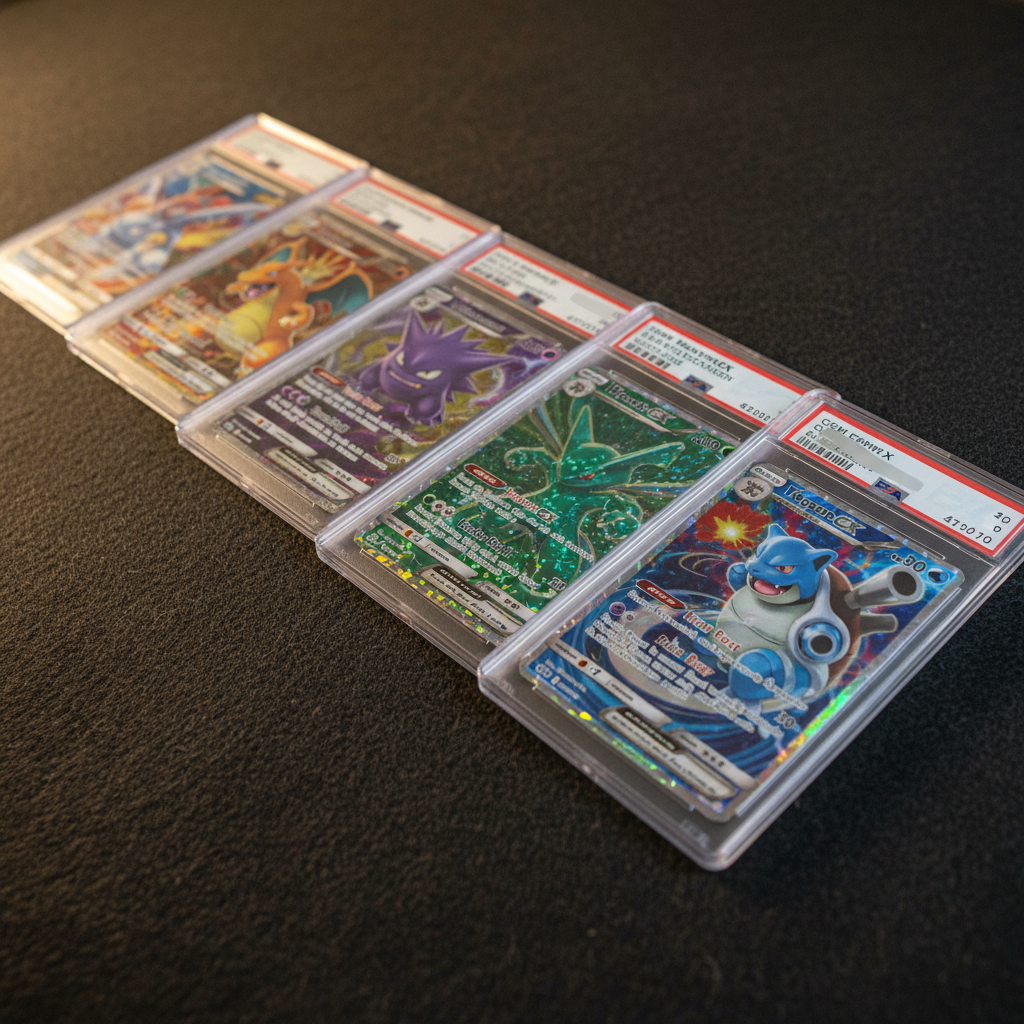
Not every Pokémon mechanic earns a second life. Mega Evolution did. Introduced during the XY era in 2014, Mega EX cards were immediately polarizing — enormous HP totals, game-ending attacks, and a brutal trade-off that handed opponents two or three Prize cards for a single knockout. A decade later, the mechanic has been reborn in modern card design, and the collector market has taken notice.
Whether you're building a competitive deck or hunting PSA 10s, the Mega Evolution lineage spans some of the most visually striking and strategically significant cards in the game's history. Here are the five that define the format — past and present.
The Gold-Border Era That Started It All
M Gengar-EX is the card that crystallized what Mega Evolution was supposed to feel like. Released in the Phantom Forces set (November 2014), it arrived with 220 HP and the Phantom Gate attack — an ability that copied any attack from either player's discard pile. In competitive play, that flexibility was genuinely terrifying. On the secondary market, the Full Art version from Phantom Forces commands consistent attention, with PSA 10 copies trading in the $80–$130 range depending on demand cycles. Not the highest ceiling in the format, but the card's historical weight is undeniable.
M Rayquaza-EX — specifically the Colorless variant from Roaring Skies (May 2015) — is arguably the most competitively dominant Mega Evolution card ever printed. Dragon Ascent hit for 300 damage with the right energy setup, and the deck it anchored became one of the most feared in the XY meta. Roaring Skies Full Art copies in PSA 10 have sold north of $200 at auction, and the Shiny variant from the same era carries a meaningful premium on top of that.
M Charizard-EX needs little introduction. Two versions exist — the Flashfire print (May 2014) and the Evolutions reprint (November 2016) — and both carry the weight of Charizard's perpetual collector demand. The Evolutions Full Art, in particular, has become a benchmark card for XY-era set completionists. PSA 10 copies have cleared $300 in strong markets. It's not the most nuanced card on this list, but when Charizard is involved, nuance rarely wins the argument.
Where Modern Design Meets Legacy Mechanics
The Scarlet & Violet era reintroduced Mega Evolution through the Pokémon ex framework, and the design team came back with a clearer visual language and significantly higher stakes for collectors. The Special Illustration Rare treatment — full-bleed artwork, textured foiling, narrative-driven compositions — has made modern Mega EX cards among the most sought-after pulls in recent sets.
M Mewtwo-EX occupies a unique position in the hierarchy. The original BREAKthrough print (November 2015) was a competitive staple, running two distinct attack profiles across two separate card variants. The Y variant's Damage Change attack — which swapped damage counters between Mewtwo and the opponent's Active Pokémon — was one of the most disruptive effects of the entire XY era. Graded copies of the Full Art have held value steadily, with PSA 10s typically in the $100–$175 range. The Mewtwo IP doesn't depreciate.
M Gardevoir-EX rounds out the list, and it's the pick that separates casual observers from serious collectors. The Steam Siege Full Art (August 2016) features one of the most elegant pieces of art in the entire XY run — and the card's Despair Ray attack, which scaled damage based on benched Pokémon discarded, gave it genuine competitive teeth. PSA 10 population on the Steam Siege Full Art remains relatively low compared to the Charizard and Mewtwo entries, which creates a scarcity dynamic that patient collectors have been quietly exploiting. Raw copies still surface at reasonable prices. That window is narrowing.
The Prize Card Problem — and Why It Still Matters
Here's the structural reality that defines every card on this list: in the modern format, knocking out a Mega Evolution Pokémon ex rewards the opponent with two to three Prize cards. In a six-Prize game, that's a massive concession. Deck builders have to engineer around that liability — which means every Mega EX that sees competitive play does so in spite of its own rules, not because of them.
That tension is exactly what makes these cards interesting to collect. They represent a design philosophy that prioritized spectacle over balance, and the secondary market has rewarded the most spectacular entries accordingly. The gap between a raw M Charizard-EX and a PSA 10 Full Art can exceed $250 — a spread that reflects both condition sensitivity and the sustained appetite for XY-era premium cards.
The Mega Evolution mechanic never needed a second act to cement its legacy. The fact that it got one anyway says everything about how deeply it's embedded in the game's DNA.