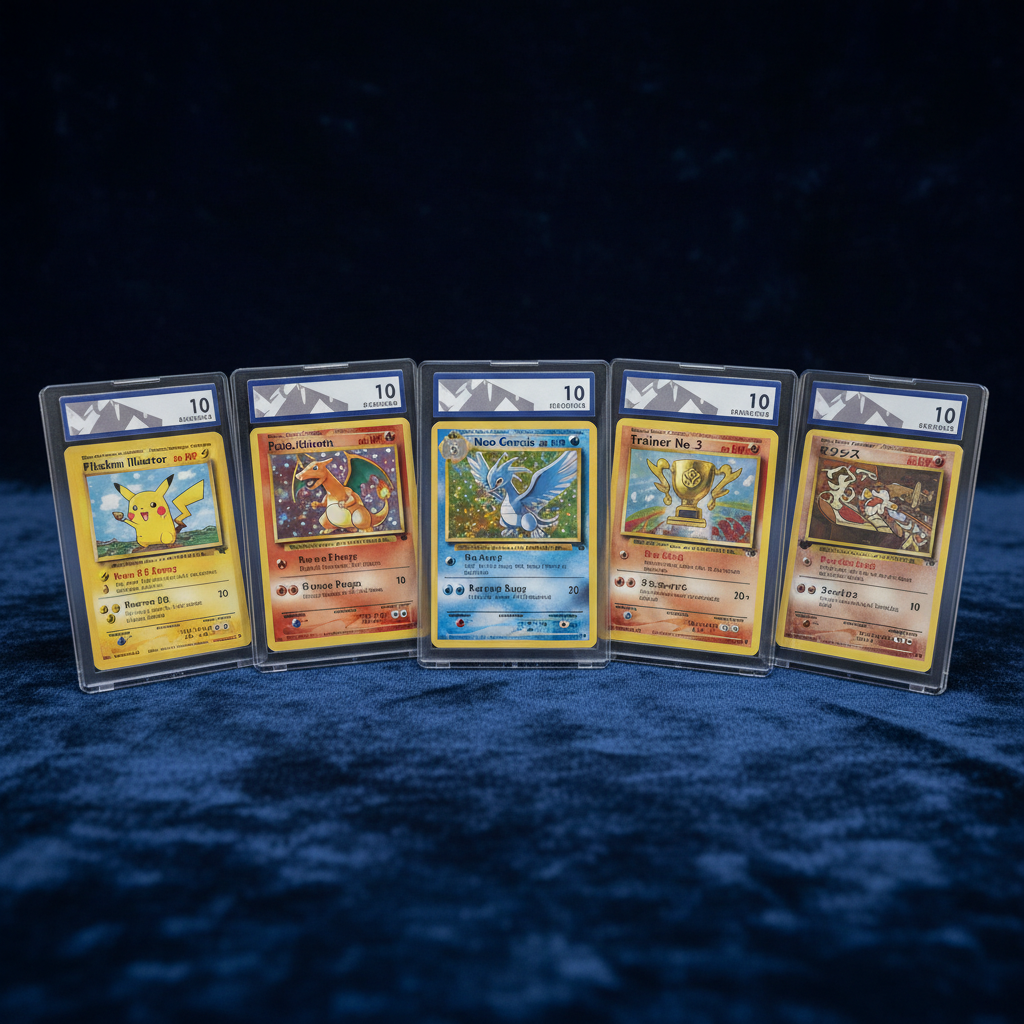
One card. Fewer than 40 known copies. A confirmed sale price of $5.275 million. The Pikachu Illustrator isn't just the rarest Pokémon TCG promotional card ever printed — it's one of the most valuable trading cards in human history, full stop.
The Pokémon TCG market has spent the last decade demanding that the broader collectibles world take it seriously. At this point, the argument is settled. Certain Pokémon promotional cards now trade at price points that embarrass vintage baseball and rival blue-chip art. What separates the truly elite tier from the merely expensive is a combination of distribution method, surviving population, and cultural weight. The five cards below represent the absolute ceiling of that hierarchy.
The Apex: Pikachu Illustrator and the Contest Cards
The Pikachu Illustrator was awarded to winners of illustration contests run through CoroCoro Comic magazine in 1997 and 1998 — not sold, not packed out, not distributed through any retail channel. Approximately 39 copies are believed to exist. The card carries the word Illustrator in place of the standard Trainer designation, making it the only card in the entire TCG's history to feature that header. That singular distinction drives its value as much as its scarcity.
PSA has graded a handful of copies, with the population at the PSA 10 level sitting in the low single digits. In July 2022, Logan Paul's PSA 10 example sold through PWCC for $5.275 million, setting the current record. Even mid-grade copies — PSA 7 and PSA 8 — have cleared $500,000 at auction. This is a card where condition sensitivity is almost irrelevant at the top end; the market will pay for existence alone.
Sitting alongside it in the contest-card tier is the Pokémon World Championships No. 1, No. 2, and No. 3 Trainer cards, awarded exclusively to finalists at the official World Championship tournaments beginning in the early 2000s. The No. 1 Trainer — given only to the champion — has appeared at Heritage Auctions with results north of $90,000 for graded examples. Population counts across all three variants remain in the dozens globally. These aren't cards that escaped into the wild through pack luck. They were handed to specific human beings on specific days.
The Trophy Cards and the Pre-Release Rarities
The Prerelease Raichu occupies a strange and contested corner of Pokémon collecting. Allegedly produced as a misprint during the Base Set era — with the Prerelease stamp applied to Raichu rather than the intended Clefable — only 8 to 10 copies are believed to exist, making it arguably rarer than the Illustrator by raw population count. Authentication has been a persistent issue with this card, which is part of what makes verified, graded examples so explosive when they surface. A PSA-authenticated copy sold for over $195,000 in recent years.
The Tropical Mega Battle promo cards — distributed at the invitation-only Tropical Mega Battle tournament held in Honolulu in 1999 and 2000 — represent another layer of the trophy card ecosystem. Attendance at that event was capped at roughly 50 players worldwide, all of whom had to qualify through regional competitions. The cards distributed there were never available through any other channel. PSA population reports for the rarest Tropical Mega Battle variants show fewer than 20 graded copies across all grades.
Rounding out the five is the Super Secret Battle No. 1 Trainer, awarded at a 1999 Japanese tournament so exclusive that its existence wasn't widely confirmed in Western collecting circles until years later. With a known population that may be as low as 7 copies, it rivals the Illustrator for sheer inaccessibility. PSA-graded examples have fetched over $90,000, though the card rarely surfaces — which means auction comps are thin and price discovery remains genuinely difficult.
What the Market Is Actually Telling You
The through-line across all five cards is distribution method. None of them came from booster packs. Every single one required either winning a competition, attending an invitation-only event, or submitting artwork to a magazine contest. That's not a coincidence — it's the defining characteristic of the Pokémon promo market's upper tier. Scarcity by design, not by chance.
The broader Pokémon card market has cooled meaningfully from its 2020–2021 pandemic peak, when sealed product speculation drove prices to levels that have since corrected sharply. But the trophy and contest card segment has held — and in some cases appreciated — precisely because supply is genuinely fixed. You cannot find another Pikachu Illustrator in a vintage lot. There are no warehouse discoveries coming. What exists has been largely catalogued.
For collectors operating at this level, the calculus is less about Pokémon nostalgia and more about provenance, authentication, and population scarcity. These cards are now competing for wall space and portfolio allocation alongside 1952 Topps Mantles and Action Comics #1 CGC copies. The grading infrastructure — PSA, BGS, CGC — has matured enough to support that conversation credibly.
At $5.275 million for a single piece of cardboard awarded to a Japanese illustration contest winner in 1998, the Pokémon promo market isn't asking for legitimacy anymore. It stopped asking a long time ago.