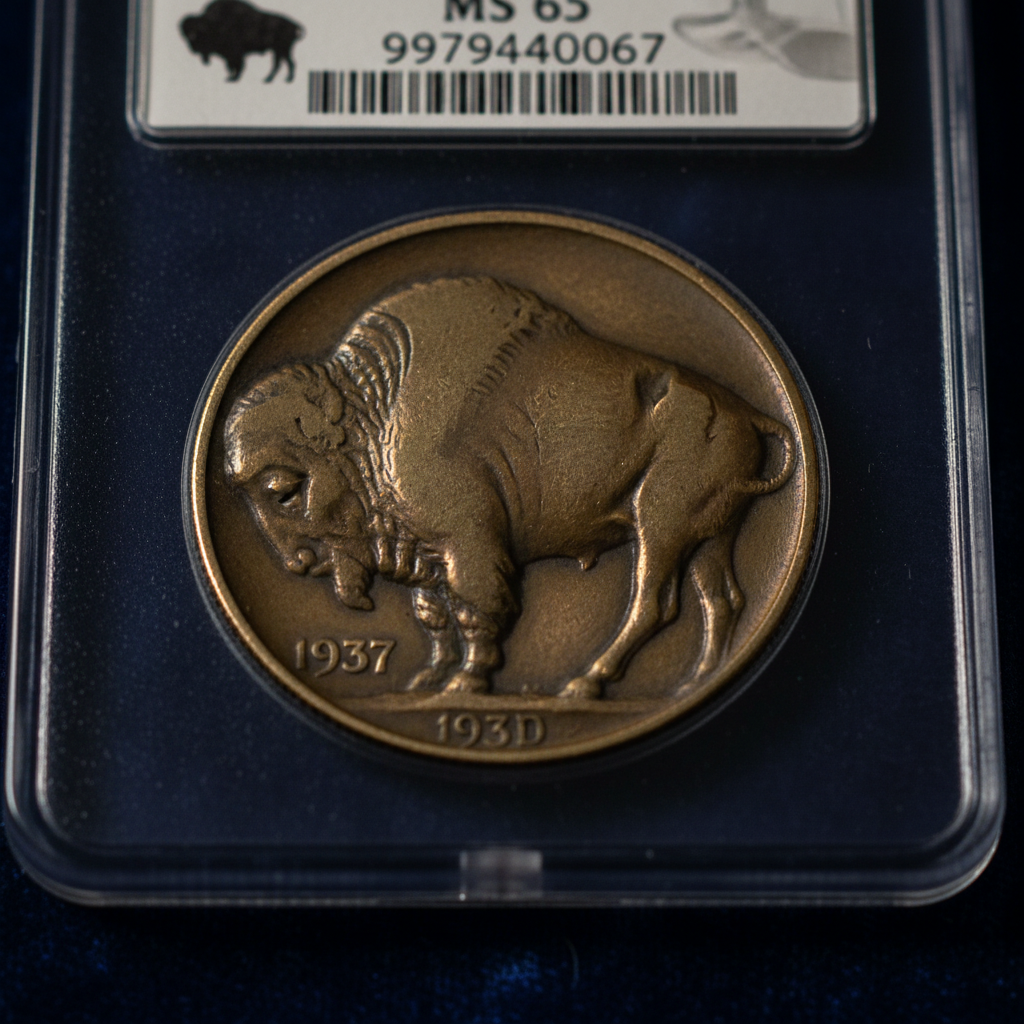
A minting error born from an overworked die and an impatient polishing job has spent nearly nine decades becoming one of the most coveted coins in American numismatics. The 1937-D 3-Legged Buffalo Nickel isn't just a curiosity — it's a masterclass in how a production mistake can transcend its origins to become a genuine icon of the hobby.
The coin's most recent headline came courtesy of Stack's Bowers Galleries, where a specimen sold for $84,000. That number alone tells you everything about where this issue sits in the market hierarchy. For a series that ran from 1913 to 1938 and produced millions of coins at multiple mints, one date from one mint in one peculiar condition has managed to dwarf nearly every other entry in the Buffalo Nickel catalog.
How a Tired Die Created a Legend
The Denver Mint in 1937 was running hard. Dies wore down faster than they could be replaced, and when a particular working die showed excessive wear on the reverse, a Mint employee took an emery tool to it — aggressively. The polishing removed so much metal from the die face that the bison's front right leg essentially ceased to exist. Coins struck from that die went into circulation. Nobody caught it in time.
What makes this error so visually arresting is that it isn't subtle. The missing leg isn't a minor weakness or a soft strike artifact — the leg is simply gone, leaving the bison in an anatomically impossible stance. The design, sculpted by James Earle Fraser and based on a real bison named Black Diamond, was already one of the most celebrated in American coin history. The error transformed it into something else entirely: a puzzle, a conversation piece, a coin that demands a second look.
Fraser's original design had already been praised as one of the finest ever produced by the U.S. Mint. Stripping away one of the animal's legs didn't diminish the coin's visual power — if anything, it concentrated it.
What the Market Says in 2024
The $84,000 Stack's Bowers result isn't an outlier — it's a data point in a long-running trend of strong performance for high-grade 3-Legged specimens. At MS-65, the coin commands six figures from serious bidders. Even circulated examples in the VF-20 to EF-45 range regularly clear $1,500 to $5,000 at major auction houses including Heritage Auctions and Goldin.
The population of certified examples tells a familiar story for key-date coins: scarcity at the top, relative accessibility in the middle grades. PCGS and NGC combined have certified a meaningful number of examples across the grade spectrum, but Mint State survivors — particularly those grading MS-64 and above — remain genuinely rare. The coin circulated. People spent it. Most didn't survive.
- VF-20: Approximate range $1,200–$1,800
- EF-40: Approximate range $2,500–$4,000
- AU-55: Approximate range $5,000–$9,000
- MS-63: Approximate range $18,000–$28,000
- MS-65: $60,000 and above — with the Stack's Bowers example clearing $84,000
Those numbers have held up through broader numismatic market fluctuations. The 3-Legged Buffalo has proven itself recession-resistant in a way that many modern issues haven't. Collectors who bought in the early 2000s at what felt like strong prices have, in most cases, seen meaningful appreciation.
Authentication Is Non-Negotiable
The flip side of that value curve is a long and well-documented history of counterfeits and alterations. The most common fraud involves taking a genuine 1937-D Buffalo Nickel and carefully removing the front leg with a tool, then re-selling it as the real error. The difference between a genuine 3-Legged coin and an altered one isn't always visible to the naked eye — but it is visible to the diagnostics that PCGS and NGC apply during grading.
On an authentic specimen, the removal of the leg by die polishing left specific secondary characteristics: a faint line near the belly of the bison where the leg would have met the body, and a distinct texture in that area that differs from a mechanically altered coin. The hoof print below the missing leg also shows particular die characteristics that counterfeiters rarely replicate convincingly.
Buy the holder, not the coin is advice that applies to the entire hobby, but it applies with unusual force here. An unslabbed 3-Legged Buffalo at any price is a risk that experienced dealers simply won't take — and neither should you.
The 1937-D 3-Legged Buffalo Nickel has now outlasted the Depression that surrounded its birth, the Mint that produced it by accident, and nearly a century of market cycles. At $84,000 for a single specimen, the error that nobody caught in time has become the most valuable thing the Denver Mint produced that year.