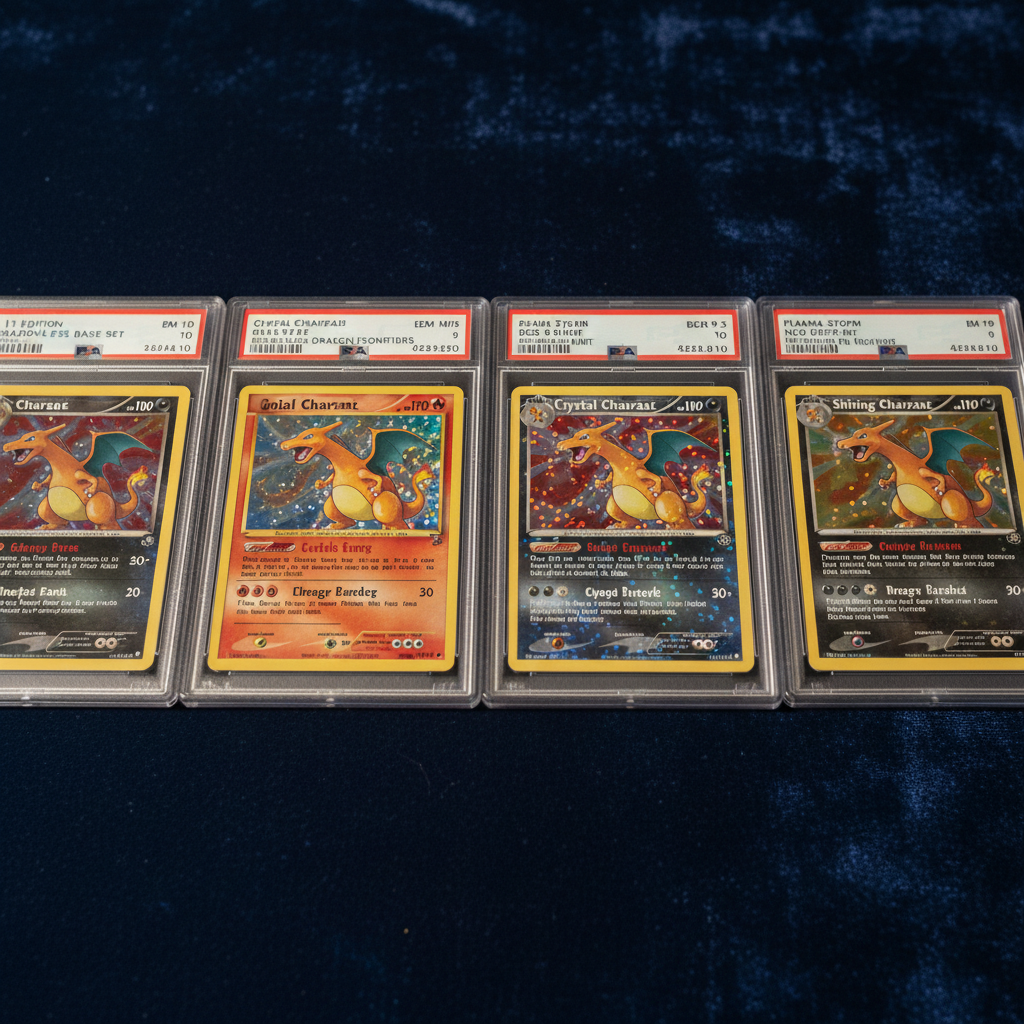
Thirty years in, and the hobby still bows to the same dragon. As Pokémon marks its landmark anniversary, the trading card market has crossed a threshold that few saw coming — grail-tier Charizard cards are now transacting at prices that rival blue-chip art, and the data makes the case without any embellishment needed.
The Charizard premium is not sentiment. It is a measurable, repeatable economic force that has widened with every market cycle since the first Base Set hit shelves in 1999. Pikachu sells merchandise. Charizard moves capital.
The Cards That Define the Ceiling
At the absolute apex sits the 1999 Pokémon Base Set 1st Edition Shadowless Charizard, graded PSA 10 Gem Mint. Logan Paul's famously televised purchase of a PSA 10 example during his 2021 WrestleMania exhibition match set a public benchmark of $150,000 — but that figure has since been eclipsed in private sales. Heritage Auctions and Goldin have both handled PSA 10 copies in the $300,000–$420,000 range, with population reports showing fewer than 120 PSA 10s across all submissions of the 1st Edition Shadowless print run. Scarcity at grade is the story here, not scarcity of the card itself.
The Prerelease Raichu comparison is instructive: a card so rare it may not legally exist in collector hands, yet Charizard's 1st Edition PSA 10 commands comparable reverence purely through market consensus. That is a different kind of rarity — one built on condition, not print run.
Second on any serious valuation list is the Pokémon Japanese Topsun Charizard (No Number, Blue Back), the earliest known Charizard card predating the Western Base Set entirely. A PSA 10 example sold through Goldin in 2022 for $493,230 — the highest publicly recorded sale for any Charizard card at the time. The Topsun set is chronologically foundational, and the market has finally started pricing it that way.
Rounding out the top tier: the 1999 Base Set Unlimited Charizard PSA 10, the Charizard Gold Star (EX Dragon Frontiers, #100) in BGS 10 Pristine, and the 2002 Legendary Collection Reverse Holo Charizard — a card whose combination of low PSA 10 population and collector nostalgia has pushed it well past what the casual market expects.
Why the Anniversary Is Accelerating Everything
Anniversary cycles in collectibles are well-documented demand catalysts. The 25th anniversary in 2021 coincided with the single most explosive year in Pokémon card history — a period when Goldin reported a 390% year-over-year increase in Pokémon card sales volume. The 30th is hitting a market that is more institutionalized, more liquid, and more globally connected than it was even four years ago.
High-net-worth buyers who entered during the 2020–2021 frenzy did not all exit. Many held, and some upgraded. The result is a two-tier market: raw and mid-grade copies have softened from their pandemic peaks, while PSA 9s and PSA 10s of key Charizard variants have either held or continued climbing. That bifurcation is the defining characteristic of a maturing collectibles market — exactly what happened to vintage baseball cards in the late 1990s when BGS introduced its 9.5 Gem Mint tier and separated the serious money from the casual flippers.
The parallel to fine art is not hyperbole. Auction houses that once specialized exclusively in Impressionist paintings — Sotheby's included — have hosted trading card sales. The infrastructure of the art market, including provenance tracking, third-party authentication, and institutional storage, has migrated wholesale into the card hobby. Charizard sits at the center of that shift because it was the first card to demonstrate that a single piece of cardboard could function as a store of value.
What the Population Data Actually Tells You
Collectors who track PSA population reports know that raw submission counts can be misleading. The 1st Edition Shadowless Charizard has seen tens of thousands of submissions over two-plus decades, but the PSA 10 population remains stubbornly low — a function of the card's notoriously difficult centering and the fragility of its holographic surface. That supply constraint at the top grade is structural, not cyclical. It does not improve with time.
The Gold Star Charizard from EX Dragon Frontiers presents a different profile: a shorter print run to begin with, a BGS 10 Pristine population in the single digits, and a collector base that skews toward completionists who rarely sell. Liquidity is thin, which means when one does surface — at PWCC or Stack's Bowers — it tends to reset the comp.
Thirty years of Pokémon, and the market's answer to every valuation question still starts with the same card. That is not nostalgia. That is price discovery doing exactly what it is supposed to do.