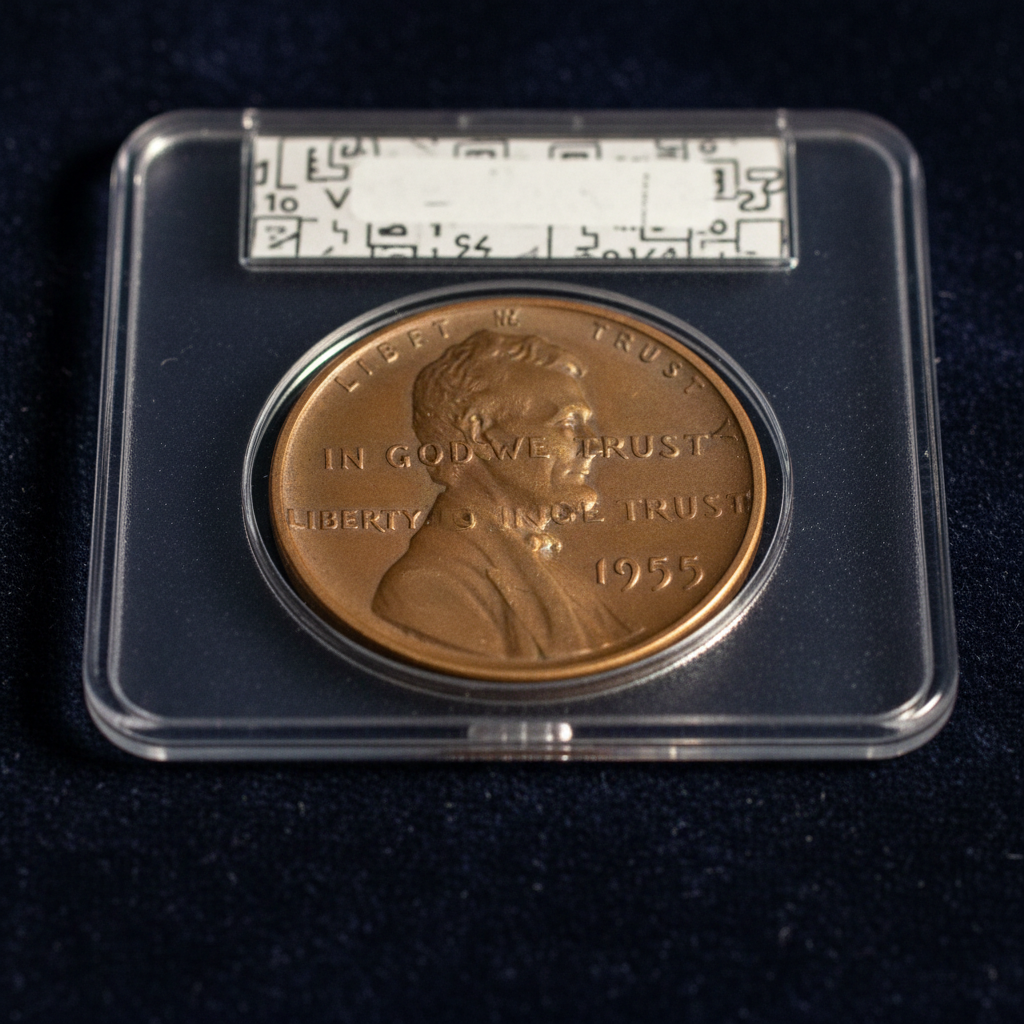
A Lincoln cent has emerged that specialists are calling the most significant modern U.S. mint error discovery in years — and the numbers back that up. The coin combines two distinct error categories simultaneously: it is both a major double-struck mint error and a recognized doubled-die variety. No other modern United States coin is known to carry both characteristics at once. That makes this a population of one.
In error coin collecting, rarity is relative. Double-struck coins exist. Doubled-die varieties exist. But the convergence of both on a single Lincoln cent — confirmed by specialists — is, by current knowledge, unprecedented in the modern series.
What Makes This Coin Different
To understand why this discovery matters, it helps to separate the two error types involved.
A doubled-die variety occurs during the hubbing process, when the die itself receives a misaligned impression from the hub, creating doubling baked permanently into every coin struck by that die. The 1955 Doubled Die Lincoln cent — the most famous example in American numismatics — commands prices north of $50,000 in MS-64 precisely because the doubling is dramatic and die-specific. Doubled dies are varieties, not errors: they're repeatable, catalogued, and assigned numbers in reference guides like the Cherrypickers' Guide.
A double-struck error, by contrast, is a mechanical accident. The planchet receives a second strike from the dies — sometimes rotated, sometimes off-center — producing a second, overlapping image. These are one-off events. No two double-strikes are identical.
This newly surfaced cent is both. The underlying coin is a catalogued doubled-die variety. Then, at some point in the striking process, it was fed back through and struck a second time. The result is a coin that carries the permanent, die-specific doubling of a variety specimen and the chaotic, mechanical drama of a major mint error. According to Mike Byers of MintErrorNews, who first reported the find via CoinWeek, no other modern U.S. coin is known to combine these two categories.
The Market Reality of a True Unique
Pricing a genuine one-of-one is as much art as science, and the error coin market has a complicated relationship with valuation. Reference points exist — but only loosely.
Major double-struck Lincoln cents in high grades have brought $5,000 to $20,000 at auction depending on the degree of the second strike, its orientation, and overall eye appeal. Significant doubled-die varieties on Lincoln cents — particularly those with strong, visible doubling — routinely clear $1,000 to $10,000 in circulated grades, with mint-state examples commanding multiples of that. Stack's Bowers and Heritage have both handled high-profile error coin sales in recent years, with the market for dramatic mint mistakes holding firm even as broader numismatic demand has softened in some segments.
But a coin that is simultaneously both? There is no comp. That's not a cliché — it's a literal statement about the current census. When NGC or PCGS assigns a designation to this piece, it will likely carry a note acknowledging its unique status, which in itself becomes part of the coin's provenance story.
The closest analog in terms of market behavior might be the 1943 Bronze Lincoln cent — a wrong-planchet error so rare that individual examples have sold for over $1 million at Heritage. The mechanism is different, but the principle is the same: scarcity so extreme it resets the pricing framework entirely.
Why the Error Coin Segment Keeps Producing Headlines
Error coins have quietly become one of the more dynamic corners of U.S. numismatics. While the market for common-date Morgans or generic Saints has flattened, dramatic mint errors — particularly those with strong visual impact — continue to attract both seasoned registry collectors and newer buyers drawn to the storytelling aspect of the hobby.
Byers, who has spent decades documenting modern mint errors, has an eye for significance, and his assessment of this cent carries weight in the specialist community. The discovery also underscores a persistent truth about Lincoln cents specifically: despite being the most produced coin in U.S. Mint history, the series continues to yield surprises. Billions struck means more opportunities for mechanical failure — and occasionally, for something genuinely new.
Grading submission details and auction placement for this coin have not yet been publicly announced. But given its status as the only known example of its kind, expect significant institutional interest when it does surface on the market. A coin this singular doesn't stay quiet for long.