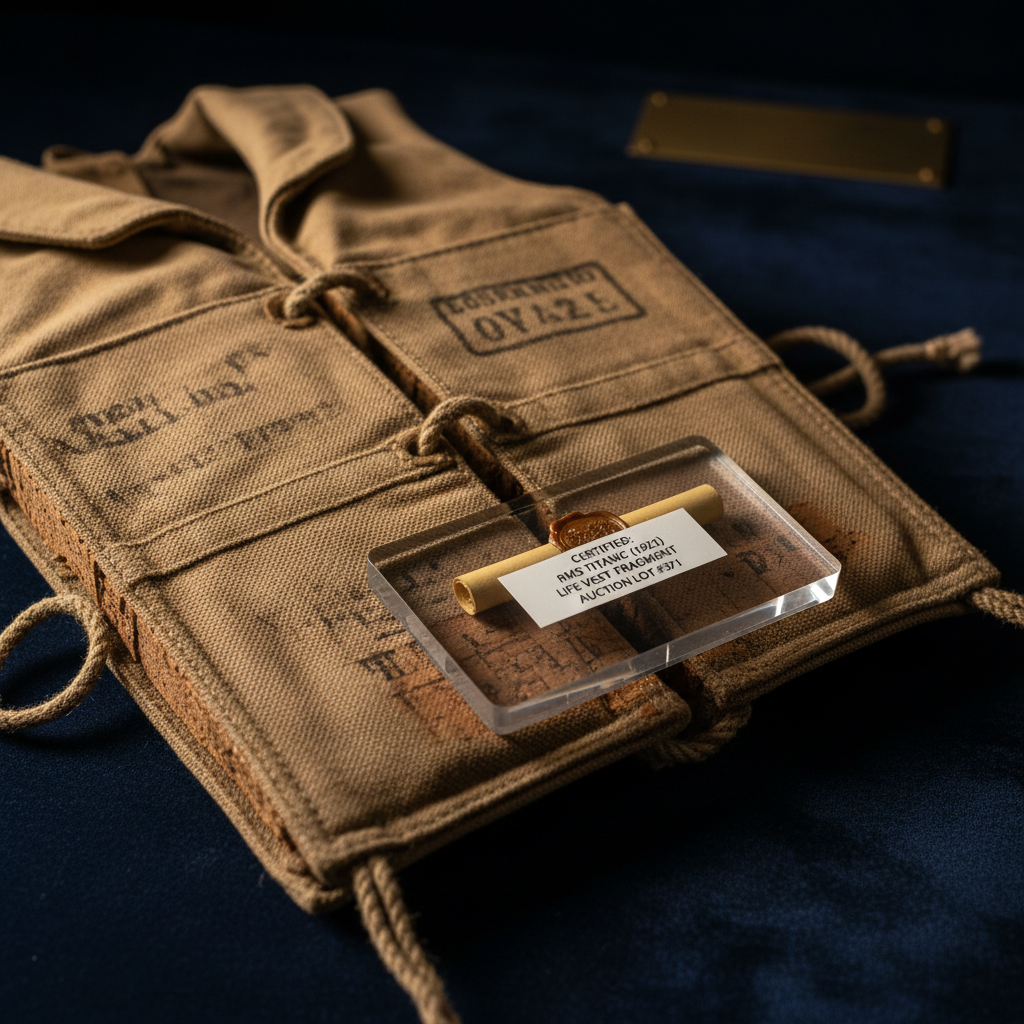
A cork-and-canvas life jacket recovered from the wreck of the RMS Titanic sold at auction for $975,000 — a figure that would have meant nothing to whoever wore it on the night of April 15, 1912, and means everything to the collector who just acquired it.
The sale, handled by Henry Aldridge & Son — the UK-based auction house that has become the definitive marketplace for Titanic artifacts — represents one of the highest prices ever paid for a piece of wearable maritime disaster history. Aldridge has brokered many of the most significant Titanic lots over the past two decades, and this result lands firmly among their top realized prices.
What You're Actually Buying
Titanic life jackets are not rare in the way a low-population graded card is rare. They are rare in the way that surviving fragments of a specific catastrophe are rare — finite by definition, impossible to reproduce, and laden with a provenance that no modern manufacturer can replicate. Approximately 1,500 people died that night. The life jackets that made it to lifeboats, to rescue ships, and eventually to shore represent a physical record of who survived and how.
This particular jacket is constructed from cork blocks sewn into a canvas vest — the standard Titanic-era design produced by Fosbery & Co. and similar manufacturers of the period. Cork jackets of this type were designed to keep an unconscious person face-up in the water, though they offered no protection against the 28-degree Fahrenheit North Atlantic temperatures that killed most victims within minutes of immersion. The jacket's survival in this condition — structurally intact, with legible markings — is itself a preservation story.
Provenance is everything in this category. Documented chain of custody from the disaster forward is what separates a significant artifact from a merely old one. Without it, you have maritime antique. With it, you have history.
The Market for Titanic Memorabilia
The Titanic artifact market operates on a different logic than most collectibles categories. There is no grading scale, no population report, no comparable sales database updated weekly. What there is: a small, serious pool of buyers who understand that supply is permanently capped and that cultural interest in the disaster — now 113 years removed — has never meaningfully declined.
Recent comps tell the story clearly. A Titanic first-class lunch menu sold for $88,000 at Aldridge in 2015. A violin believed to have been played by bandmaster Wallace Hartley as the ship sank fetched $1.7 million in 2013. Passenger letters, deck chairs, and even a lifeboat compass have all cleared six figures in the past decade. The trajectory is unmistakably upward.
The $975,000 result for this life jacket slots between those data points and signals something meaningful: wearable, tactile artifacts — objects that were physically on a person during the disaster — command a premium over paper ephemera. A menu tells you what first-class passengers ate. A life jacket tells you someone chose to put it on.
- Wallace Hartley violin — $1.7M (2013, Henry Aldridge & Son)
- Titanic life jacket (this sale) — $975,000
- Captain Smith's pocket watch — $156,000 (2013, Henry Aldridge & Son)
- First-class lunch menu — $88,000 (2015, Henry Aldridge & Son)
- Lifeboat compass — $62,000 (2019, Henry Aldridge & Son)
Scarcity That Only Deepens
Unlike vintage sports cards, where high-grade copies occasionally surface from old collections, Titanic artifacts don't get rediscovered in attic boxes. The universe of authenticated, provenance-backed material is essentially known. What exists has been catalogued, studied, and in many cases already sold through Aldridge or comparable houses. Each sale removes a piece from potential future circulation — private collections don't always return to market, and some artifacts have moved into institutional holdings that will never sell.
That dynamic creates a market where demand is broad and supply is structurally shrinking. Serious collectors understand this. So do the underbidders who pushed this life jacket past the half-million mark before the hammer fell at $975,000.
The Titanic sank once. The number of artifacts it left behind is fixed. The only variable is how much the next buyer is willing to pay — and based on the trajectory of the past decade, the answer keeps going up.