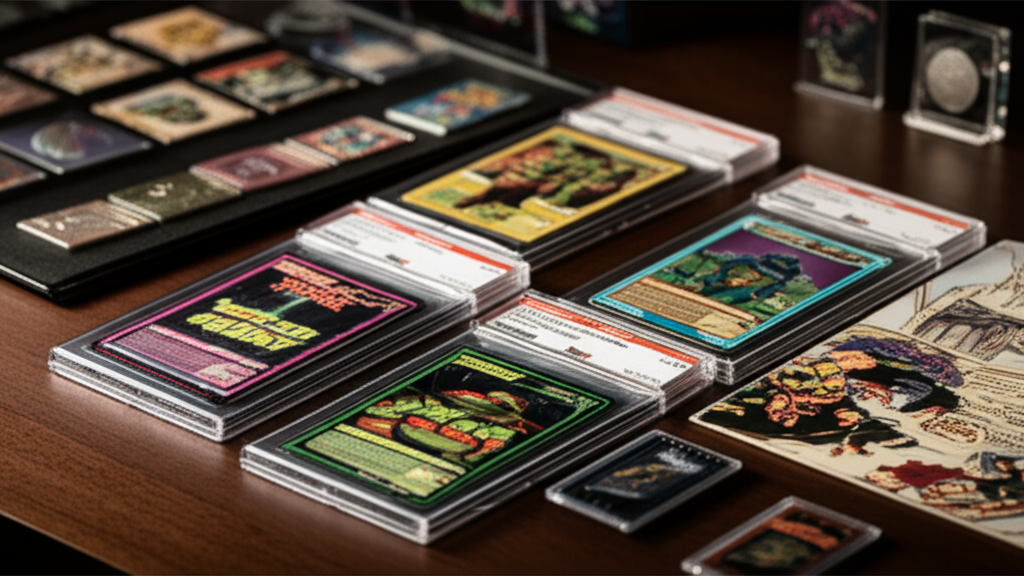
Magic: The Gathering's Teenage Mutant Ninja Turtles set, released March 6, 2026, is already bending Standard's competitive landscape — and the secondary market is paying attention. At just 190 cards, the set is lean by modern MTG standards, but mechanical density is doing the heavy lifting. This isn't a nostalgia cash-grab. It's a precision instrument dropped into one of the most complex Standard environments the format has seen in years.
Fifteen legal sets currently populate Standard. That's a sprawling card pool, and yet five cards from a licensed crossover set are generating serious discussion at Friday Night Magic tables and on the Arena ladder alike. That's not coincidence — that's design intent meeting format opportunity.
A Format Already Under Pressure
The context matters here. Wizards of the Coast's Foundations rules update quietly removed damage assignment order from the combat system, and the downstream effect has been significant. Combat is now more surgical — blockers and attackers interact with less ambiguity, and that shifts the calculus for aggro, midrange, and any strategy built around combat tricks. Decks that once relied on stacking damage assignment to push through lethal are rethinking their threat packages.
Into that environment, the TMNT set drops four iconic characters and a supporting cast of mechanically distinct spells. The synergy-first design philosophy is visible throughout: rather than introducing raw power-creep threats, the set offers enablers, payoffs, and role-players that slot into existing archetypes rather than demanding entirely new ones. That's a harder design challenge, and by most competitive accounts, the team threaded the needle.
For collectors and speculators watching the singles market, this distinction is critical. Cards that enable existing archetypes tend to hold value more durably than standalone bombs. When a card becomes a four-of in a top-tier deck, its floor is anchored by demand that doesn't evaporate after a single tournament cycle.
The Five Cards Driving the Conversation
While the full source breakdown of all five cards is behind the Beckett paywall, the competitive signals are clear enough to read directionally. Leonardo, Donatello, Raphael, and Michelangelo each carry distinct mechanical identities — the set's designers avoided the lazy route of making each turtle a slight variation on the same template. That individuality is what makes the set interesting from a gameplay and collection standpoint simultaneously.
- Combat-oriented turtles are finding homes in aggressive and midrange shells that benefit from the post-Foundations combat environment.
- Utility spells in the set are generating interest in control and tempo archetypes that needed specific interaction tools.
- Synergy payoffs — cards that reward building around the TMNT creature type or specific mechanical conditions — are the highest-variance picks, capable of either spiking hard or fading quickly depending on whether the supporting archetype materializes.
The secondary market on these is still price-discovering. Early tournament results over the first two weekends post-release will be the real indicator of which cards cement themselves as format staples versus which ones were hype-driven at launch. Collectors who've tracked MTG singles through previous crossover releases — The Walking Dead Secret Lair in 2020, the Fortnite and Street Fighter drops that followed — know that licensed crossover cards can carry a premium that outlasts their competitive relevance, purely on collectibility grounds.
Crossover Cards as Collectibles
That's the angle casual competitive coverage tends to miss. MTG crossover cards occupy a dual market: competitive players driving short-term price action, and IP collectors who don't play the game at all but want a graded Leonardo card for the same reason they'd want a graded TMNT action figure variant. Heritage Auctions and PWCC have both seen MTG crossover singles appear in their catalog over the past three years, and the trajectory has been upward.
PSA and BGS have been grading MTG cards with increasing volume since 2020. High-grade crossover cards with low population counts — particularly PSA 10 and BGS 9.5 Black Label copies — have commanded meaningful premiums over raw copies at auction. For a newly released set, the grading window is now. Population reports on TMNT set cards will be thin for the next 60 to 90 days, which is historically when the best raw-to-graded arbitrage exists.
The TMNT IP has demonstrated sustained collectible demand across multiple categories — vintage toys, comics, original animation art — for four decades. Wizards of the Coast didn't pick this license by accident. Whether the competitive meta impact of these five cards persists through the next rotation or fades by summer, the collectible case for high-grade copies of the set's key cards is built on a foundation that doesn't depend on tournament results.
Fifteen sets deep into a complex Standard environment, it took 190 cards and four turtles to move the needle. That's either a testament to tight design or a preview of how licensed crossovers are going to keep reshaping what competitive Magic looks like — probably both.