Thomas Thompson walked out of federal prison after nearly a decade behind bars. The treasure is still missing. That's the story — and it's one of the strangest in American numismatic history.
Thompson, the Ohio-based marine scientist who in 1988 located the wreck of the S.S. Central America nearly a mile beneath the Atlantic Ocean, became a legend the moment his team hauled up what historians estimate was $150 million worth of Gold Rush-era coins and bullion. The ship had gone down in a hurricane in 1857, taking with it 425 lives and a cargo of California gold that had been reshaping the American economy. Finding it was a genuine triumph of science, engineering, and obsession. What followed was something else entirely.
From National Hero to Federal Fugitive
The legal unraveling took years. Investors who had backed Thompson's Columbus-America Discovery Group sued for their share of the proceeds. Thompson, rather than face those claims in court, disappeared in 2012. He was found in 2015 in a Florida hotel, living under an assumed identity with a companion and a collection of library books on avoiding detection. He was arrested, held in contempt for refusing to disclose the location of assets, and sat in a federal facility in Ohio for the better part of a decade — never convicted of a crime, just held for contempt.
The crux of the outstanding mystery: roughly 500 gold coins from the Central America recovery remain unaccounted for. Thompson has claimed ignorance. Courts have not found that convincing. And so the coins — or whatever became of them — remain one of the great open questions in American treasure law.
What Those Coins Are Actually Worth
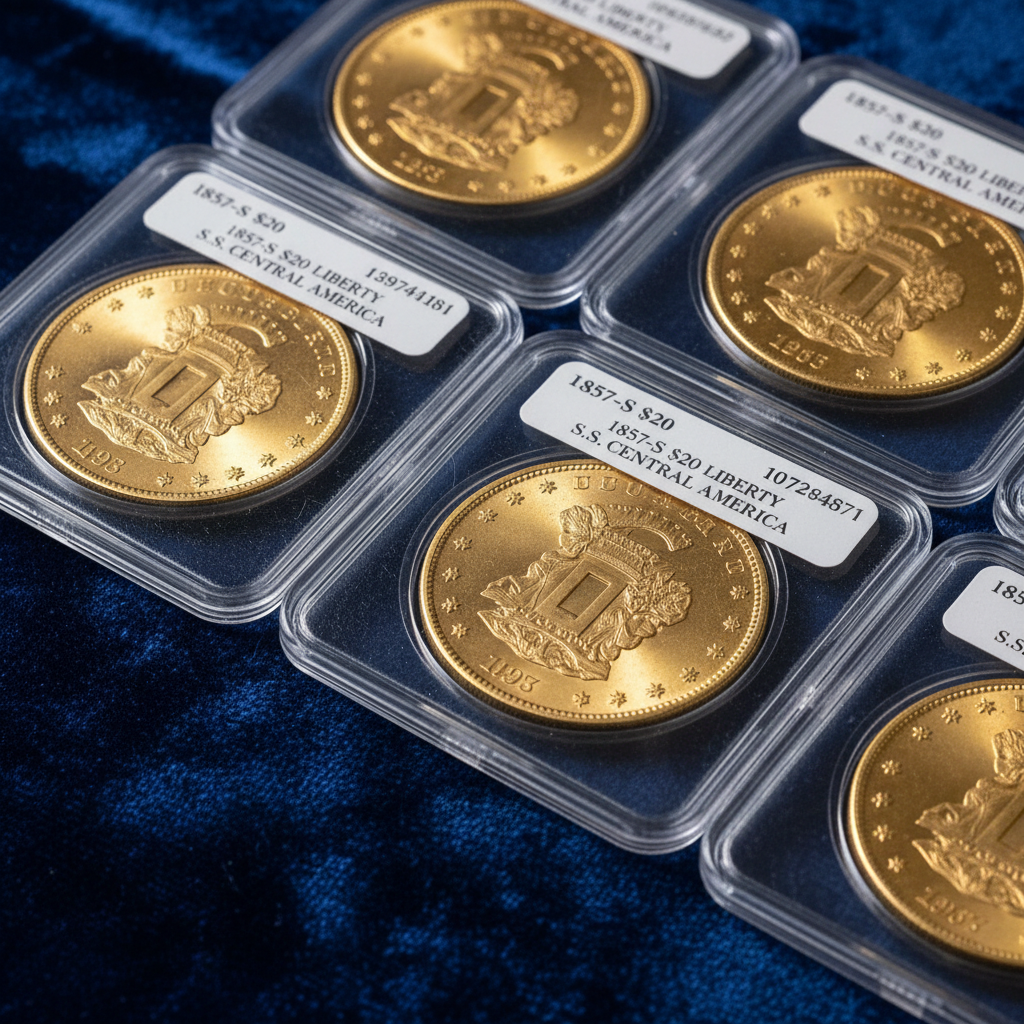
To understand the stakes, you need to understand what Central America coins represent in the numismatic market. These aren't generic gold pieces. They are 1857-S Double Eagles, half eagles, and other Gold Rush-era issues recovered from a sealed, anaerobic deep-ocean environment — meaning many came up in extraordinary, uncirculated condition despite more than 130 years underwater. The preservation paradox is real: the cold, pressurized, oxygen-deprived deep sea protected surfaces that land-stored coins rarely achieve.
NGC certified the bulk of the recovered material, and examples graded MS-65 and above have sold at major auction for well into five figures individually. A single 1857-S Double Eagle in MS-65 has commanded prices north of $35,000 at Heritage Auctions. Rarer dates and higher grades from the same recovery have gone considerably higher. Multiply that across 500 coins and you're looking at a pool of assets potentially worth $10 million or more at current market rates — a conservative estimate given how aggressively the market for certified pre-Civil War gold has moved over the past five years.
The coins that were properly distributed through legal channels have become some of the most coveted pieces in American numismatics. Collectors prize them not just for grade but for provenance — the Central America pedigree is a documented, verifiable story that adds a dimension no grading label alone can provide. That provenance premium is real and substantial.
The Unresolved Question
Thompson's release doesn't resolve the contempt order — it reflects a legal determination that continued imprisonment was no longer serving its coercive purpose. He has spent years maintaining he cannot produce what he doesn't know the location of. Whether that's true, and whether the 500 coins were sold privately, transferred offshore, or simply lost to the chaos of a legal battle that stretched across three decades, remains genuinely unknown.
For the numismatic community, the missing coins represent more than a legal footnote. If they surface — through an estate sale, a foreign auction, or a quiet private transaction — the market will notice immediately. Central America coins carry enough documented history that a sudden appearance of uncatalogued examples would raise flags at any reputable grading service. NGC's registry and the detailed recovery records maintained by the Columbus-America group create a paper trail that would make laundering these coins through legitimate channels extremely difficult.
That doesn't mean they're gone forever. It means whoever has them — if anyone does — is either holding, waiting, or operating well outside the mainstream market.
Thompson found one of history's great treasures. The smaller mystery he left behind may take just as long to solve.