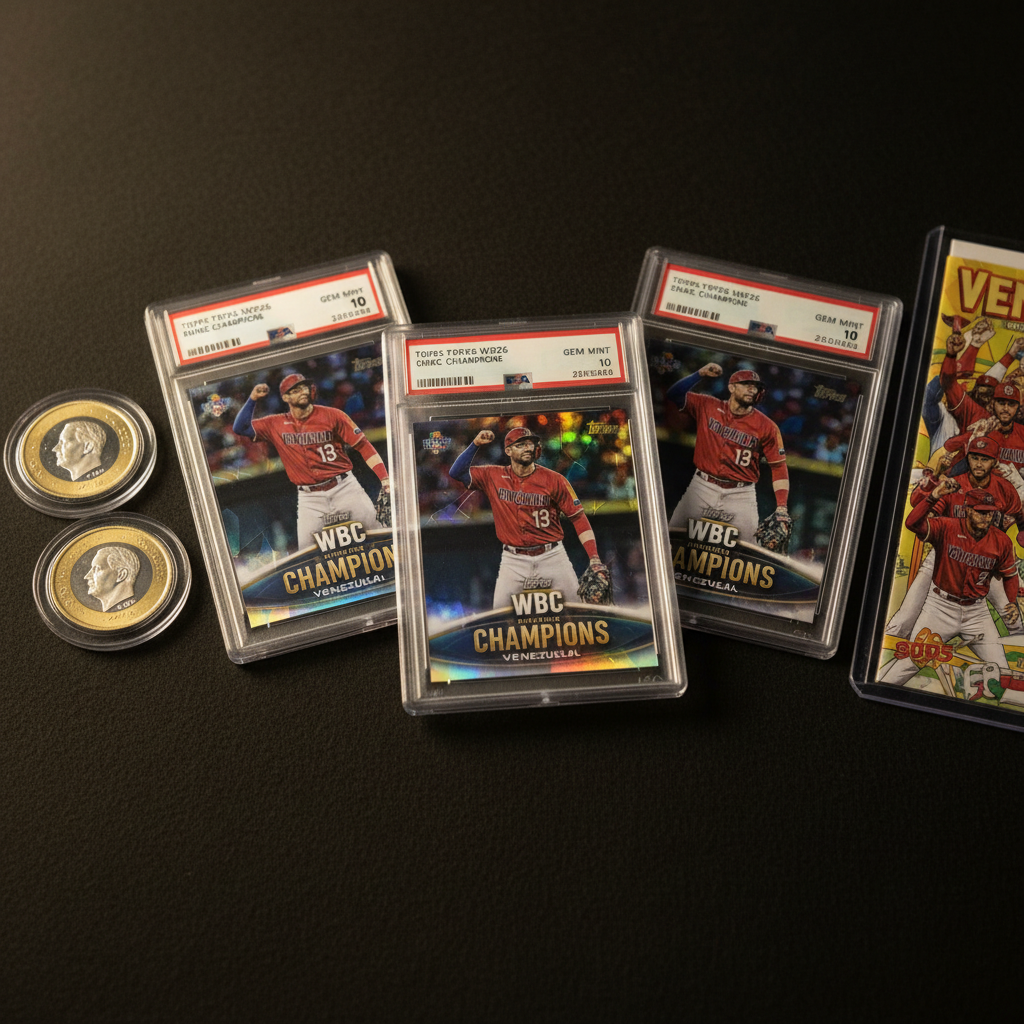
Venezuela is coming for its flowers. Topps Now is delivering them in cardboard form.
Topps has announced the 2026 Topps Now Team Venezuela World Baseball Classic Championship Team Set, a limited-run release celebrating Venezuela's run to the WBC title. The set follows the Topps Now model that has become the de facto commemorative format for marquee baseball events — print-to-order windows, hard stops on production, and a checklist built around the roster that made the run possible.
For collectors, the formula is familiar. For Venezuelan baseball fans — and there are millions of them, with deep ties to MLB rosters across the league — this one carries genuine emotional weight. Venezuela has long been one of the most productive baseball nations on the planet, and a WBC championship is the kind of moment that turns a regional fanbase into a global buying force almost overnight.
What's in the Set
The checklist covers the full championship roster, with base cards anchoring the release. Beyond the base layer, the set includes autograph cards, short prints (SPs), and parallels — the standard Topps Now tiered structure that creates multiple entry points depending on budget and collecting goals.
Autographs are the obvious focal point for investment-minded buyers. Topps Now autos on championship sets have historically carried a premium over standard base issues, particularly when the subjects are active MLB players with existing card markets. Venezuela's WBC roster is stacked with recognizable names from across the majors, and any certified auto from a championship-winning national team set tends to hold value better than a mid-season standalone card.
The parallel structure adds another dimension. Topps Now parallels — typically color-coded and numbered — compress the population counts that make graded copies meaningful. A PSA 10 on a numbered parallel from a championship set is a fundamentally different asset than a base copy, and the secondary market prices reflect that gap consistently.
Short prints, as always, are the wild card. SPs in Topps Now sets are often undisclosed at the time of ordering, which means collectors are making purchase decisions with incomplete information. That opacity frustrates some buyers and creates opportunity for others — the secondary market premium on confirmed SPs can be substantial once the print window closes and the actual population becomes clear.
The Topps Now Model and Why It Works Here
Topps Now was built for exactly this kind of moment. The print-to-order structure means supply is permanently capped at whatever demand existed during the ordering window, which is typically 24 to 72 hours. There's no warehouse of unsold inventory to suppress prices later. Once the window closes, the only way to acquire the card is on the secondary market.
That scarcity mechanic has worked well for high-profile events. WBC releases in particular have shown strong secondary market performance when the team in question has a passionate, geographically dispersed fanbase — and Venezuela qualifies on both counts. The Venezuelan diaspora spans the United States, Latin America, and Europe, and the country's MLB pipeline means stateside collectors already have rooting interests in the players on this checklist.
For context, Topps Now WBC sets from the 2023 tournament generated meaningful secondary market activity, with autograph copies of marquee players trading well above issue price in the weeks following their respective championship runs. Japan's 2023 championship set, anchored by a roster that included Shohei Ohtani, became one of the most-discussed Topps Now releases of that cycle. Venezuela's 2026 equivalent has comparable narrative energy.
The grading angle is worth tracking closely. Topps Now cards are printed on modern stock that grades well under both PSA and BGS standards when handled carefully from pack to submission. The population on these sets tends to build slowly — collectors who submit early, before the PSA 10 pop count climbs, are in the best position if the market for a specific player strengthens over time.
Who to Watch on the Checklist
Without the full checklist confirmed at time of publication, the smart play is to focus on the players whose existing Topps card markets are already active. Venezuelan-born MLB stars with established collector bases will drive the most secondary market interest, particularly at the autograph tier. Base cards of role players or bench contributors may see soft demand relative to the headliners, but that same dynamic creates selective buying opportunities for collectors who know the roster deeply.
The championship set format also tends to reward patience. Initial excitement drives prices up in the first few weeks post-release, but sets from smaller-market nations sometimes stabilize — or dip — before recovering as the players' MLB careers develop. Buying into a championship auto of a 24-year-old Venezuelan shortstop who becomes a perennial All-Star looks very different five years from now than it does today.
Venezuela finally has its WBC title. The cards commemorating it are already on the clock.