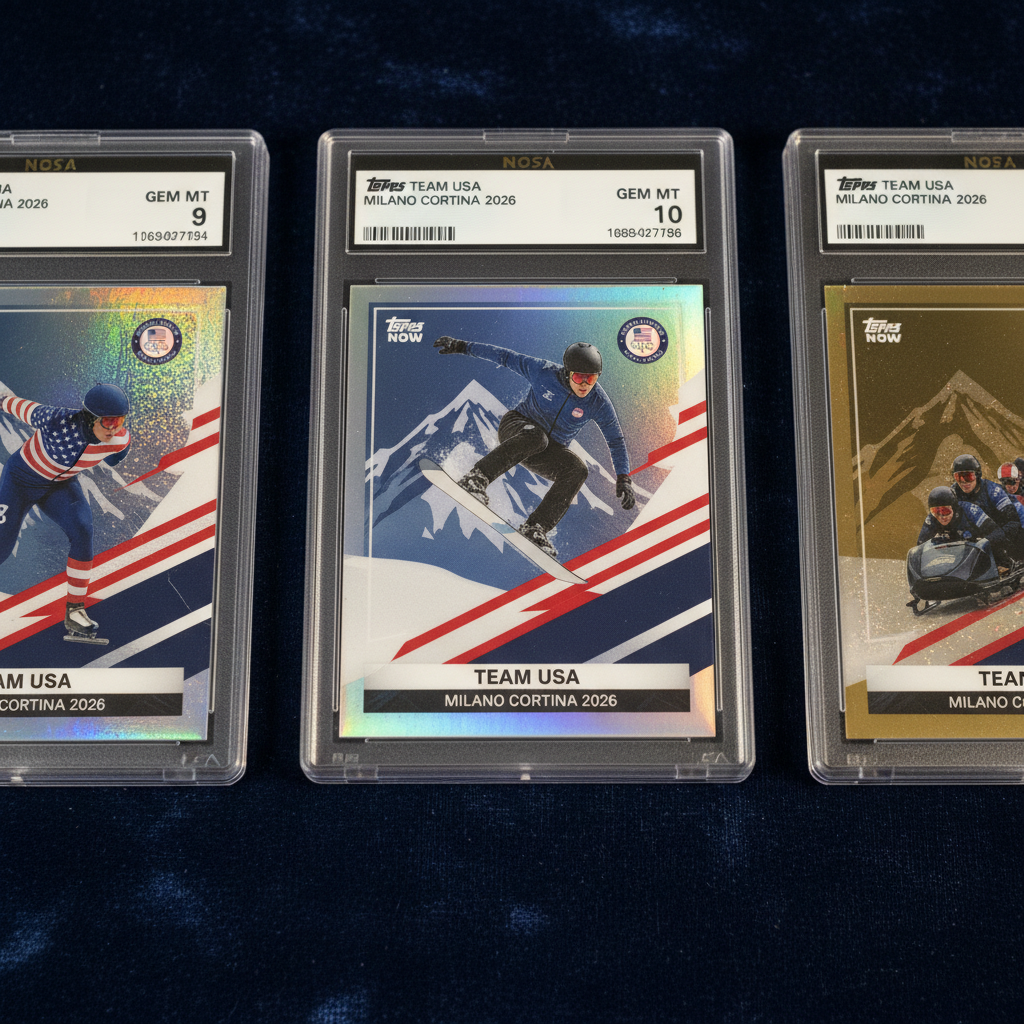
Topps is bringing its on-demand model to the 2026 Winter Olympics, launching a Topps Now Team USA Milano Cortina series that will produce cards in real time as American athletes compete on snow and ice in northern Italy. The set follows the same print-to-order structure Topps has used for baseball, soccer, and previous Olympic cycles — meaning every card's print run is determined entirely by the number of orders placed during a limited window, typically 24 to 48 hours per card.
For collectors who've tracked the Topps Now Olympics program since its Tokyo 2020 debut, the Milano Cortina release is the most anticipated winter iteration yet. The format has matured. The athlete pool is deeper. And the secondary market data from Beijing 2022 and Paris 2024 gives buyers a clearer framework for evaluating what's worth chasing.
How the On-Demand Model Works — and Why Print Runs Are Everything
The Topps Now structure is deceptively simple: a card goes live, collectors order during the window, Topps prints exactly that many copies, and the final count is stamped on the back. No pack odds. No case-breaking lottery. Just transparent supply meeting real-time demand.
That transparency is also the format's sharpest double-edged sword. A card for a breakout gold medalist — someone who wasn't on the radar before the Games — can close with a print run under 500 copies, creating genuine scarcity. A card for a well-known favorite, ordered heavily in anticipation, might land at 3,000 or more, which historically suppresses secondary market premiums to near-flat against the original retail price.
Retail pricing for standard Topps Now cards has held around $9.99 per card in recent Olympic releases, with autographed parallels and multi-card lots carrying higher price points. Autograph editions, when available, are typically sequentially numbered and produced in far smaller quantities — often under 25 copies — and those are where the real secondary market action concentrates.
The Beijing 2022 Topps Now release offered a useful case study. Cards for athletes who underperformed or failed to medal traded at or below issue price within weeks. But cards for surprise medalists — particularly in events like freestyle skiing and short track speed skating — saw secondary premiums of 3x to 5x retail on eBay in the days immediately following competition, before supply caught up with the narrative.
What to Watch on the Checklist
The full Milano Cortina checklist will build progressively through the Games, which run February 6 through February 22, 2026. Cards are issued reactively — a podium finish triggers a card, not a roster announcement — so the checklist is, by design, impossible to complete in advance.
That said, the athletes most likely to generate high-demand, low-print-run cards share a common profile: they compete in marquee events, they weren't household names before the Games, and they win. Figure skating, alpine skiing, and ice hockey historically produce the highest-volume orders simply because of mainstream visibility. Niche disciplines — biathlon, Nordic combined, skeleton — tend to generate smaller print runs, which can translate to stronger long-term scarcity even if the immediate secondary market is quieter.
- Standard base cards: Approximately $9.99 retail, print run determined by order window
- Autograph parallels: Numbered editions, typically sub-25, with premium retail pricing
- Multi-card team sets: Bundled options available for select events or disciplines
- Order windows: Generally 24–48 hours per card following the qualifying performance
Grading these cards adds another layer of calculus. PSA and BGS both accept Topps Now submissions, and for low-print-run cards from Paris 2024, PSA 10 populations on notable athletes remained in the single digits months after grading submissions closed — a meaningful scarcity signal for anyone building a registry set or speculating on future demand.
The Bigger Picture for Olympic Card Collecting
The Olympics card market sits in an interesting structural position. Unlike baseball or basketball, there's no continuous season creating a steady drumbeat of new product. Demand concentrates intensely over three weeks, then largely dissipates until the next cycle. That episodic nature means the window to acquire key cards at or near issue price is genuinely short — and collectors who wait for the dust to settle often find that the cards worth having have already moved.
Topps' decision to anchor its Olympic strategy around the on-demand model rather than traditional hobby boxes is a deliberate one. It lowers the barrier to entry, eliminates the randomness of pack-based collecting, and lets the market self-sort by athlete performance rather than by print-run decisions made months in advance. It also means Topps carries essentially zero inventory risk — a structure that's proven durable across five-plus years of the Topps Now format.
For the serious collector, the play with Milano Cortina is the same as it's always been with Topps Now Olympics: identify the athletes most likely to surprise, order conservatively during the window rather than in bulk, and treat autograph parallels as the only tier with genuine long-term upside. The base cards are collectible. The autos are the investment.
The Games start in February. The cards start the moment the first American steps onto a podium.