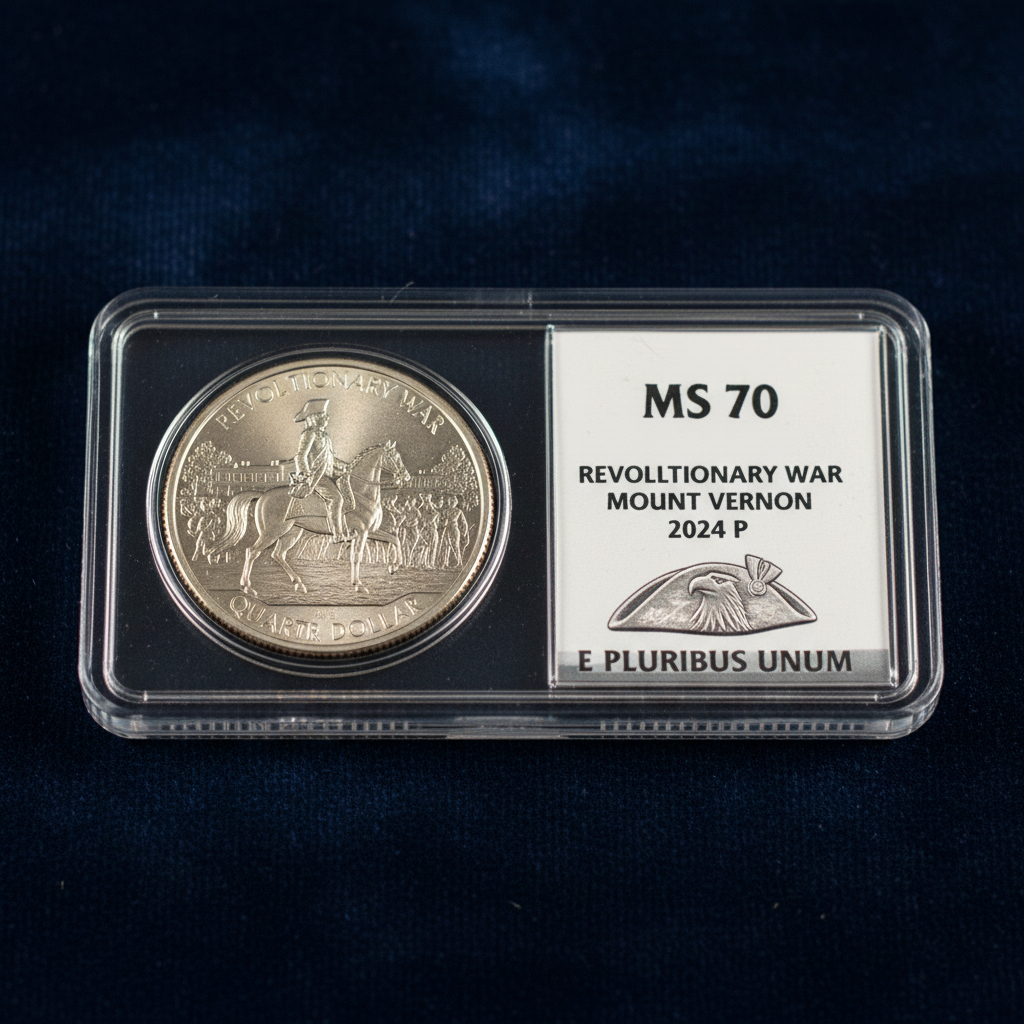
The second coin in the U.S. Mint's 2026 Semiquincentennial Circulating Coin Program entered circulation on March 23, 2026 — and the Mint chose its launch venue carefully. Standing on the grounds of George Washington's Mount Vernon, officials released the Revolutionary War Quarter into the Federal Reserve system, marking one of the more symbolically loaded coin drops in recent memory.
This isn't a bullion play or a limited-edition proof set chasing premium buyers. This is a circulating quarter — 25 cents, pocket change — designed to put American history directly into everyday hands during the nation's 250th anniversary year.
The Program Behind the Coin
The Semiquincentennial Circulating Coin Program is the Mint's flagship numismatic initiative for 2026, structured around America's 250th birthday. The Revolutionary War Quarter is the second issue in that series, following the program's debut release earlier this year. The full lineup hasn't been publicly finalized, but the program's architecture mirrors past multi-coin circulation efforts — think the 50 State Quarters program that ran from 1999 to 2008 and produced some of the most widely collected modern U.S. coinage ever struck.
That comparison matters for collectors sizing up long-term interest. The State Quarters program minted billions of coins across its run, yet certain low-mintage issues — particularly the 2009 District of Columbia quarter and select Proof and Satin Finish variants — still command meaningful premiums in high grade. A 2009-S DC quarter graded NGC PF-70 Ultra Cameo regularly trades in the $30–$60 range, modest by coin standards but a genuine multiple over face value for a circulating denomination.
The Semiquincentennial series carries stronger thematic gravity than the State Quarters ever did. The 250th anniversary of American independence is a once-in-a-lifetime event from a marketing standpoint, and the Mint knows it. Collector demand for commemorative issues tied to the anniversary is already running hot.
What Collectors Should Watch
For raw coin hunters, the play here is straightforward: pull these from circulation early, handle them minimally, and watch for low-mintage date-and-mint combinations. Philadelphia and Denver strikes will be the workhorses, but San Francisco proof and special mint set versions — if the Mint follows its standard production calendar — are where grade-sensitive collectors will focus.
The grading population story on these coins won't develop for months. PCGS and NGC will begin seeing submissions as collectors pull high-quality strikes from mint sets and early rolls. First-strike and early-release designations will add a premium layer for registry set builders. On comparable modern commemoratives, a PCGS MS-70 or NGC MS-70 designation on a circulating quarter can push values to $40–$150 depending on the issue's mintage and thematic appeal — not life-changing money, but real upside on a coin that costs a quarter to acquire.
The Mount Vernon launch itself adds a layer of provenance narrative that dealers will use. Coins distributed through Federal Reserve channels on release day — especially any recovered from the event itself — carry the kind of origin story that moves product at shows and online marketplaces. It's anecdotal, not graded, but collector psychology runs on exactly this kind of detail.
Beyond the pure numismatic angle, the 2026 program arrives at a moment when modern U.S. coin collecting is experiencing a quiet resurgence. Younger collectors priced out of vintage key dates are building sets in the modern era, and anniversary programs with clear thematic arcs — beginning, middle, end — give them a structured entry point. The Semiquincentennial series, if it runs to a satisfying conclusion, could become a defining set for that demographic the same way the Statehood Quarters defined a generation of casual collectors in the early 2000s.
The Bigger Picture
Launching at Mount Vernon wasn't an accident. The estate of the nation's first commander-in-chief is one of the most visited historic sites in the country, drawing over one million visitors annually. Releasing a coin commemorating the Revolutionary War — the conflict Washington led — at the home where he lived and died is the kind of institutional storytelling the Mint executes well when it commits to it.
The 250th anniversary calendar is crowded with commemorative product across every collectibles category. Coins, stamps, trading cards, medals, and signed memorabilia tied to the Semiquincentennial are all competing for the same collector dollar. What the Revolutionary War Quarter has that most of those products don't is ubiquity — it will circulate in billions of pockets, wallets, and couch cushions for years. Most people won't notice. The ones who do will be the ones building the sets that, fifty years from now, someone else will be hunting.
Two hundred and fifty years is a long time. The coins that survive it in gem condition will be worth finding.