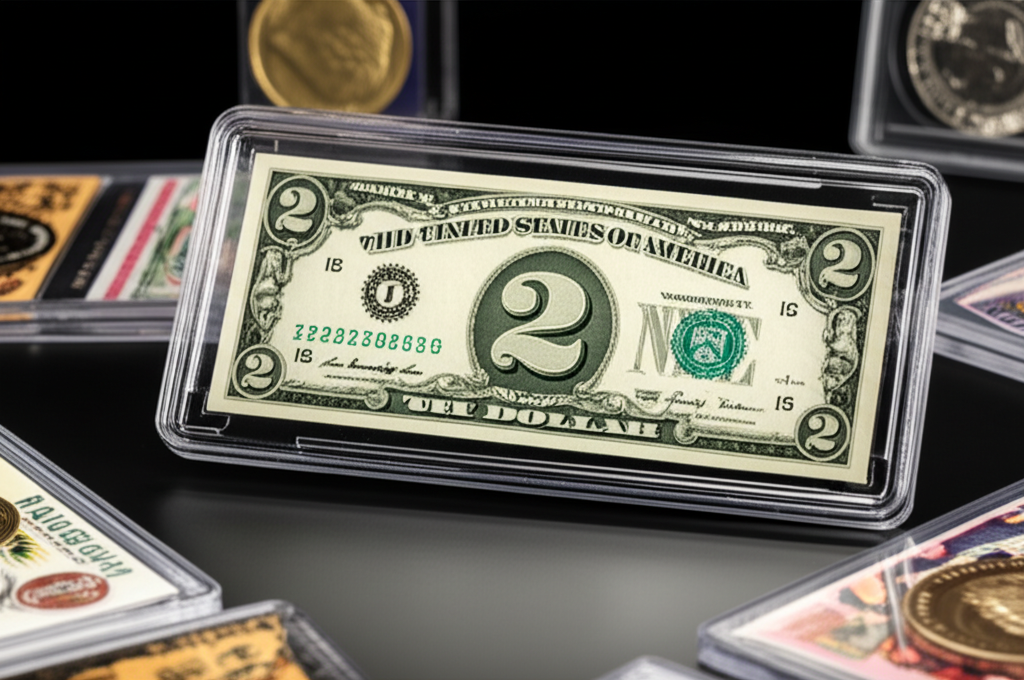
A 1928E $2 Legal Tender Star Note graded PMG Choice Uncirculated 64 EPQ — one of the most elusive small-size currency survivors in American numismatics — is heading to the block at Stack's Bowers Galleries' U.S. Currency Rarities Night on March 12. This isn't a note you stumble across at a coin show. The 1928E series star replacement notes represent one of the lowest-mintage issues in the entire small-size $2 Legal Tender run, and finding one in Choice Uncirculated condition with Exceptional Paper Quality designation is, by any honest measure, a generational collecting opportunity.
The Note, the Sale, and the Significance of That Star
At first glance, the 1928E $2 bill looks like any other Depression-era small-size Legal Tender note — red Treasury seal, portrait of Thomas Jefferson, the familiar brick-red serial number. But the star suffix on the serial number changes everything. Star notes were printed as replacement notes to substitute for sheets damaged or destroyed during the production process. They were never intended for wide circulation, and the quantities printed were a fraction of the regular-issue runs. In the 1928E series specifically, the star note population is exceptionally thin — making high-grade survivors extraordinarily scarce in the PMG and PCGS Currency census data.
The consigning note carries a PMG 64 EPQ designation, meaning it grades Choice Uncirculated with the premium EPQ qualifier — confirming the paper retains its original body, no artificial enhancements, no cleaning, no pressing. For currency collectors, EPQ is not a cosmetic bonus; it is a fundamental marker of authenticity and originality that directly drives realized prices. Notes without EPQ at the same numerical grade routinely sell at meaningful discounts. The Stack's Bowers U.S. Currency Rarities Night format is itself a signal — the auction house reserves that session for material that commands serious attention and serious money.
Stack's Bowers has built one of the most respected currency auction platforms in the country, consistently delivering strong realized prices for rare Legal Tender and Federal Reserve issues. Their Rarities Night sessions attract institutional-level bidders alongside advanced private collectors, which means competitive hammer prices rather than sleepy room estimates.
Why This Note Belongs in a Different Conversation Than Your Average $2 Bill
The broader $2 bill market has seen a surge in mainstream attention over the past several years — driven partly by social media novelty and partly by a genuine resurgence in collector interest in U.S. small-size currency. But that rising tide has not lifted all boats equally. The real value acceleration has happened at the top of the quality pyramid, in high-grade, low-population notes with documented scarcity. The 1928E star note sits squarely in that premium tier.
Consider the market context: high-grade star notes from the 1928 series Legal Tender issues have consistently outperformed their regular-issue counterparts at auction, sometimes by multiples. A PMG 64 EPQ example of a low-mintage star note in this series would represent a comp-busting result if bidding runs deep — and given current collector appetite for certified, original-paper U.S. currency, there is every reason to expect it will. The EPQ designation alone narrows the available competition dramatically. Search PMG's population data for 1928E $2 star notes at 64 EPQ or above and you are looking at a census count that can likely be counted on one hand.
This also arrives at a moment when the certified currency market is benefiting from crossover interest — collectors priced out of key-date coins and high-grade sports cards are discovering that rare U.S. paper money offers comparable historical resonance and scarcity with a market that, in many pockets, remains undervalued relative to its numismatic significance. Star notes, in particular, have become a focused collecting discipline, with specialists tracking population data and auction records the way card collectors track PSA pop reports.
Collector Takeaway: Watch the Hammer, Then Watch the Market React
If you are an advanced currency collector or a cross-category investor with liquidity, the Stack's Bowers March 12 Currency Rarities Night deserves your full attention. A PMG 64 EPQ 1928E $2 Legal Tender Star Note at this grade level does not come to market on a predictable schedule — the next comparable example could be years away. The realized price here will set a meaningful comp that dealers and collectors will reference for the foreseeable future.
For collectors who won't be bidding, the takeaway is equally clear: document this result. Whatever this note brings on March 12 will recalibrate expectations for the entire 1928-series $2 star note market. If you already hold examples in mid-to-high grades, this sale may validate holdings you've underestimated. And if you've been sitting on the sidelines waiting for a reason to take small-size Legal Tender seriously as a collecting category — this is that reason.