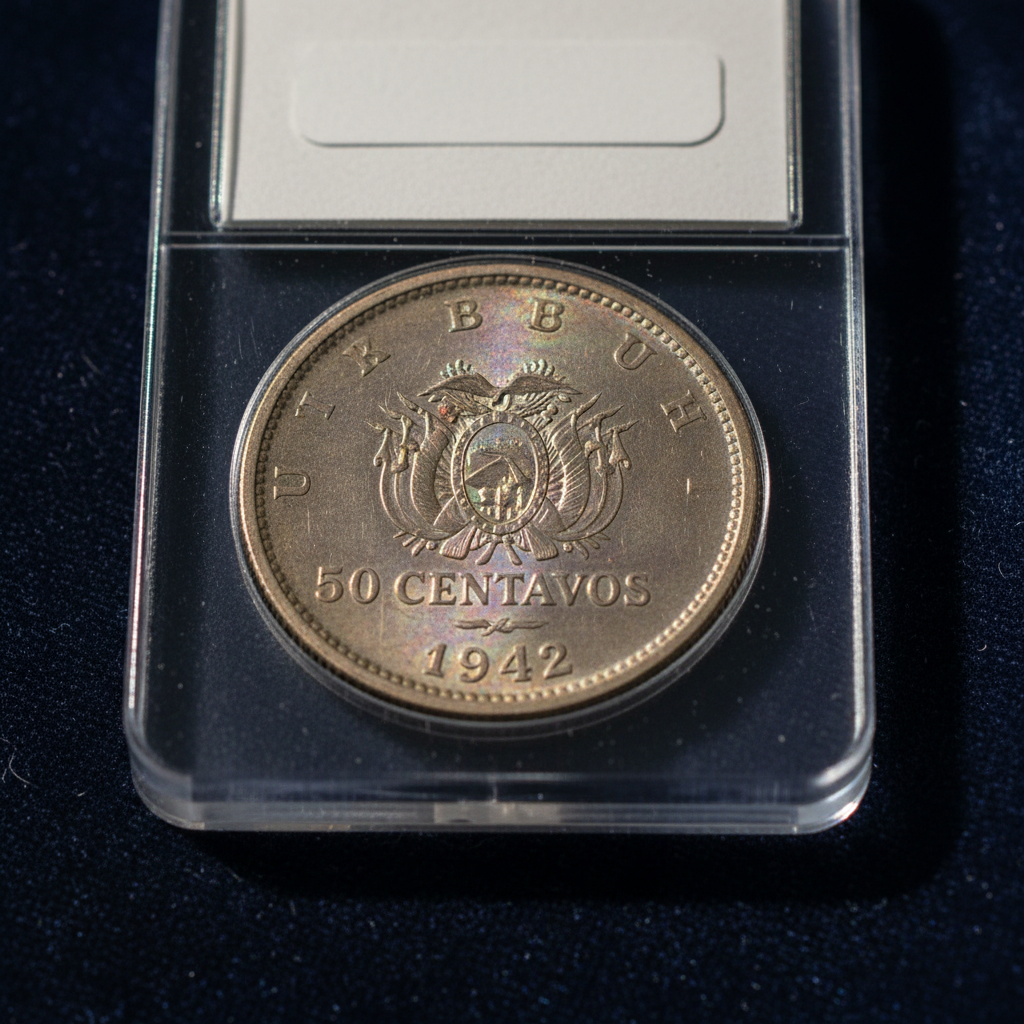
There is exactly one known example of this coin. That fact alone places the Bolivia 1942 50 Centavos struck on a U.S. wartime nickel planchet in a category occupied by almost nothing else in twentieth-century numismatics — a genuine, documented error of geopolitical circumstance, minted at the Philadelphia Mint during the most logistically strained years of World War II.
The piece isn't a fantasy coin. It isn't a counterfeit. It is the product of a specific, congressionally authorized program that permitted the U.S. Mint to produce coinage on behalf of foreign nations — and a single planchet that ended up in entirely the wrong press at entirely the right moment in history.
How a Bolivian Coin Got a U.S. Wartime Soul
By 1942, the Philadelphia Mint was running at a wartime pace that would strain any facility. Congress had granted the Mint broad authority to strike coins for allied and friendly foreign governments, a program that produced legitimate coinage for dozens of nations throughout the 1940s. Bolivia's 1942 50 Centavos issue was part of that arrangement.
Simultaneously, the U.S. was in the middle of its own wartime metallurgical pivot. The standard copper-nickel composition of the American five-cent piece was suspended in 1942 in favor of a 35% silver alloy — the so-called wartime nickel — to redirect nickel toward military production. Those planchets were being prepared, handled, and moved through the same facility producing foreign coinage.
The result: one Bolivian 50 Centavos die came down on a U.S. wartime nickel planchet. The diameter and weight specs were close enough that the press accepted it. The strike landed. And somehow, the coin escaped quality control and left the Mint.
Eighty-plus years later, it remains the only documented example of this specific pairing.
The Error Coin Market and Why Unique Pieces Defy Conventional Grading Logic
Pricing a coin with a population of one is more art than science, and the error coin market has its own gravitational rules. Major auction houses — Heritage Auctions, Stack's Bowers, and Goldberg Coins among them — have long demonstrated that true unique errors command premiums that bear almost no relationship to the underlying type coin's value. A common-date issue in AU-58 might catalog at $40. The same date, struck on a wildly wrong planchet, certified and documented? The floor is wherever the most motivated bidder decides it is.
The Bolivia 1942 50 Centavos in standard form is not a rare coin. The Philadelphia Mint produced the issue in quantity, and circulated examples are readily available. What makes this piece extraordinary is entirely the planchet beneath the strike — the wrong metal, the wrong country, the wrong denomination, all colliding in a single object that the Mint's own oversight failed to catch.
For context, off-metal errors on U.S. coinage from the same era — Lincoln cents struck on dime planchets, wartime nickels struck on cent planchets — routinely bring four to five figures depending on grade and documentation. A foreign coin struck on a U.S. planchet, with a population of one and a fully traceable wartime backstory, operates in a different conversation entirely.
- Planchet composition: U.S. wartime nickel alloy (56% copper, 35% silver, 9% manganese)
- Intended composition: Bolivian 50 Centavos standard (copper-nickel)
- Mint facility: Philadelphia, under congressional foreign coinage authority
- Known population: 1 (unique)
- Year of issue: 1942
What Unique Really Means at Auction
The word unique gets abused in collectibles. It appears in press releases for items that are merely scarce, or low-pop, or simply unsold. This coin's uniqueness is structural — there is no second example waiting in a European collection or a Bolivian government archive. The circumstances that produced it were accidental, brief, and unrepeatable.
When genuinely unique coins with strong provenance and historical narrative come to market, the results tend to surprise even seasoned dealers. The 1974-D aluminum cent, unique by legal circumstance, has been valued in the millions. The 1943 copper Lincoln cent — not unique, but extremely rare — has crossed $1 million at Heritage. The Bolivia piece operates in a different tier of fame, but the underlying principle is identical: scarcity plus story plus documentation equals a market that sets its own ceiling.
Any collector acquiring this coin isn't buying a Bolivian 50 Centavos. They're buying a piece of wartime Mint logistics, a documented failure of quality control, and the singular satisfaction of owning something that, by every reasonable expectation, should not exist. That's a value proposition that doesn't expire.