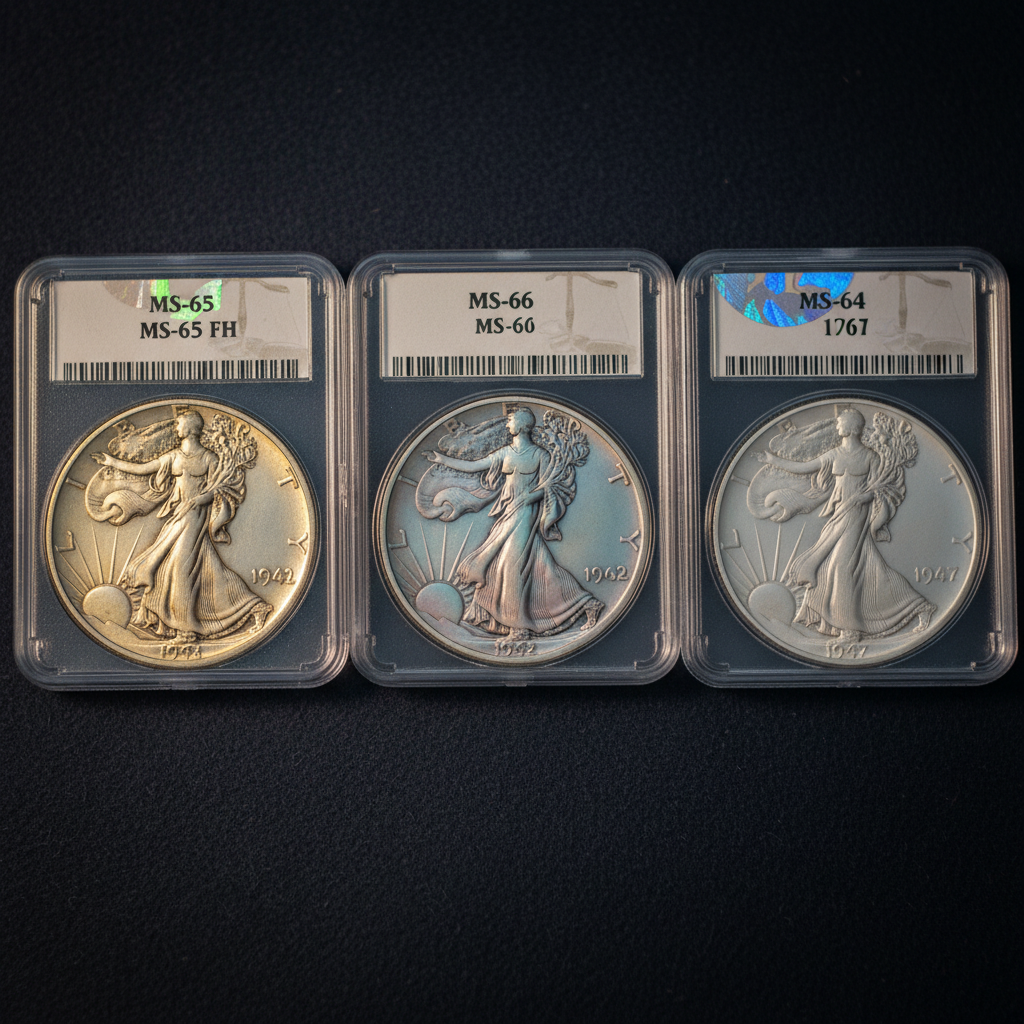
The Walking Liberty Half Dollar is one of the most beautiful coins ever struck by the U.S. Mint — and one of the most punishing series to complete. Thirty-one years of production, from 1916 to 1947, across three mints, with a handful of early dates that can drain a serious budget before you've filled a third of the album. The full date-and-mint set, assembled in circulated grades, can easily run $10,000 to $20,000 or more once you account for the key dates. In Mint State, you're looking at multiples of that.
Which is exactly why the short set deserves serious attention.
What the Short Set Actually Is
The Walking Liberty short set concentrates on coins struck from 1941 through 1947 — the final chapter of the series. During this stretch, production volumes were high, key dates are scarce but not ruinous, and the coins are attainable in grades that actually display the design's full glory. No 1916-S at $1,500 in Fine. No 1921 or 1921-D — the two genuine stoppers of the series, with the 1921-D routinely trading above $2,000 in VG and climbing sharply from there in higher circulated grades.
The short set sidesteps all of that. The core run from 1941 onward includes Philadelphia, Denver, and San Francisco issues, most of which are affordable in MS-63 to MS-65 grades. A collector working this window can build a legitimately impressive, fully graded set — think PCGS or NGC holders throughout — for somewhere in the range of $1,500 to $4,000 depending on grade targets and whether you're chasing registry-level coins or simply want a presentable, coherent collection.
The one relative challenge within the short set is the 1941-S, which sees a meaningful price jump in gem grades due to its notoriously soft strike. A well-struck MS-65 example can bring $400 to $600 at auction, and strong specimens have exceeded that at Heritage and Stack's Bowers. The 1942-S presents similar strike issues. These aren't key dates in the traditional sense — they're condition rarities, which is a different and arguably more interesting collecting challenge.
The Design Makes the Case
Adolph Weinman's 1916 design remains a benchmark of American numismatic art. Liberty strides forward, draped in an American flag, arm extended toward a rising sun. The reverse features a perched eagle, wings spread, set against a mountain backdrop. It is not a subtle coin. In MS-65 or better with full, sharp strikes, the Walking Liberty half dollar is a legitimate display piece — the kind of coin that stops non-collectors mid-conversation.
That aesthetic quality matters for long-term collecting value. Series with strong visual appeal maintain collector demand across market cycles. The Walking Liberty has been a foundation of U.S. type collecting for decades, and the short set format makes it accessible to collectors who don't have the appetite — financial or otherwise — for a full registry run.
For context: a PCGS MS-65 example of the common-date 1944 Philadelphia issue typically trades in the $80 to $120 range. The 1943-S in MS-65 runs closer to $150 to $250. Even the toughest short-set coins in gem grades are priced within reach of a collector operating on a disciplined monthly budget.
Building It Right
The short set works best when approached with grade consistency as the primary goal. A set where every coin grades MS-64 or better, all in matching PCGS or NGC holders, tells a coherent story and holds up well for resale or future registry submission. Mixing raw coins with graded examples, or chasing one MS-67 while accepting MS-62s elsewhere, undermines both the visual and investment logic.
Population data is worth consulting before you buy. PCGS and NGC both publish online pop reports, and for short-set dates in MS-66 and above, populations thin out quickly — creating legitimate scarcity at the top end that supports premium pricing. The 1946-S in MS-67, for instance, has a combined population in the low double digits across both services, making a gem-quality example a meaningful numismatic acquisition, not just a type coin.
The short set isn't a compromise. It's a focus. And in a hobby where scope creep and key-date anxiety derail more collections than budget constraints ever do, that focus is worth something.