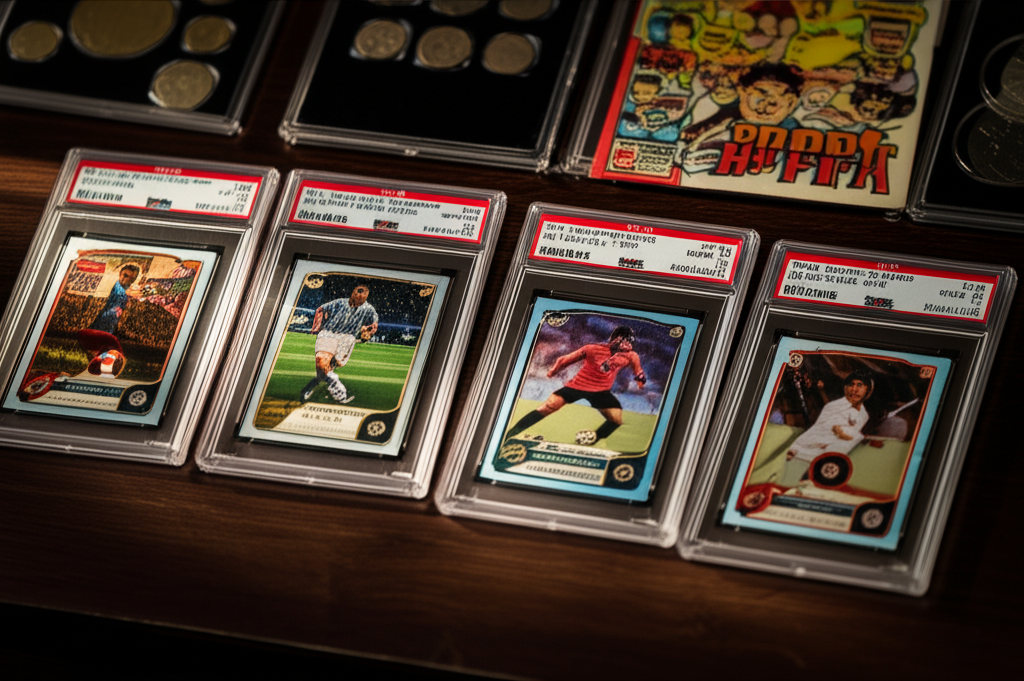
There's a moment every serious collector remembers — the first time they held a slab and realized they weren't just holding a card, they were holding a market. For a generation of American hobbyists, that moment happened with basketball or baseball. But right now, in 2024, the collectors who are quietly building the most asymmetric positions in the graded card market aren't chasing Wembanyama rookies or vintage Mantles. They're chasing Erling Haaland. They're chasing Kylian Mbappé. They're chasing Pedri. And if the data is any guide, they're about to be very, very right.
The Setup: Why Soccer Cards Are a Structural Opportunity
Let's start with the macro picture, because it's impossible to understand the soccer card market without understanding what's happening to soccer itself in North America. Major League Soccer's media rights deal with Apple TV+, signed in 2022 for a reported $2.5 billion over ten years, was the first signal that something tectonic was shifting. Then came Lionel Messi's Inter Miami signing in July 2023 — a moment that didn't just move the needle, it shattered it. Apple TV+ reported a 70% surge in MLS Season Pass subscriptions within weeks of the announcement. Messi's first home game drew viewership numbers that eclipsed the NBA Finals in certain demographics.
Now layer on what's coming: the 2026 FIFA World Cup, co-hosted by the United States, Canada, and Mexico. Sixteen American cities will host matches. The tournament is projected to generate over $5 billion in economic activity on U.S. soil alone. This is not a peripheral event for American sports fans — it will be the single largest sporting event ever held in North America, full stop. And when 48 nations play in front of sold-out American stadiums for a month, the casual sports fan who has never thought about a Panini Prizm is going to start thinking about a Panini Prizm.
This is the structural setup. The demand curve for soccer cards isn't just rising — it's about to be hit with a catalyst that the baseball and basketball markets never had: a global mega-event landing on American soil at the precise moment when graded card collecting is mainstream. The infrastructure is there. The audience is growing. The product exists. What's missing is the price discovery that happens when those three things fully collide.
And here's what makes this a collector's opportunity rather than just a speculator's trade: the graded population numbers on elite soccer cards are, by the standards of basketball and baseball, laughably thin. That thinness is about to matter enormously.
The Data Doesn't Lie: Auction Results and Price Trends
Thesis-driven investing without data is just storytelling. So let's talk numbers — real auction results, real comps, real trends.
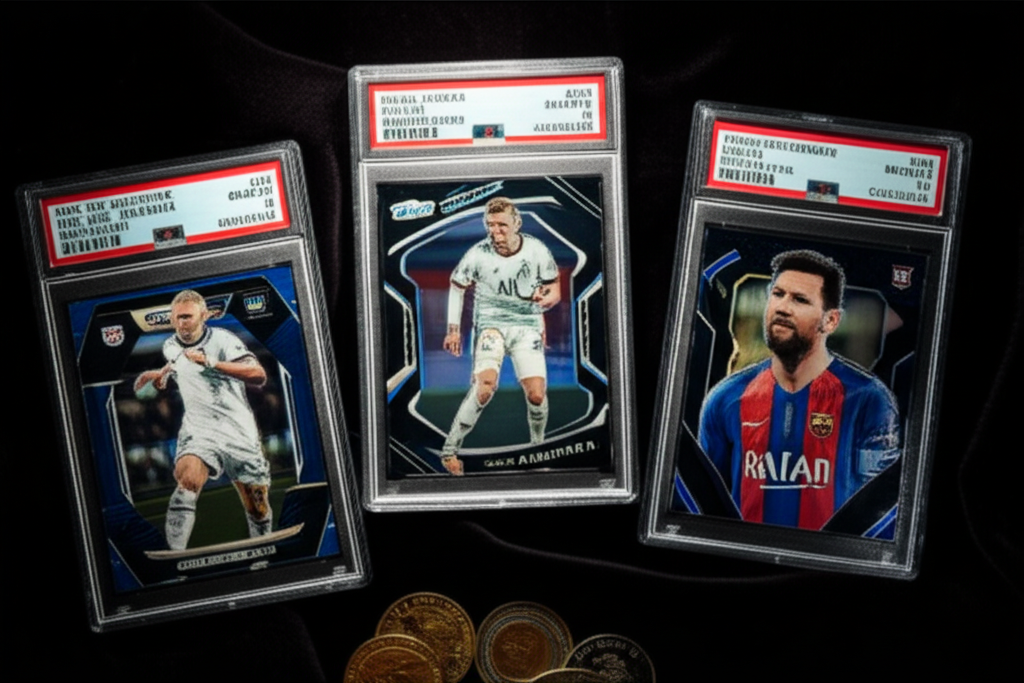
The 2018 Panini Prizm FIFA World Cup Kylian Mbappé #80 PSA 10 is arguably the benchmark card for this entire conversation. In early 2021, at the height of the broader card market boom, this card was trading hands on eBay and PWCC for $8,000 to $12,000. The market corrected in 2022, as it did across virtually every collectibles category, and the card dipped to the $3,500 to $5,000 range through most of 2022 and into early 2023. Then something interesting happened. Post-Messi-to-Miami, post-World-Cup-announcement momentum began rebuilding the floor. By Q4 2023, Heritage Auctions saw a PSA 10 example close at $7,200. A February 2024 Goldin sale brought $8,800. The card has essentially reclaimed its pre-correction highs — without the 2026 World Cup catalyst having fired yet.
Mbappé's trajectory is instructive, but Haaland's is arguably more exciting from a pure value standpoint. The 2019-20 Topps Chrome UEFA Champions League Erling Haaland Rookie Autograph PSA 10 — his true widely-recognized rookie — traded in the $1,200 to $1,800 range through much of 2022. Post-Champions League title with Manchester City, post-Premier League Golden Boot, that same card has been consistently clearing $3,500 to $5,500 at Heritage and on PWCC's marketplace. A BGS 9.5 example — which carries a different premium dynamic than PSA 10, a nuance we'll get to — sold on Goldin in January 2024 for $4,100.
Pedri's 2020-21 Panini Prizm Pedri #248 PSA 10 is the sleeper in this conversation. A Barcelona academy product, Ballon d'Or contender, and the kind of technically gifted midfielder that the global soccer cognoscenti obsess over — his PSA 10 Prizm was trading at under $400 as recently as mid-2023. Recent Heritage sales have it in the $650 to $900 range, with one outlier at $1,150 in March 2024. The card hasn't been discovered yet by the American mainstream. That's the opportunity.
Compare these price trajectories to analogous basketball rookies. A 2018-19 Panini Prizm Luka Dončić PSA 10 — a card with obvious structural comparisons to the Mbappé Prizm — has traded between $9,000 and $18,000 over the same period. The Mbappé card, of a player with comparable global fame and arguably greater international recognition, trades at a persistent discount. That discount is the thesis in a single data point.
"The soccer card market is where basketball cards were in 2017 — the infrastructure of grading and authentication is established, the talent pool is generational, but the American collector base hasn't fully arrived yet. When it does, the repricing will be significant."
The PSA Population Problem — and Why It's Actually Good News
Here's where the analysis gets genuinely interesting, and where I'll make a claim that might surprise you: the relatively low PSA population numbers on elite soccer cards are not a sign of weakness. They are the single most bullish data point in the entire soccer card investment thesis.
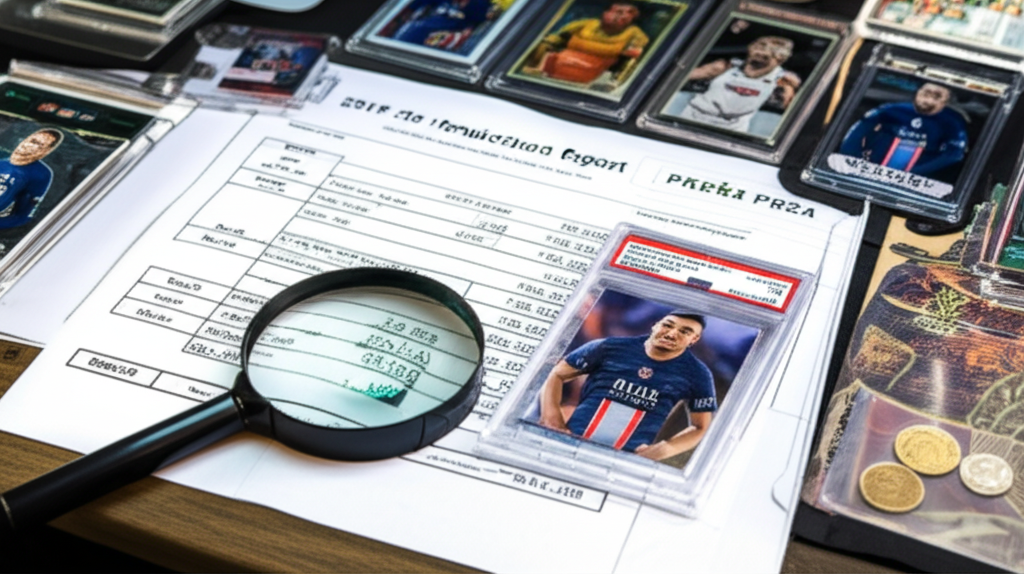
Pull up the PSA Population Report for the 2018 Panini Prizm FIFA World Cup Mbappé #80. As of Q1 2024, PSA has graded approximately 1,847 total copies, with 312 receiving a PSA 10. That's a PSA 10 rate of roughly 17% — consistent with Prizm's typical centering and surface quality issues. Now compare that to the 2018-19 Panini Prizm Luka Dončić #280: PSA has graded over 14,000 copies, with nearly 2,100 PSA 10s in the population. The Dončić card has been submitted in far greater volume because American collectors recognized its importance immediately. The Mbappé card's lower population reflects the fact that American collectors were slower to the trigger.
But here's the critical dynamic: as the American soccer audience grows and the 2026 World Cup approaches, submission volume for key soccer cards is going to accelerate. We're already seeing it. PSA reported that soccer card submissions grew by approximately 34% year-over-year in 2023, the fastest growth rate of any sport in their submission pipeline. When those submissions come back and the PSA 10 population grows, two things happen simultaneously: the raw card inventory shrinks (because submitters are pulling from the available supply), and the graded market deepens with more liquidity.
The BGS dynamic adds another layer of complexity worth understanding. Beckett Grading Services uses a subgrade system — centering, corners, edges, surface — that produces a composite grade. A BGS 9.5 (Gem Mint) is widely considered the BGS equivalent of a PSA 10, but the market treats them differently. For soccer cards specifically, PSA 10 commands a premium over BGS 9.5 in most cases, typically 15% to 30% higher on comparable cards. This is partly a liquidity premium — PSA's marketplace integration and brand recognition in the American market remains dominant — and partly a collector preference that has calcified into market convention. For soccer cards targeting the American collector base, PSA 10 is the grade you want.
CGC, which has expanded aggressively into trading cards, presents an interesting alternative. Their card grading operation has grown substantially, and for certain soccer card sets — particularly vintage Panini stickers and early Topps soccer issues — CGC has been gaining traction. But for the modern Prizm and Chrome era cards that represent the primary investment opportunity, PSA remains the gold standard that moves markets.
The population story also reveals which cards to prioritize. Sets with naturally low PSA 10 rates due to manufacturing quality — certain Panini Mosaic runs, some Select parallels — create artificial scarcity that supports price floors. When a card has a PSA 10 population of under 50 copies and the player becomes a household name in the American market, the repricing can be violent and rapid. That's not speculation — that's supply and demand with a very specific, very identifiable catalyst on the calendar.
The Contrarian Case: What the Bears Get Wrong
Good analysis requires engaging with the strongest counterarguments. The bears on soccer cards make several points that deserve serious consideration — and that I believe the data ultimately refutes, though not dismisses.
Bear Case #1: Soccer has always been "the next big thing" in America and never fully arrives. This is the most intellectually serious objection, and it's rooted in real history. Soccer's American breakthrough has been predicted after every World Cup since 1994. The MLS has existed for nearly thirty years without triggering a baseball-level cultural moment. Why is this time different?
My answer: the infrastructure of fandom has fundamentally changed. In 1994, if you wanted to follow the Premier League, you were watching grainy VHS recordings. Today, every Premier League match is available live on Peacock, every Champions League match on Paramount+, every MLS match on Apple TV+. The friction of being a soccer fan in America has essentially been eliminated. Streaming has done for soccer what cable did for the NFL in the 1970s. And the demographic reality is stark: soccer is the most-played youth sport in America, and those youth players are now in their 20s and 30s — prime collecting age. The generational shift is real and measurable.
Bear Case #2: Soccer card products lack the brand cachet of Topps baseball or Panini basketball. This is fair, and it's a real friction point. The soccer card product ecosystem is fragmented — Panini holds licenses for major international tournaments and leagues, Topps (now owned by Fanatics) holds UEFA Champions League rights, and the licensing landscape is messier than American sports. Some collectors find it confusing.
But here's the contrarian read: that fragmentation is actually creating value pockets. Because the product ecosystem is less organized, price discovery is less efficient. Cards that would be immediately recognized as key rookies in basketball or baseball are flying under the radar in soccer. The collector who does the homework — who knows that the Topps Chrome UEFA Champions League is the premier chrome product, that Panini Prizm World Cup is the flagship international set, that Topps Chrome MLS is the key domestic rookie card source — has a genuine informational edge over the mass market. That edge closes as the market matures. The time to exploit it is now.
Bear Case #3: The 2022 correction proved soccer cards are just as vulnerable to hype cycles as everything else. Absolutely true, and I won't pretend otherwise. The 2021-2022 card market was a mania, and soccer cards participated in it. Cards that were trading at 3x-5x their fundamental value came back to earth. That correction was healthy and necessary.
But look at where the floor settled for the best soccer cards. The Mbappé 2018 Prizm PSA 10 found support around $3,500 — still dramatically higher than pre-pandemic levels of $400 to $600. The market didn't return to 2019 prices. It found a new, higher equilibrium. That's what happens in a market with genuine underlying demand growth, as opposed to pure speculative froth. The floor rising after a correction is a bullish signal, not a bearish one.
What to Buy, What to Avoid, and Where to Look
Let me be direct here, because this is where a lot of market commentary becomes frustratingly vague. I'm going to give you specific, actionable intelligence — the cards I'd be building positions in, the ones I'd avoid, and where to source them.
The Core Positions:
- 2018 Panini Prizm FIFA World Cup Kylian Mbappé #80 PSA 10 — The benchmark card. Buy on weakness, target the $6,500-$7,500 range if you can find it. This card will be a four-figure grail by 2027 if the World Cup delivers as expected.
- 2019-20 Topps Chrome UEFA Champions League Erling Haaland RC Auto PSA 10 — The best modern soccer rookie autograph available at non-insane prices. At $4,000-$5,500, this is still accessible. Haaland is 23 years old and already has a Champions League title and Premier League Golden Boot. His career arc has decades of runway.
- 2021-22 Panini Prizm Pedri PSA 10 — The highest-upside, lowest-cost position in this thesis. Under $1,000 for a player who will almost certainly be a Ballon d'Or winner before 2028. The American market hasn't priced in his talent level yet.
- 2019-20 Topps Chrome MLS Christian Pulisic PSA 10 — The American angle. If the World Cup generates the domestic soccer boom I'm predicting, the best American player's key card becomes a must-own for a huge segment of new collectors. Currently trading in the $800-$1,200 range. That's the entry point.
What to Avoid:
- Panini sticker peel versions and low-end base cards of any player — the grading economics don't work and the collector demand is thin.
- Cards of players without Champions League or World Cup exposure — domestic-only stars don't translate to the global collector base that drives price discovery.
- Over-graded BGS 9 cards being marketed as equivalent to PSA 10s — they're not, the market has spoken clearly on this distinction.
- Ungraded raw cards in this category unless you have exceptional grading expertise — the authentication and condition risk is too high relative to the cost savings.
Where to Source: Heritage Auctions runs regular sports card sales with strong soccer card representation — their buyer's premium is 20%, factor that in. Goldin Auctions has been increasingly active in the soccer space and their platform attracts serious bidders. PWCC Marketplace offers a secondary market with more price transparency than raw eBay listings. For raw cards pre-submission, reputable eBay sellers with strong feedback histories remain viable, but verify, verify, verify. Stack's Bowers, traditionally a coin and currency house, has been expanding into cards and occasionally surfaces interesting soccer inventory at prices that haven't been fully discovered by the card-specialist platforms.
The submission strategy matters too. Current PSA turnaround times for standard service are running 45 to 90 days depending on tier. If you're buying raw cards now with a 2026 World Cup thesis in mind, you have time — but don't wait until 2025 to submit. The submission surge that will precede the tournament will create backlogs that make current wait times look quaint.
- The structural setup is unprecedented: The 2026 FIFA World Cup on U.S. soil, combined with the Messi effect and streaming accessibility, is creating a once-in-a-generation demand catalyst for soccer cards.
- The pricing gap is real and measurable: Comparable soccer cards trade at 40-60% discounts to NBA equivalents — a discount that is not justified by talent level or global recognition, only by American collector adoption lag.
- PSA 10 populations are thin and getting thinner relative to growing demand: The supply/demand math on elite soccer card PSA 10s is increasingly favorable as submission volume rises and raw card inventory is absorbed.
- The correction floor is higher than pre-pandemic levels: The 2022 pullback proved underlying demand, not speculative fragility. Cards found new, higher equilibria.
- Specific cards, specific grades, specific timing: Mbappé 2018 Prizm PSA 10, Haaland Chrome UCL RC Auto PSA 10, and Pedri Prizm PSA 10 represent the best risk-adjusted positions in the thesis.
- Submit raw cards now: Don't wait for the pre-World Cup submission surge to create PSA backlogs. The window for efficient grading turnaround is open today.
What This Means for Collectors
I want to be honest about what this thesis is and isn't. It isn't a guarantee. The 2026 World Cup could underperform as a cultural moment. Mbappé could get injured. The broader card market could face another correction driven by macroeconomic headwinds. Collectibles are illiquid assets, and anyone who tells you otherwise is selling something.
But the best opportunities in collecting have always looked like this: a genuinely world-class asset class that is temporarily undervalued because the primary market hasn't caught up to the global reality. Japanese collectors have known Mbappé's value for years. European collectors have been building Haaland positions since his Salzburg days. The American collector — the one with the deepest pockets and the most developed graded card infrastructure — is only now arriving at the party.
The 2026 World Cup isn't just a soccer tournament. For the graded card market, it's a marketing event of extraordinary scale that will introduce millions of American sports fans to players they'll want to own a piece of. When that moment arrives, the collectors who built their positions quietly in 2024 and 2025 will be the ones with the inventory, the grades, and the patience to let the market come to them.
That's not speculation. That's collecting with conviction. And in this market, right now, soccer cards are where the conviction belongs.