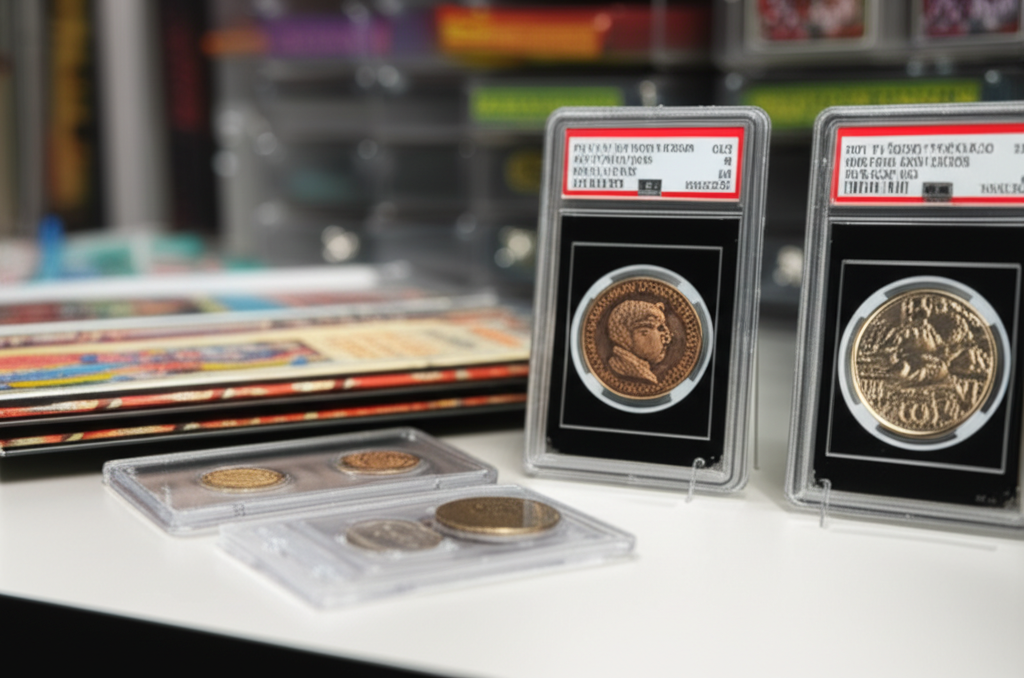
The difference between a collector who overpays and one who doesn't often comes down to a single variable: knowledge. Not gut instinct. Not a dealer's word. Knowledge — the kind that only comes from deep, sustained reading in the literature of the field.
Numismatics has one of the richest bibliographic traditions in all of collecting. The discipline has been documented, catalogued, and debated in print for centuries. Auction catalogues from Stack's Bowers, population reports from PCGS and NGC, die variety references, grading guides, historical monographs — the serious collector who ignores this body of work is leaving money on the table, and probably doesn't know it.
The Literature Is the Market Intelligence
In trading cards, market intelligence lives in real-time platforms — eBay sold listings, PSA pop reports, Goldin auction results. Coins work differently. The numismatic market is older, more opaque, and far more dependent on specialized knowledge that simply doesn't surface in a five-second Google search.
Take die varieties. A 1955 Doubled Die Lincoln cent in MS-64 Red is worth roughly $1,500 to $2,000 at current market. A visually similar 1955 cent without the doubled die is worth face value plus a few dollars of copper melt. The difference is invisible to the untrained eye — and the only way to train that eye is through reference literature like A Guide Book of United States Coins (the Red Book) or Cherrypickers' Guide to Rare Die Varieties by Fivaz and Stanton, now in its sixth edition.
That's not a hypothetical. Dealers at every major coin show will tell you that misidentified varieties still move through the market regularly. The collector who has done the reading catches them. The one who hasn't funds someone else's retirement.
The same logic applies to grading. NGC and PCGS slabs provide a grade, but they don't explain the reasoning, the strike characteristics of a given series, or the eye appeal standards that separate a problem-free coin from a cleaned one. The Official ANA Grading Standards for United States Coins remains the foundational text — but it works best alongside series-specific references that address the quirks of, say, early American copper or Seated Liberty coinage.
The Reference Shelf That Actually Moves the Needle
Building a numismatic library doesn't require a rare book budget. The most essential titles are widely available and relatively affordable. A core shelf might include:
- A Guide Book of United States Coins (Whitman Publishing) — updated annually, the baseline price and identification reference for U.S. coinage
- Cherrypickers' Guide to Rare Die Varieties, Vol. I & II — indispensable for anyone hunting repunched mintmarks or doubled dies
- Official ANA Grading Standards for United States Coins — the grading bible, period
- United States Pattern Coins by Judd — essential for anyone exploring experimental and off-metal strikes
- Early American Cents by Sheldon — the foundational text for large cent collectors, and the origin of the Sheldon scale that became the modern 1–70 grading standard
- Series-specific references: Walking Liberty Half Dollars by Wiley and Bugert, Liberty Seated Coinage by Bowers, Morgan Dollar references by Leroy Van Allen
Auction catalogues deserve a mention here. Heritage Auctions and Stack's Bowers publish detailed lot descriptions that function as mini-essays on individual coins — their provenance, their die characteristics, their place in the population. Reading through past catalogues for a series you collect is one of the most efficient forms of market education available, and most are accessible online at no cost.
Knowledge Compounds Like Interest
There's a financial case to be made here, and it's straightforward. A collector who can identify a 1942/1 Mercury Dime overdate — currently valued at $500 to $700 in VF-20 — in a dealer's junk box priced at face value has turned a reference book purchase into a real return. That kind of find happens. It happens to prepared collectors.
But the argument for building a library goes beyond cherry-picking. The numismatic market rewards specialization. Collectors who develop genuine expertise in a series — who understand the die marriages, the mintage anomalies, the condition census — are better positioned to buy intelligently, sell confidently, and avoid the quiet losses that come from purchasing cleaned coins, improperly attributed varieties, or overgraded material.
Dr. William Sheldon built the 70-point grading scale in 1949 as part of his study of early American large cents. That scale now governs a multi-billion-dollar certified coin market. The infrastructure of modern numismatics was built by people who took the literature seriously. The collectors who follow their lead tend to fare considerably better than those who don't.
The coins have been around for centuries. The books explaining them have been accumulating almost as long. There's no excuse for not reading them.