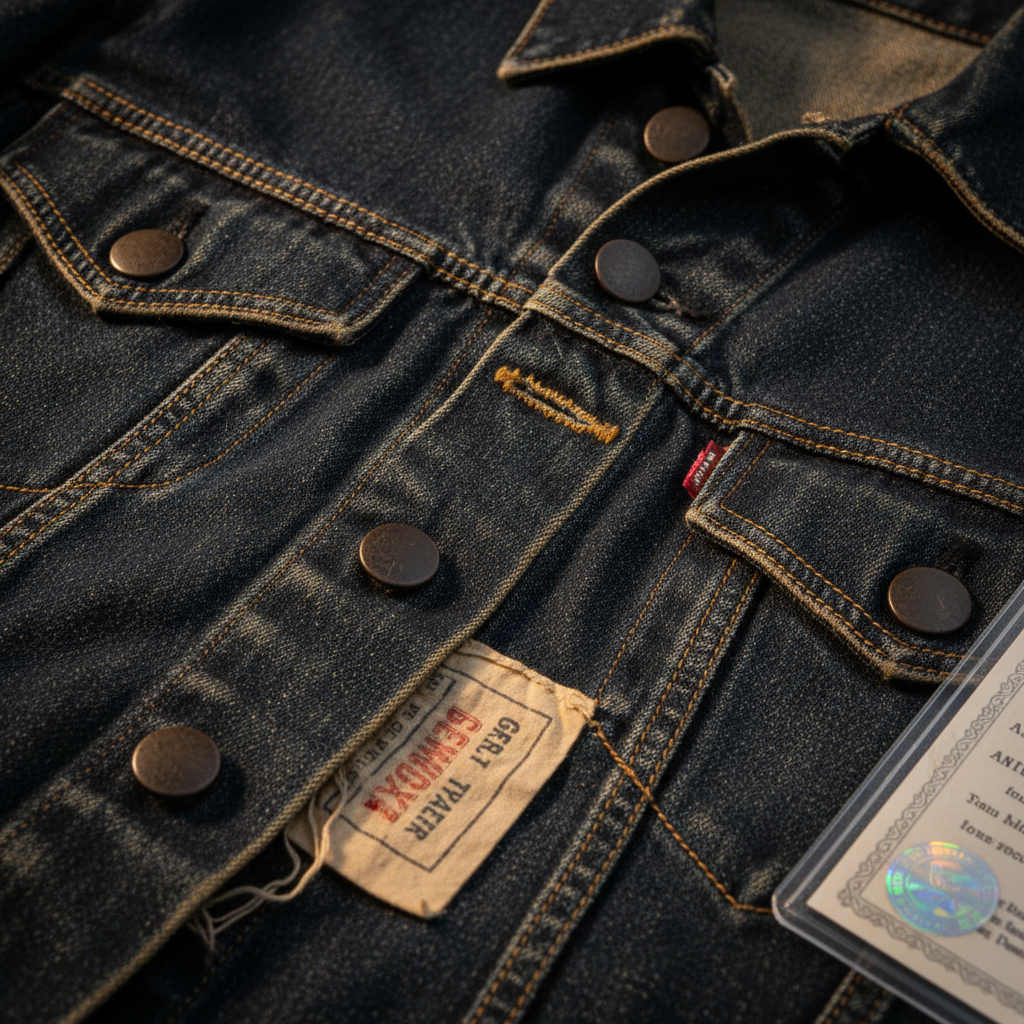
A denim jacket doesn't usually belong in the same conversation as a Honus Wagner T206 or a 1933 Goudey Babe Ruth. After this sale, that conversation needs to change.
A World War II-era Levi's denim jacket — bearing the physical evidence of wartime fabric rationing in every seam and panel — has sold for a price so extraordinary it earned official recognition in the Guinness Book of World Records as the most valuable denim jacket ever sold at auction. The exact hammer price has not been independently confirmed at press time, but the Guinness certification alone signals a figure that almost certainly eclipses any prior comp in the vintage denim category by a significant margin.
Why Wartime Denim Commands a Premium
To understand the magnitude of this sale, you need to understand what wartime rationing did to American manufacturing — and what it did to Levi Strauss & Co. specifically.
During World War II, the U.S. War Production Board imposed strict limitations on the use of materials deemed essential to the war effort. For denim garments, that meant the elimination of decorative stitching, the removal of the iconic arcuate back-pocket stitching (replaced temporarily with painted-on versions), and reductions in metal hardware. Levi's produced a version of its workwear during this period that was, by design, stripped down — utilitarian in a way the brand's peacetime output never was.
That austerity is exactly what makes surviving examples so compelling to collectors. These aren't just old jackets. They're physical documents of a specific moment in American industrial and social history, manufactured under constraints that no longer exist and will never exist again in the same form. Condition, completeness of period-correct details, and provenance all drive value — and a jacket that checks every box is genuinely rare.
The vintage denim market has been quietly building toward a moment like this for years. Japanese collectors, in particular, have driven sustained demand for pre-war and wartime American workwear since at least the 1980s, treating pieces like this Levi's jacket with the same reverence Western collectors apply to pre-war baseball cards or early American coins. That cross-cultural collector base has deepened the market considerably.
The Record in Context
For reference, the previous benchmarks in vintage denim were already eye-opening. A pair of 19th-century Levi's 501 jeans recovered from a Nevada mine shaft sold for $87,000 in 2022. Rare deadstock denim from the 1930s and 1940s regularly clears five figures at specialist auction houses and through private dealers who cater to the Japanese vintage market. The trajectory has been consistently upward.
A Guinness-certified world record in this category means the jacket in question didn't just edge past those comps — it broke the ceiling entirely.
What separates record-setting pieces in any collectibles category is usually a combination of condition, provenance, and timing. In vintage Americana — which is effectively what serious denim collecting is — condition is everything. A wartime Levi's jacket with original hardware intact, period-correct stitching alterations, and no post-production alterations is the equivalent of a PSA 10 in the trading card world. The population of surviving examples at that level is vanishingly small.
The rationing details are the authentication anchor here. Collectors and authenticators look for the specific construction compromises mandated by wartime regulations — the absence of certain stitching patterns, changes to pocket configuration, and material substitutions that were documented and date-specific. A jacket that displays all of those markers consistently is not something you can fake convincingly, which gives the category a natural floor of authenticity that some other collectibles lack.
What This Means for the Vintage Americana Market
Records like this don't exist in a vacuum. When a single item in a category achieves Guinness-level recognition, it reframes the entire market around it. Dealers who have been sitting on wartime-era Levi's inventory will reassess their pricing. Collectors who dismissed vintage denim as a niche within a niche will start paying attention. And auction houses that haven't prioritized Americana workwear will begin actively sourcing it.
The analog in the card hobby is instructive: when a T206 Honus Wagner sold for $6.6 million in 2021, it didn't just set a record — it recalibrated how the entire pre-war card market was perceived by institutional money. A world record in any collecting category functions as a credibility signal to capital that wasn't previously paying attention.
Vintage denim has earned that signal. The category has the rarity, the authentication infrastructure, the international collector base, and now the headline sale to support serious investment-grade interest. The only question is whether the market has enough supply at the top tier to sustain that momentum — and based on what survives from the wartime production era, the answer is almost certainly no.
Scarcity, in the end, is always the story.