The Legendary Modern Decks 2026 box set has done something remarkable: it's made the Yu-Gi-Oh! extra deck affordable again. Released in early March, the L26D product has flooded the secondary market with high-utility reprints at common and rare rarity, sending prices on some of the game's most sought-after staples into freefall — and for budget-conscious collectors and competitive players, the timing couldn't be better.
This isn't the first time Konami has leaned on a reprint product to democratize access. The original Legendary Duelists series and the various Structure Deck waves have historically compressed prices on meta-relevant cards within weeks of release. But L26D appears to be hitting harder and faster than most. By the week of March 30, 2026, a meaningful portion of the competitive staple pool has settled below the $10 threshold — a watermark that, six months ago, would have seemed laughable for several of these cards.
S:P Little Knight Leads the Value Window
S:P Little Knight sits at the top of the list, and it's not particularly close. The card has been a fixture in competitive sideboards and main decks since its initial release, prized for its ability to banish monsters and spells without targeting — a mechanic that punishes a wide swath of the current format. Pre-L26D, near-mint copies of the original Secret Rare were trading between $35 and $50 depending on condition and platform. The L26D reprint version has collapsed that entry point to under $8 on TCGPlayer as of late March.
For collectors specifically, the calculus is interesting. The original Secret Rare retains its premium — collectors who want the foil treatment and the first-print provenance aren't switching to a common reprint. But for anyone who just needs the card functional in a deck, the L26D copy is an obvious call. The spread between the original and the reprint is now wide enough that it's essentially a two-tier market for the same card.
That dynamic isn't unique to Little Knight. It's the defining story of the entire March 2026 secondary market.
The Reprint Effect: How Deep Does It Go?
Reprint products create predictable price curves. The initial supply shock drives prices down sharply in the first two to four weeks post-release. Then one of two things happens: prices stabilize if demand absorbs the new supply, or they continue sliding if the reprint was heavy enough to permanently alter the population ceiling.
L26D appears to be a heavy reprint. The box set's distribution model — wide retail availability rather than hobby-exclusive allocation — means supply is genuinely broad. Cards that were previously gated by low print runs or set scarcity are now accessible at Target and Walmart, not just local game stores. That changes the supply equation in a way that a single tournament pack reprint typically doesn't.
The cards benefiting most from this window share a few characteristics:
- High competitive relevance across multiple archetypes
- Previously restricted to high-rarity printings in limited sets
- No functional errata or ban list concerns in the current format
- Broad applicability — cards that go in many decks, not just one
S:P Little Knight checks every box. So do several of its L26D companions. The practical result is that a player building a competitive deck in late March 2026 can assemble a functional extra deck for a fraction of what it would have cost at the start of the year.
What This Means for Collectors vs. Players
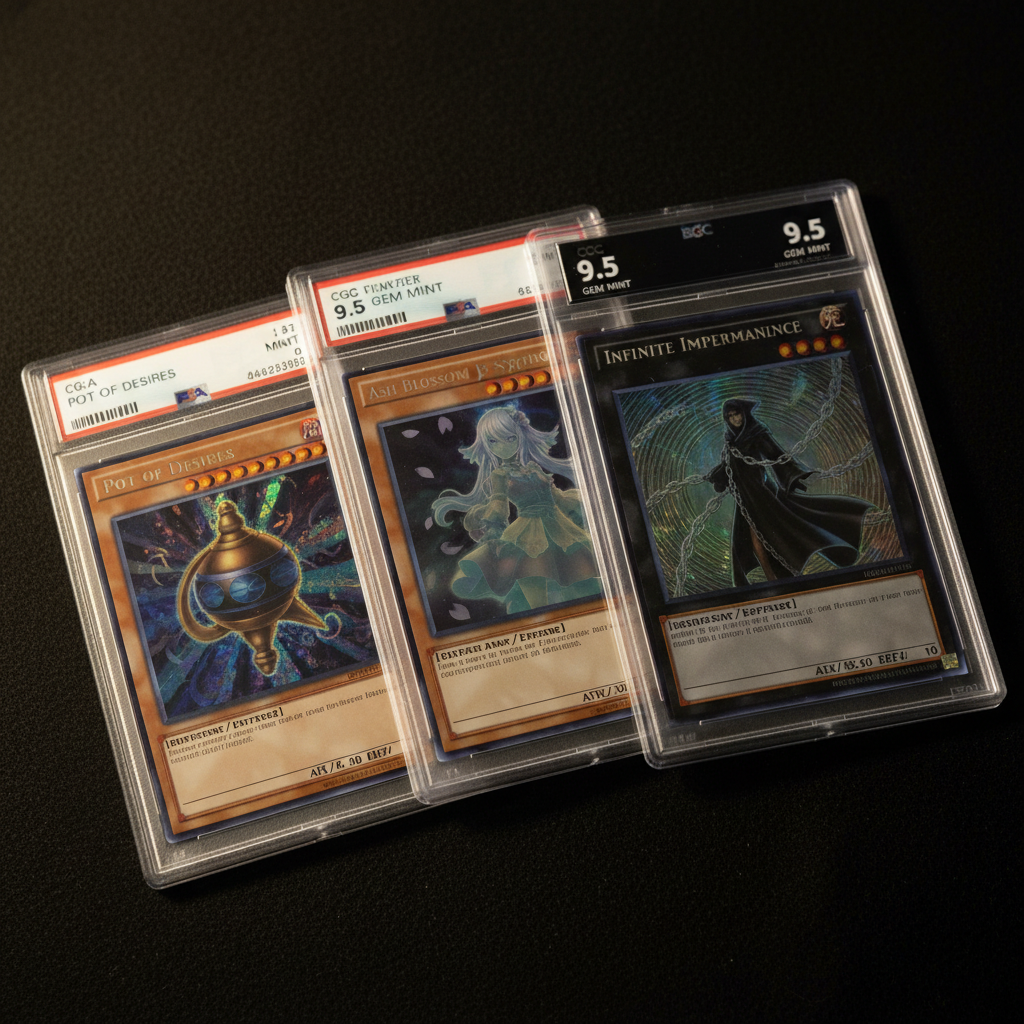
The collector and player markets for Yu-Gi-Oh! have always operated on parallel tracks, but L26D is widening the gap between them in a specific way. Original printings — particularly Secret Rare and Starlight Rare versions of the reprinted cards — are holding value better than expected. Graded copies through PSA and BGS of first-edition Secret Rares have seen minimal price movement, suggesting the collector floor is intact.
The compression is almost entirely in the raw, playable-copy segment of the market. That's actually a healthy bifurcation. It means the collectible premium is being preserved for high-grade, first-print material while the gameplay market becomes more accessible. Both communities get something out of it.
For dealers, the margin play right now is straightforward: acquire L26D copies at retail for player demand, and hold original Secret Rares for collector demand. The two populations want different things, and the price gap between them is currently wide enough to support both strategies.
March 2026 is, without exaggeration, one of the better entry points for Yu-Gi-Oh! staples in recent memory. Whether that window stays open through April depends entirely on how quickly L26D supply gets absorbed — and whether the next ban list announcement reshuffles the competitive relevance of the cards currently sitting comfortably under $10.