How to Grade Sports Cards: The Complete Guide (2026)
You've got a card you think might be special. Maybe it's a rookie you pulled from a pack in 1994 and kept in a shoebox. Maybe it's a recent hit you're not sure whether to flip or hold. Either way, you're asking the right question: should I get this graded?
Professional card grading has transformed the hobby. A raw card and a slabbed card of the same player, same year, same print run can differ in value by a factor of ten — sometimes more. But grading isn't free, it's not instant, and it isn't magic. Done wrong, it costs you money. Done right, it's one of the most powerful moves you can make as a collector or investor.
This guide covers everything: how grading works, who the major services are, what they actually evaluate, how to submit, and how to decide whether grading makes financial sense for your card.
What Is Sports Card Grading?
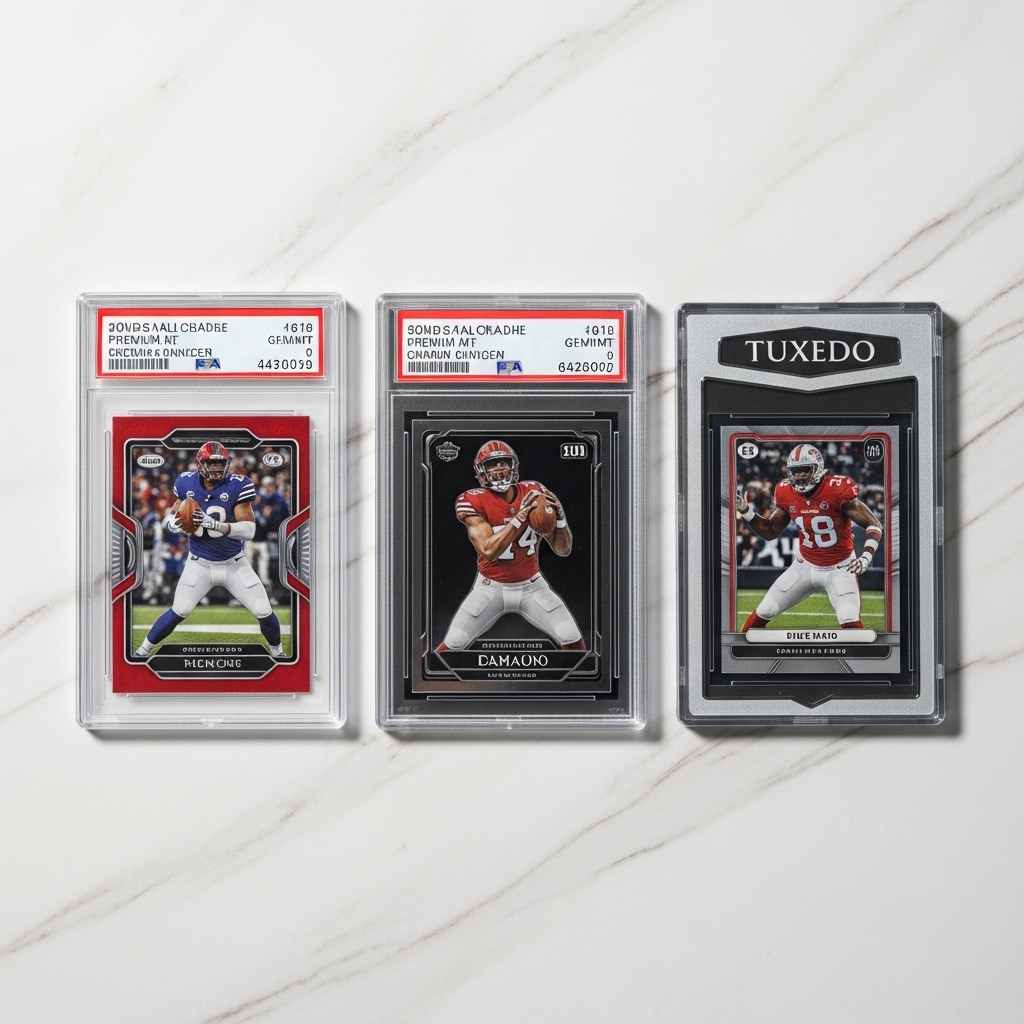
Professional card grading is the process of having an independent, third-party company evaluate your card's condition and seal it in a tamper-evident plastic case — commonly called a “slab” — with an official grade printed on the label.
The grade represents the card's condition on a standardized numeric scale. PSA, the dominant grading service, uses a 1–10 scale. A PSA 10 is Gem Mint — essentially perfect. A PSA 1 is Poor. Most cards that collectors bother grading land somewhere in the 6–9 range.
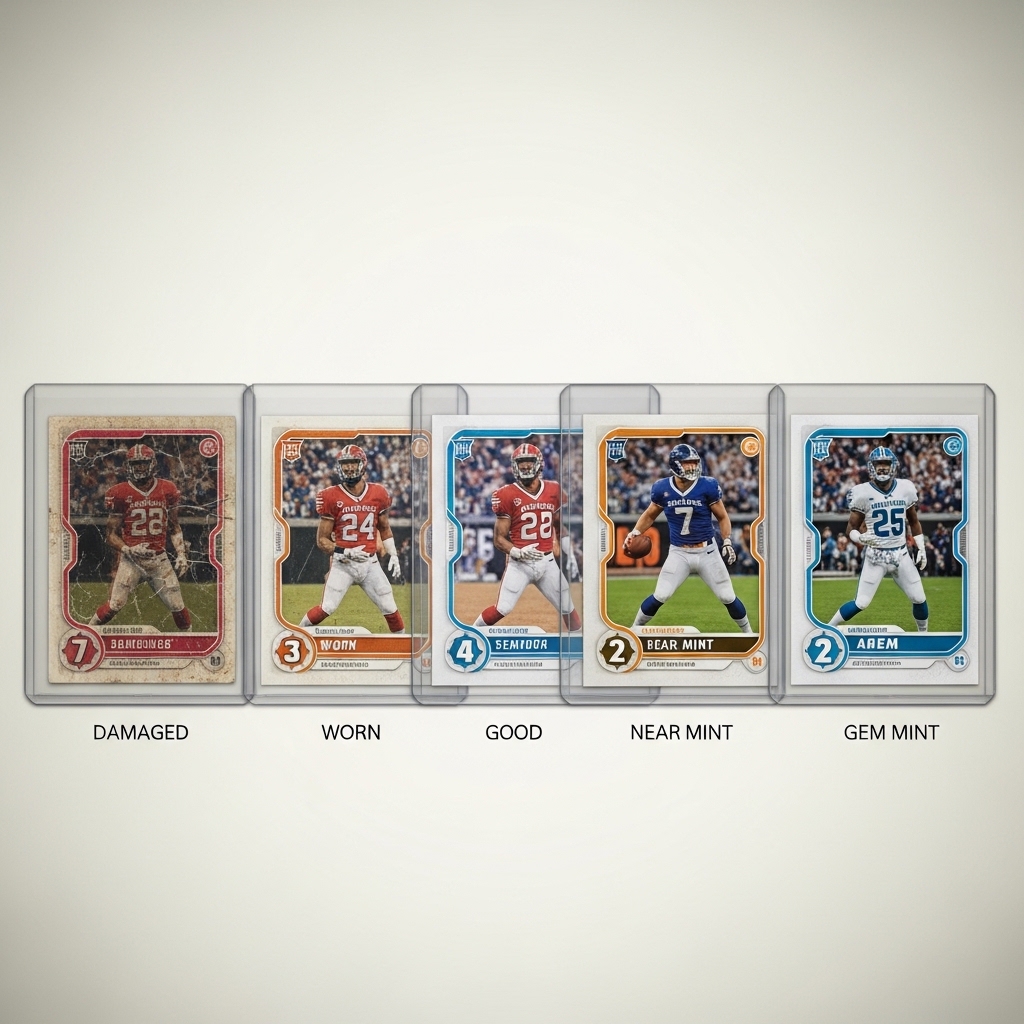
Why does this matter? Because grading solves a fundamental problem in the collectibles market: trust. When you buy a raw (ungraded) card, you're trusting the seller's eye and honesty. When you buy a slabbed card with a PSA 9 label, you're trusting an institution that has graded hundreds of millions of cards and puts its reputation on every grade it issues.
That trust is worth money. Real money.
The Four Criteria Graders Evaluate
This is where most collectors underestimate the process.
PSA doesn't just look at whether your card is scratched. They grade on four distinct criteria — and most collectors only think about one.
1. Centering
Centering measures how well the image is centered within the card's borders. It's expressed as a ratio — 60/40 means the left border is 60% of the right border. PSA's Gem Mint standard requires no worse than 55/45 on the front and 75/25 on the back.
Off-center cards are one of the most common reasons for grade deflation. You can have a card with zero surface scratches and razor-sharp corners — and still land a PSA 7 because a printing press hiccuped in 1987.
2. Corners
Corner wear is cumulative abuse: shuffling through a binder, a rubber band around the stack, one rough tumble from a table. Graders examine all four corners under magnification. PSA's 10 standard requires corners that appear “sharp and well-defined” with no perceptible wear.
The harsh truth: even cards you've stored carefully can have corner wear from the pack itself. Some print runs are notorious for soft corners straight from the factory.
3. Edges
Edges run along the perimeter of the card. Nicks, chips, and rough cuts are edge defects. Like corners, edge condition is assessed under magnification. A card can look pristine to the naked eye and have micro-chipping that costs it two grades.
4. Surface
Surface covers both the front and back of the card: scratches, print lines, stains, creases, and print defects. This is the broadest category — it includes everything from a fingernail scratch to a factory-fresh print spot.
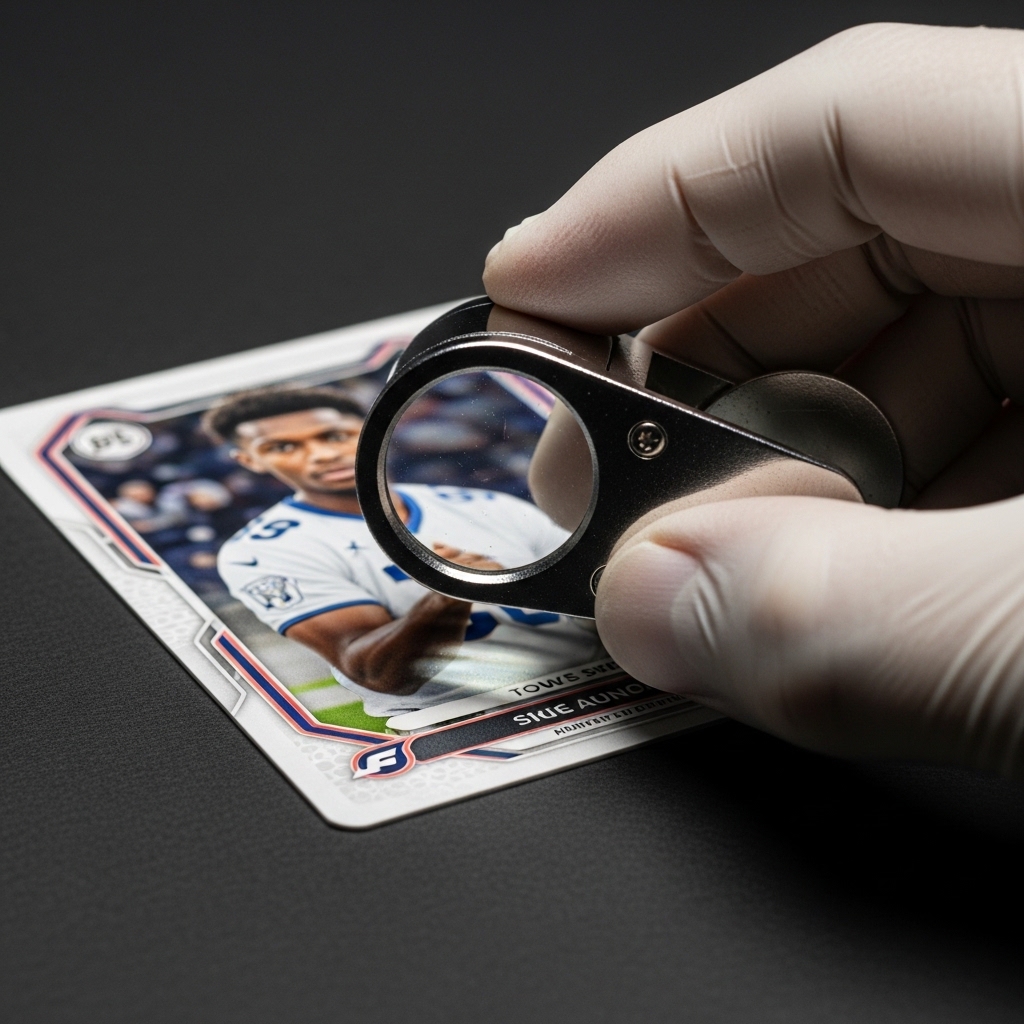
The key insight: A card needs to be strong across all four criteria to earn a high grade. One weak dimension will drag the entire grade down. This is why experienced collectors learn to do their own pre-grade assessment before sending anything out.
The Major Grading Services Compared
Three companies dominate the professional card grading market. Each has its own reputation, scale, and niche.
PSA (Professional Sports Authenticator)
PSA is the industry standard. They've graded over 50 million items. When collectors, dealers, and auction houses talk about “the grade,” they usually mean PSA. PSA 10s carry the strongest market premiums across most categories — vintage baseball, basketball rookies, and modern box breaks alike.
Typical turnaround (2026): Bulk/value tiers run 90–180 days. Express services get you to 10–30 days. Super Express and Walk-Through are available for high-value cards.
Starting price: ~$20–$25 for the slowest tier (bulk, cards valued under $499). Prices scale up for higher declared value and faster turnaround.
Best for: Most card types where resale or long-term holding is the goal. The PSA label carries the strongest market liquidity.
BGS / Beckett Grading Services
Beckett (BGS) is PSA's closest competitor and the preferred grading service in certain collector communities, particularly high-end modern basketball and football. BGS grades on a 1–10 scale but goes to half-points (a BGS 9.5 is distinct from a BGS 9). Their “Black Label” — a BGS 10 with four perfect 10 subgrades — is among the most coveted slabs in the hobby.
BGS also publishes its four subgrades on the label, which some collectors prefer for transparency. You can see exactly where a card was dinged.
Starting price: Comparable to PSA, ranging from ~$20 for economy services to hundreds for fast/high-value tiers.
Best for: Modern super-premium cards, especially where the subgrade transparency matters for valuation. Some basketball-specific markets favor BGS 9.5 over PSA 10.
SGC (Sportscard Guaranty Company)
SGC is the third major player and has seen significant resurgence in the vintage market. Their slabs are clean and minimal — the “gun metal” holder is iconic in vintage circles. SGC uses a 1–10 scale with half-point grades.
SGC often has faster turnaround times and lower prices than PSA and BGS. For vintage cards where PSA saturation has created grade inflation concerns, some collectors and dealers actively prefer SGC grades.
Starting price: ~$18–$22 for standard tiers.
Best for: Vintage cards (pre-1980), T206s, early Topps, and collectors who want competitive turnaround without PSA wait times.
How to Submit Your Card for Grading — Step by Step
Professional grading isn't complicated, but the details matter. Here's the process for PSA (the most common submission target), which is similar for BGS and SGC.
Step 1 — Pre-Grade Your Card
Before you spend a dollar on grading, spend 10 minutes evaluating the card yourself. Use bright, consistent lighting — a loupe or 10x magnifier helps enormously. Check centering with a ruler if you want to be precise. Look at the corners, then the edges, then run your eye across the surface in raking light (angled light that reveals surface scratches).
If the card has obvious corner wear, heavy print lines, or is noticeably off-center, reconsider. Low-grade cards (PSA 4–6) rarely justify grading costs unless the card itself is very valuable raw.
Step 2 — Determine Declared Value and Choose a Tier
PSA's tiering is based on declared value and desired turnaround speed. You declare what you believe the card is worth ungraded. This determines minimum fees and insurance.
For most submissions: start with the bulk or value tier if you have multiple cards and can tolerate a longer wait. For high-value singles, Express or Super Express is worth the premium — a card sitting in PSA's queue for six months is a card that can't be sold.
Step 3 — Prepare Your Submission
Cards must be submitted in soft sleeves inside semi-rigid card savers (not top-loaders — PSA's submission guidelines are specific). Use penny sleeves that fit snugly. Do not use rubber bands. Do not write on sleeves. Each card needs a filled submission form or, increasingly, a digital submission via PSA's website or app.
Step 4 — Ship to PSA
PSA requires registered or certified mail with tracking. Insure the package for the full declared value of your submission. Package cards securely — wrap in bubble wrap, use a rigid outer box, don't let cards shift in transit.
Step 5 — Track and Receive
PSA's submission tracker lets you monitor where your cards are in the process: received, research & ID, grading, quality control, assembly, shipped. The process feels slow when you're watching a $500 card sit in “research & ID” for three weeks. It's normal.
When your slab arrives, inspect it before doing anything else. If there's a label error (wrong year, wrong player), PSA has a correction process — don't try to open the slab yourself.
A PSA 10 can be worth 10x a PSA 8 of the same card. That's not a typo. The difference between a near-mint and a perfect grade can mean thousands of dollars.
Is Grading Worth It? The Financial Reality
The math is simple: grading makes financial sense when the expected increase in value from the grade exceeds the cost of submission.
For a $30 card with a $25 grading fee and a realistic shot at PSA 9 — it might not pencil out. For a modern rookie short print that's worth $200 raw and $800 as a PSA 10, the math is compelling even at an Express tier price.
Key variables:
- Current raw value of the card
- Realistic grade ceiling (be honest about your pre-grade assessment)
- PSA 10 multiplier for that specific card (look up recent sales on eBay completed listings or PWCC)
- Grading cost at the tier you'd use
- Time horizon — grading takes months; that's capital tied up
The market also matters. High-profile players, short prints, 1st editions, and cards with strong collector communities carry stronger PSA 10 premiums than common base cards.
Grading is an investment decision, not a vanity project. The question isn't “is my card nice?” — it's “will the cost of grading come back with a return?”
FAQ — Common Grading Questions
How long does PSA grading take?
It depends on the tier. As of 2026, PSA's bulk/value tier typically runs 90–180 days. Express service (cards declared under $999) runs approximately 10–30 days. Walk-Through service, available at PSA shows, can return grades in 5 business days. Super Express is faster still, but minimum declared value requirements apply. Always check PSA's current turnaround estimates before submitting — they fluctuate based on submission volume.
What grade do most cards receive?
The majority of submissions to PSA land in the PSA 7–9 range. PSA 10 (Gem Mint) is genuinely rare — on many modern sets, the PSA 10 pop is under 10% of total submissions. Vintage cards grade lower on average due to age-related wear. A PSA 8 (Near Mint-Mint) is a strong, respectable grade for most cards.
Can a card be re-graded?
Yes. You can crack a slab and resubmit a card for grading. Collectors do this when they believe a card was undergraded, or when they want to try a different service. There's always risk — the card might come back the same, or lower. Cracking and resubmitting a PSA 9 chasing a PSA 10 is a decision that requires careful thought about the value differential.
What's the difference between PSA and BGS?
Both are reputable third-party graders using a 1–10 scale. PSA has greater market liquidity overall — more buyers recognize and accept PSA grades. BGS publishes four subgrades on the label (centering, corners, edges, surface), which appeals to collectors who want full transparency. BGS 9.5 (Gem Mint) is the most common high-grade for modern cards at Beckett and commands strong premiums in certain markets, particularly basketball. Choose based on what the market for your specific card prefers.
Should I grade every card I think is nice?
No. Grading is an investment decision, not a vanity project. The question isn't “is my card nice?” — it's “will the cost of grading come back with a return?” Apply the math: raw value, realistic grade ceiling, PSA 10 multiplier for that card, grading cost. If the numbers don't work, keep the card raw or sell it raw. There's nothing wrong with a raw card.
The Bottom Line
Grading is one of the most consequential decisions a collector makes. A well-graded card opens doors: stronger resale prices, buyer confidence, protection for a card you're holding long-term. But grading is not a cure for a weak card, and the economics have to work before you drop a card in a semi-rigid and ship it cross-country.
The checklist:
- Pre-grade your card honestly — centering, corners, edges, surface
- Look up PSA 10 sales for your card on eBay completed listings
- Run the math: expected grade value minus grading cost
- Choose the right service (PSA for most; BGS for certain modern premiums; SGC for vintage)
- Submit correctly — semi-rigid, sleeve, proper documentation, insured shipping
The collectors who build real value in this hobby aren't the ones who chase every hit with a submission order. They're the ones who grade strategically — and let the grades compound over time.
Loading articles...