Coin Collecting for Beginners: Your First Year in the Hobby (2026)
Most people discover coins by accident.
A grandfather’s coffee can in the attic. A silver quarter that feels different from the rest of your change. A birthday gift from a relative who “used to collect.” One coin, in your hand, that makes you look twice.
That’s how it starts for most serious collectors. Not with a plan — with a coin that made you curious.
What you do with that curiosity is up to you. But if you want a roadmap — a practical, specific guide to your first year in the hobby — you’re in the right place.
VaultCollect.XYZ covers the full spectrum of collectibles: cards, coins, comics, and more. Coins are our numismatics home base. This is your starting point.
Why Coin Collecting? The Case for the Hobby
Coin collecting is not a niche hobby. The American Numismatic Association has been around since 1891. PCGS and NGC have certified over 100 million coins between them. There are more active coin collectors in the United States than there are people in most major cities.
Here’s why the hobby holds:
It’s tangible. You hold the asset. A 1921 Morgan Silver Dollar is a physical object — 90% silver, struck at a United States Mint, 105 years old. It doesn’t need a server to exist.
The entry point is low. The ceiling is high. You can start for $20. Complete Lincoln cent sets through the 20th century are available at most coin shops for what you’d spend on lunch. The other end of the spectrum: key date Morgan dollars, 1909-S VDB cents, and 1804 silver dollars that trade for six figures. Most collectors live somewhere in between — and find that deeply satisfying.
The market is active and legitimate. PCGS, NGC, Heritage Auctions, Stack’s Bowers, thousands of local coin shops, hundreds of annual coin shows. This is a structured, documented market with 130+ years of price history. You can learn it.
Every coin is a primary source document. Coins carry dates, mint marks, artistic decisions, and metallurgical choices that reflect the historical moment they were made. Collecting Mercury dimes from 1917 means holding an object struck during World War I. That’s not trivia — it’s context that deepens the hobby.
What to Collect First: 5 Beginner-Friendly Coin Series
This is the question every newcomer asks, and most guides answer it vaguely. We’re going to be specific.
The best beginner series share three qualities: they’re widely available, they have active collector communities, and they offer a clear path to set completion. Here are the five we recommend.
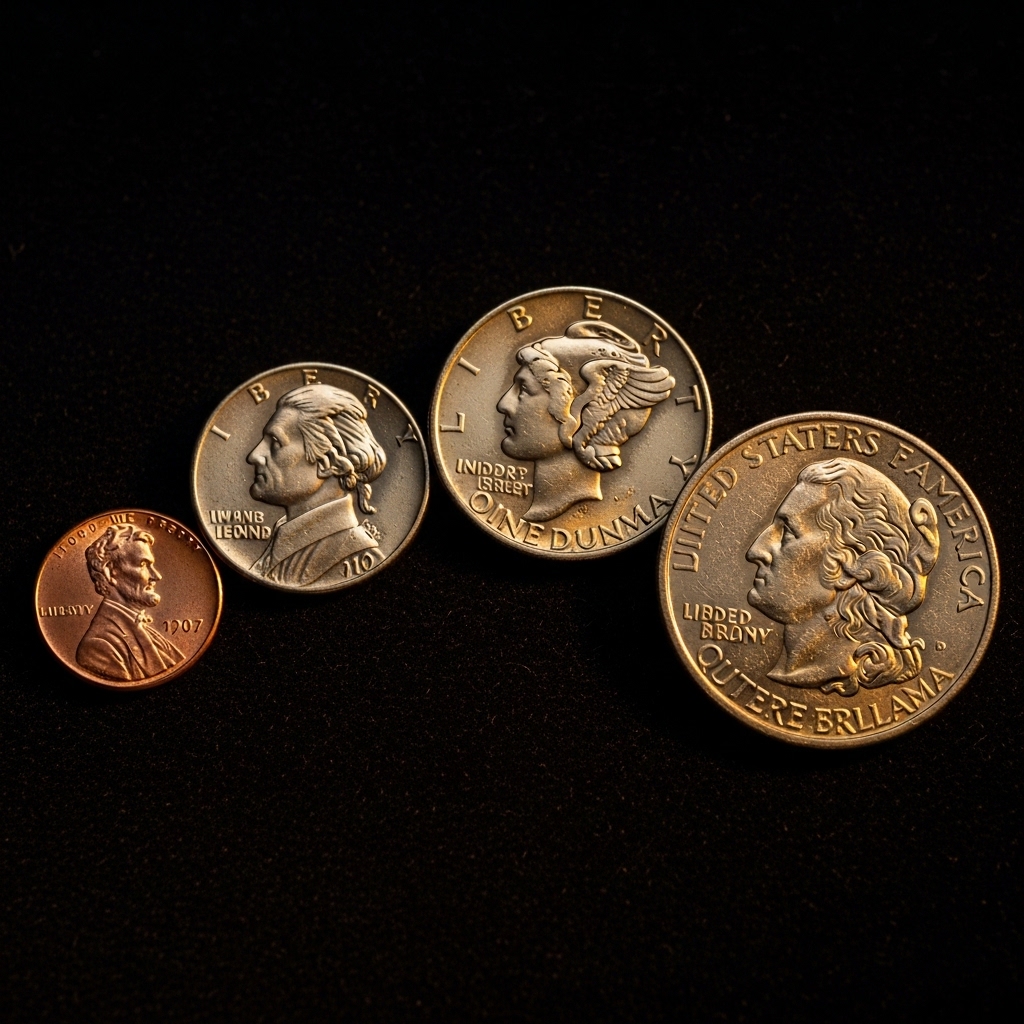
Lincoln Cents (1909–Present)
The most accessible entry point in American numismatics.
Lincoln cents are everywhere. You can start your collection tonight from your change drawer. The series runs over 110 years, with dates across dozens of mint marks — enough to keep you busy for a long time, without spending significantly more than face value on most dates.
What to target first: Circulated examples from 1934 onward are common and cheap — $1 or less for most dates. Start there. Build the modern dates first, then work backward.
Key dates to know (not necessarily to buy yet): The 1909-S VDB is the series’ crown jewel — $700+ in circulated grades. The 1955 doubled die is an error coin that most collectors recognize on sight. The 1914-D is another strong key. These are aspirational; you don’t buy key dates raw (more on that in the grading section).
Practical note: Lincoln cents pre-1982 are 95% copper. Post-1982 are copper-coated zinc. Copper coins hold value better and age more gracefully. Worth noting as you build.
Starting budget: $20–30 gets you most common dates from 1934–2000. A Whitman folder to organize them runs about $5.
Jefferson Nickels (1938–Present)
A logical second series — affordable, long-running, with a built-in precious metals angle.
Jefferson nickels are set-completion friendly. Most dates are available for under $5 in Very Fine condition. The series is long enough to be satisfying, not so long it’s overwhelming.
Key angle — wartime silver nickels (1942–1945): During World War II, the U.S. Mint replaced nickel with an alloy of silver, copper, and manganese to preserve nickel for military equipment. These “war nickels” have a large P, D, or S mint mark above Monticello and contain 35% silver. They’re still common — and every one is a real silver coin.
Key date: The 1950-D is the series’ rarest regular-issue coin — mintage of just 2.6 million. In Very Fine condition: $15–25. A legitimate key date at a beginner price point.
Grading bonus: Jefferson nickels teach “full steps” — the steps of Monticello on the reverse are a secondary grading element that collectors chase. It’s your introduction to the idea that eye appeal matters, not just condition grade.
Starting budget: $30–50 for a solid run of dates in Very Fine, including several wartime silvers.
Mercury Dimes (1916–1945)
This is where the hobby starts to feel like art.
Mercury dimes — officially called Winged Liberty Head dimes — feature one of the most beautiful designs in American coinage. Adolph Weinman’s work. The obverse shows Liberty wearing a winged cap (commonly mistaken for Mercury, the Roman messenger god — hence the nickname). The reverse shows a fasces bound by an olive branch.
The appeal: All Mercury dimes are 90% silver. Every coin in the series is a genuine silver coin. Common dates in Very Fine condition run $4–8 — real silver for less than a fast food meal.
The series structure: 77 regular-issue coins across 1916–1945. Most are affordable. A handful are genuinely rare.
Key date: The 1916-D is one of the most famous coins in American numismatics — mintage of just 264,000. In Very Fine: $800+. Don’t buy this raw. But knowing it exists, and knowing what separates it from the common 1916 Philadelphia issue, teaches you attribution fast.
A 2–3 year project: A complete circulated Mercury Dime set in VF condition can be assembled for $400–600, depending on patience and sourcing. The 1921 and 1921-D will be your biggest challenges after the 1916-D.
Starting budget: $30–50 for a representative run of common dates in VF — enough to get familiar with the series before committing to completion.
Morgan Silver Dollars (1878–1921)
The series most coin collectors eventually own at least one of. For good reason.
“A Morgan Silver Dollar in Very Fine condition costs $25–35. It contains over 0.77 oz of pure silver. It’s 100+ years old. And you can hold it in your hand.”
Morgan dollars are substantial coins — 26.73 grams, 38.1mm diameter, 90% silver. Heavy in hand in a way that communicates value immediately. They’re the coins people find in grandfather’s collections and wonder if they’ve stumbled onto something.
The range: Common dates in Very Fine condition run $25–35 — near silver melt value. That’s your floor. Key dates push dramatically higher: the 1893-S in Fine-12 is a six-figure coin. The 1889-CC in any condition is significant.
What beginners should buy: Common-date Morgans. Philadelphia mint (no mint mark), Carson City (CC), New Orleans (O), San Francisco (S), and Denver (D) all have different mintages. The 1881-S, 1898-O, and 1904-O are beautiful, common, and affordable. Buy one. Learn what a high-grade silver dollar looks like.
Critical note on counterfeits: Morgan key dates are among the most counterfeited coins in American numismatics. The 1893-S, 1895, 1895-O, and 1889-CC are targets. Only buy key-date Morgans in PCGS or NGC slabs. Never raw. This rule has no exceptions.
Starting budget: $50 buys you one nice common-date Morgan in Very Fine. Start there.
State Quarters (1999–2008)
These aren’t serious investment vehicles. They are, however, the gateway drug for a generation of collectors — and for good reason.
The State Quarter program ran from 1999–2008, releasing five designs per year honoring each of the 50 states. Hundreds of millions of each were struck. You probably have some in a drawer right now.
Why they’re a good beginner series: They’re free to find in circulation, they teach date and mint mark attribution (Philadelphia = P, Denver = D), they introduce the concept of set completion, and they’re an excellent first project for younger collectors.
The upgrade path: Once you’ve assembled a circulated P+D set, consider the proof coins — struck in San Francisco (S) for collectors. A complete proof set in original government packaging runs under $30 and is a satisfying display piece.
What this series teaches: Condition grading, mint mark identification, the habit of looking at coins before spending them. Skills that transfer to every other series.
Where to Buy Coins Without Getting Ripped Off
This is the section most beginner guides skip. It’s also one of the most important.
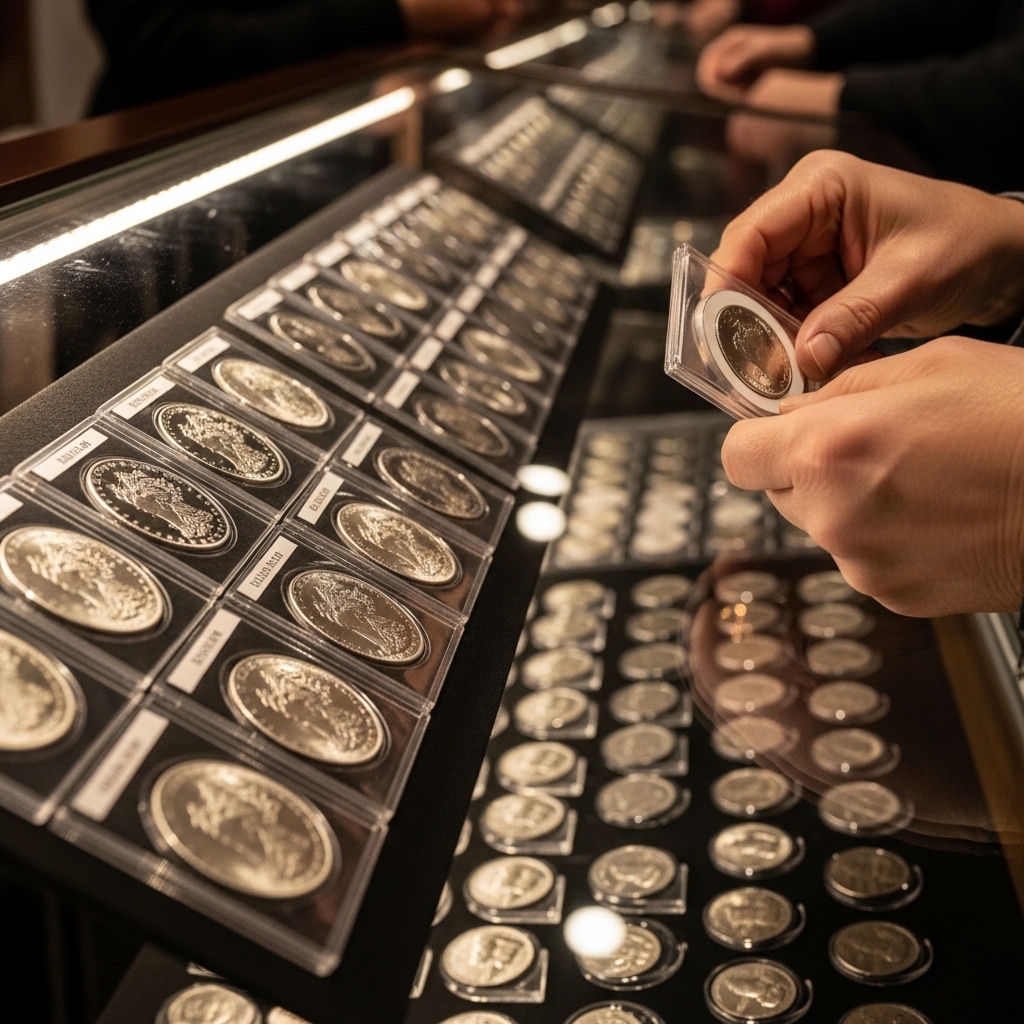
Local Coin Shop (LCS)
Your best starting point, especially for your first purchases.
A good LCS lets you see coins in hand, ask questions, and develop a relationship with a knowledgeable dealer. Expect to pay a slight premium over market — typically 10–20% over gray sheet (the Coin Dealer Newsletter, which tracks wholesale pricing). That premium pays for the existence of the shop and the expertise it provides. It’s fair.
What to look for in a good LCS: A dealer who shows you coins out of their flip, explains the grade, and doesn’t pressure you to buy quickly. Red flags: dealers who won’t let you examine a coin, no price transparency, excessive premiums without explanation.
How to find one: Use the PCGS coin dealer locator or ask in r/coins — the community maintains informal recommendations for most major metro areas.
Coin Shows
Coin shows are where dealers compete for your business — and that competition drives better prices.
Shows range from one-table local club events to the American Numismatic Association’s national conventions with hundreds of dealers. A regional show typically offers better variety than most local shops, and prices are negotiable in a way that LCS fixed prices often aren’t.
Etiquette matters in this hobby: Look before you touch. Ask permission before handling coins. Never touch a coin’s face — hold by the edges only. Experienced dealers will notice, and it signals that you’re serious.
How to find a show: The ANA (americannumismatic.org) maintains an event calendar. Most states have a numismatic association with its own show schedule.
eBay
The largest coin marketplace in the world, and the most important price research tool you have.
For buying: Focus on sellers with 99%+ feedback across 500+ coin transactions. Photos must show both obverse and reverse clearly. Return policies matter — legitimate sellers stand behind their coins.
For research: eBay’s completed listings (filter: “Sold”) show you what coins actually sold for, not what sellers hope to get. This is real market data. More accurate than most published price guides for common dates.
What to avoid on eBay: “Gold coins” sold by weight from overseas sellers, any expensive coin without clear photos of the actual coin (not stock photos), and sellers with feedback under 100.
Heritage Auctions and Stack’s Bowers
The two dominant auction houses for serious numismatics. Important for beginners, even if you’re not ready to bid.
Heritage Auctions (ha.com) has a searchable archive of auction results going back decades — the best price history database in the hobby. You can look up any coin, any grade, and see what it’s traded for over time. Use this before you buy anything significant.
Stack’s Bowers operates similarly and is particularly strong in early American coinage and world coins.
Both have “buy now” sections with certified coins across all price points. Heritage’s certified coin section includes PCGS and NGC slabs under $100 — legitimate key date coins at accessible prices.
“Before you pay more than $50 for any coin, look it up in Heritage’s auction archives. Know what it’s worth before you hand over money.”
Coin Grading Basics: What PCGS and NGC Actually Mean
You don’t need to become a coin grader in your first year. You do need to understand the system well enough to buy intelligently.
The Two Dominant Grading Services
PCGS (Professional Coin Grading Service): Founded 1986. Approximately 45 million coins certified. Industry-standard for key dates and high-grade material. The PCGS registry drives premium prices for registry-quality coins.
NGC (Numismatic Guaranty Company): Founded 1987. Over 60 million coins certified. Comparable authority to PCGS, arguably slightly more conservative grades on some series. Accepted interchangeably with PCGS by most serious buyers.
Unlike the sports card world — where the PSA vs. Beckett debate gets heated — coin collectors are relatively neutral between PCGS and NGC. Both services are respected. Both slabs are marketable. The debate exists, but it doesn’t dominate the way it does in card collecting. (We’ve covered the equivalent grading service comparison for sports cards here.)
The Sheldon Scale
All PCGS and NGC grades use the Sheldon scale, developed by Dr. William Sheldon in 1949. Grades run from P-1 to MS-70.
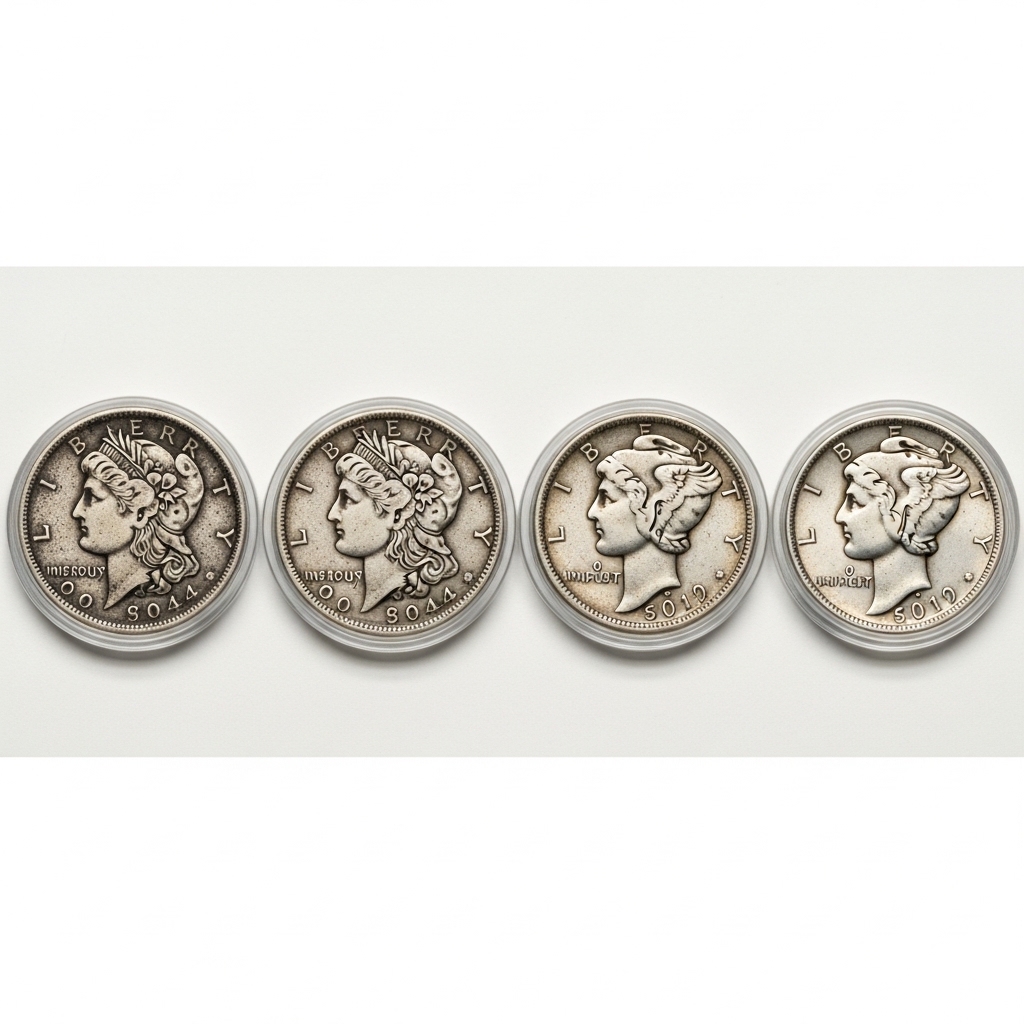
| Grade Range | Abbreviation | What It Means |
|---|---|---|
| P-1 | Poor | Barely identifiable |
| G-4 to G-6 | Good | Date and major design visible |
| VG-8 to VG-10 | Very Good | Moderate wear, design clear |
| F-12 to F-15 | Fine | Even wear, major details present |
| VF-20 to VF-35 | Very Fine | Light to moderate wear on high points |
| EF/XF-40 to EF-45 | Extremely Fine | Slight wear on highest points only |
| AU-50 to AU-58 | About Uncirculated | Traces of wear, mostly mint luster |
| MS-60 to MS-70 | Mint State | No wear — grades reflect marks and eye appeal |
What beginners need to understand:
Very Fine (VF-20 to VF-35) is the sweet spot for affordable collecting. “Honest wear” — the coin circulated, all the major design elements are clear, it’s a genuine historical artifact. Most beginner sets can be built in VF without significant financial strain.
Extremely Fine (EF/XF-40 to EF-45) is the intermediate collector’s target — visible detail, minor wear. Premium over VF, but not dramatic on most series.
“The jump from MS-64 to MS-65 can be 2–5x the price of the same coin. Grade matters exponentially at the top.”
Should You Get Coins Graded?
For most coins in your first year: no.
Professional grading costs $30–50 per coin at PCGS and NGC (see our grading costs breakdown — the economics apply equally to coins and cards). Submitting a $15 Lincoln cent for a $35 grading fee doesn’t make financial sense unless you’re confident it grades high on a key date.
The exception — and it is absolute: only buy key-date coins in PCGS or NGC slabs. Morgan key dates, Mercury Dime key dates, anything over $200 should be certified before you buy. Counterfeiting is real. Cleaned coins are common. A slab is your protection.
Storing Your Coins Properly: Don’t Ruin What You Just Bought
“Never clean a coin. Not even gently. Not even with distilled water. Cleaning is permanent, immediately detectable, and destroys numismatic value. The answer is always no.”
This is not optional. This is not a matter of preference. Cleaning — even gentle cleaning, even distilled water, even “professional” coin cleaning products — permanently destroys the numismatic value of a coin. PCGS and NGC will detail-grade any cleaned coin, which dramatically reduces its market value.
Handling: Always hold coins by the edge. Never touch the face. The oils from your fingerprints cause permanent spotting — called contact damage — that reduces grade and value. Handle like you mean it.
Storage options by collection stage:
- Starting out: Whitman folders (the classic cardboard coin folders) and Dansco albums work well for circulated material. Inexpensive, organized, accessible. Most coin shops carry them.
- As the collection grows: Air-Tite holders — hard plastic capsules sized to specific coin diameters — are the right storage for uncirculated or valuable coins. Airtight seals prevent environmental damage.
- What to avoid: Old PVC (polyvinyl chloride) coin flips. They off-gas over time and cause green slime on coins — permanent damage called PVC contamination. Any old plastic flip should be considered suspect. Replace immediately.
- Environment: 45–55% relative humidity, room temperature, away from exterior walls and basements. Humidity fluctuation is the enemy.
For a full breakdown of storage systems, materials, and common mistakes across all collectibles, see our Sports Card Storage Guide 2026 — the principles apply directly to coin storage.
5 Beginner Mistakes That Cost Collectors Money
- Cleaning coins. Already covered. It bears repeating: this is irreversible, immediately detectable, and permanently destructive to value. Never do it. Tell anyone who tries to convince you otherwise that they’re wrong.
- Buying from TV shopping channels. These are typically overpriced commemorative coins marketed on emotional appeal. They are not numismatically significant. The markup is enormous. The resale market is minimal. Don’t do it.
- Paying retail for common dates. Every Lincoln cent from 1941–1980 is a common coin. If a dealer is asking $5 for a common date, check eBay completed listings first. Common dates are worth what the market pays for them — usually a fraction of what uninformed sellers charge to uninformed buyers.
- Skipping certification on key dates. If a coin costs $200 or more, it should be in a PCGS or NGC slab. Period. Counterfeiting of key-date Morgans and other popular series is well-documented. A certified slab is the only reliable protection.
- Over-investing in storage before you have a collection. Some beginners spend $200 on premium storage before they’ve bought $100 in coins. Start simple: a Whitman folder, basic poly flips, a box. Upgrade your storage as your collection — and your knowledge — grows.
FAQ: Coin Collecting for Beginners
How do I start a coin collection?
Start with what you have. Check your change drawer for pre-1982 pennies (copper) and pre-1965 dimes and quarters (silver). Buy a Whitman Lincoln Cent folder at a local coin shop for $5. Sort through $25 in cent rolls from your bank. That’s it. You’ve started.
What coins are best for beginners to collect?
Lincoln cents (1909–present) for accessibility; Jefferson nickels (1938–present) for the wartime silver angle; Mercury dimes (1916–1945) for beauty and genuine silver content. State quarters (1999–2008) if you’re starting a younger collector. Morgan Silver Dollars when you’re ready to spend $30–50 on a single coin that will last your lifetime.
Is coin collecting a good investment?
Depends what you mean by investment. Key-date certified coins have historically maintained value and outpaced inflation in many series. Common dates typically track melt value for silver coins. The best collectors buy what they love and treat appreciation as a bonus, not the primary goal. If you’re purely return-seeking, this may not be your hobby. If you want to own something with historical depth that also holds value — coin collecting is worth your attention.
How much does it cost to start collecting coins?
$20–30 gets you started with a Lincoln cent collection and a Whitman folder. A first-year budget of $100–200 is more than sufficient to build meaningful sets in two or three series, attend a coin show, and acquire a piece of genuine silver — a Mercury dime or wartime Jefferson nickel — that you’ll own for decades.
Your First Year Plan: A Month-by-Month Roadmap
Here’s your actual plan. Specific, achievable, in sequence.
Month 1: Check your change. Buy a Whitman Lincoln Cent folder ($5). Order $25 in cent rolls from your bank. Sort by date and mint mark. Learn to identify mint marks: no mint mark = Philadelphia, D = Denver, S = San Francisco. Fill every slot you can from circulation. Cost: $30 total.
Month 2: Visit a coin show or LCS. Find your nearest coin shop (PCGS dealer locator) or a regional coin show. Spend $20–30 on 2–3 Mercury Dimes in Very Fine condition. Hold them. Compare the design quality to what you’ve been sorting. Ask the dealer one question: “What would you buy if you were starting today?” Good dealers love this question.
Month 3: Join the community. Create an account on the PCGS forums or Coin Talk. Join the ANA (American Numismatic Association) — free for collectors under 18, nominal annual fee for adults. Read one issue of Numismatist magazine. Browse r/coins once a week. You’ll learn more from the community’s discussions than from any single article.
Months 4–6: Build focus. Pick one series and focus on it. Set a monthly budget — $25–50 is reasonable for a casual collector. Don’t chase every shiny new coin. Depth in one series is more satisfying and more educational than a scattered collection of one-offs.
Months 7–12: Identify your first want-list coin. Name one aspirational key date. Research it thoroughly: Heritage auction archives, PCGS price guide, eBay completed listings. Know what it’s worth in every grade from Good to EF. Save for it deliberately. The anticipation is part of the hobby.
Year-end goal: Two complete sets (Lincoln cents plus one other series), at least one piece of genuine silver, a basic but proper storage setup, and an active connection to at least one collector community. That’s a real first year.
Ready for Year 2? Subscribe to VaultCollect.XYZ. We publish monthly coin market analysis, key date price tracking, and collector guides across every major series. The Beginner Collector’s Starter Kit — our curated resource guide for new collectors — is available to subscribers. Enter your email below and we’ll send it immediately.
Loading articles...