Pokémon Card Investing in 2026: What the 30th Anniversary Means for Your Collection
In 2021, the Pokémon card market exploded — and then collapsed.
Logan Paul pulled a $5.275 million Pikachu Illustrator on YouTube. The price of a 1st Edition Base Set Charizard in PSA 10 hit $420,000 at auction. Pull videos went viral. Collectors who’d never bought a pack in their lives were cracking cases of Vivid Voltage hoping to flip Umbreon V Alternate Arts.
By late 2021, the bubble had deflated. Prices on modern sets dropped 40–60% from peak. Speculators who overpaid got burned. The Pokémon card market became a cautionary tale in mainstream finance media: a classic speculative mania driven by influencer FOMO, not fundamental value.
2026 is structurally different. And the difference matters for how you position your collection now.
Why 2026 Is Not 2021
The 2021 run was demand-driven in the worst way: speculation by people who didn’t know the hobby, buying anything Pokémon-branded, at any price. There was no framework — no grading discipline, no population data, no distinction between a 1st Edition Base Set holo and a Target reprint blister pack.
The 2026 catalyst is real: Pokémon’s 30th anniversary, with a confirmed Celebration Collection set dropping worldwide in October — the first-ever global simultaneous release in the franchise’s history.
But more importantly, the market that will respond to this anniversary is a different market. Three structural changes since 2021:
1. Graded card market maturation. PSA returned from its submission pause, dramatically reduced backlogs, and is now processing TCG submissions routinely. The population data is real, current, and actionable. Investors can look at a card’s PSA census before buying — not guess.
2. Institutional buyers entered the market. Alt assets platforms and collectibles funds began building Pokémon card positions in 2023–2024, specifically in PSA 9/10 vintage. This isn’t retail FOMO; it’s yield-seeking capital moving into verifiable scarcity plays.
3. The speculative excess got shaken out. The people who paid $400 for an Evolving Skies Umbreon V SAR in 2021 and sold at a loss in 2022 are not coming back. The buyers in the current market know what a PSA 10 is, what a census looks like, and what “tight pop” means.
That doesn’t mean 2026 can’t produce its own excess. It means there’s a rational investment framework available — if you know how to use it.
The Four-Tier Investment Framework for 2026
Not all Pokémon cards respond the same way to an anniversary catalyst. Here’s how to think about positioning across four categories:
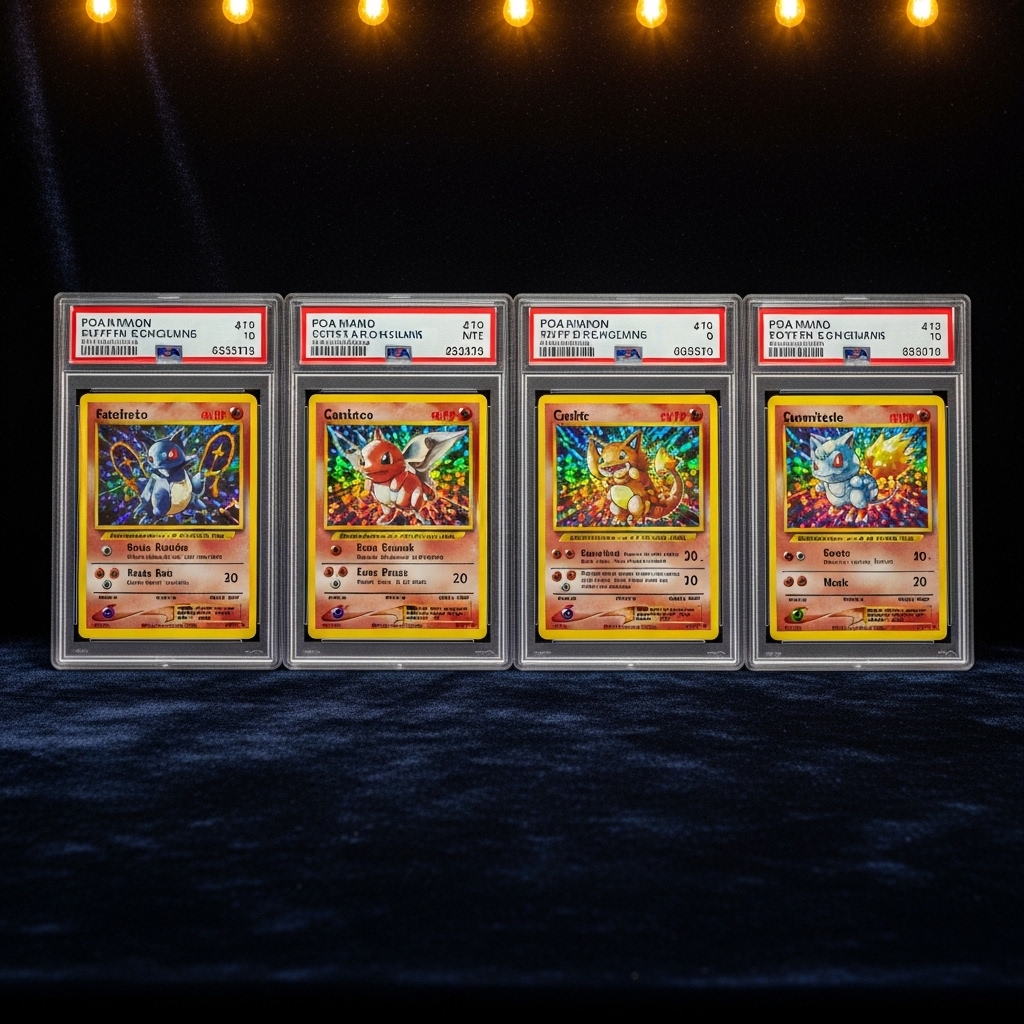
Tier 1: Blue-Chip Vintage (1998–2003 WOTC-Era Holofoils)
The floor is the floor. 1st Edition Base Set holofoils — Charizard, Blastoise, Venusaur, and the full complement of rares — are the blue chips of the Pokémon investment market. They have 25+ years of price history, near-total market recognition, and institutional legitimacy.
1st Edition Base Set holos have gained 30–50% year-to-date in 2026 against Jan 2025 baselines. PSA 9 and PSA 10 copies have driven the gains — raw copies in equivalent condition have moved less.
Anniversary thesis: The 30th anniversary is the most natural catalyst for vintage nostalgia buys. Collectors who grew up with the original sets in the late 1990s are now in their 30s and 40s, with disposable income, and the anniversary triggers the emotional purchase decision. Institutional holders know this — they’ll be selling into anniversary liquidity.
Investment posture: If you already hold vintage PSA 9/10, hold through October 2026 and reassess after the Celebration Collection hype cycle peaks. If you’re buying in now, you’re paying for a catalyst that is widely known — the margin of safety is thin. Be selective: PSA 10 premium over PSA 9 is significant (often 3–7x on key holos), and population for PSA 10 is genuinely tight on the most desirable cards.
Grade discipline: PSA 9+ only for investment-grade vintage. Ungraded vintage is a lifestyle purchase, not an investment.
Tier 2: Sealed 30th Anniversary Products
When anniversary products hit — sealed booster boxes, Elite Trainer Boxes, special collections — sealed is always the right call for collectors playing a multi-year hold.
Sealed Pokémon product has a near-perfect track record for long-term appreciation. 1st Edition Base Set sealed booster boxes have sold for over $400,000. More recently, sealed Evolving Skies booster boxes that retailed at $150 now sell for $400–600 on the secondary market, even after the 2021–2022 correction in singles.
Anniversary thesis: The Celebration Collection is a confirmed October 2026 release. MSRP will be retail-standard. First-print sealed boxes held 3–5 years will appreciate significantly if prior anniversary releases are any guide — the 25th Anniversary (Celebrations set, 2021) proved it even in a distorted market environment.
Investment posture: Buy at retail if you can get it. Secondary market premiums on release-day sealed will be high — the entry point matters. Don’t pay 2x MSRP day-of. The long play doesn’t require it.
Tier 3: Modern Chase Cards — PSA 10 Only
The modern chase card market is concentrated in three categories: Alternate Art (AA) rares, Special Art Rares (SARs), and Hyper Rare / Gold rare equivalents. These are the cards that drive case-break demand and secondary market liquidity in sets from Sword & Shield era through current Scarlet & Violet releases.
In modern chase cards, PSA 10 is the only investment-grade. The price differential between a PSA 9 and PSA 10 on high-demand cards is extreme — commonly 3–10x.
A PSA 9 Charizard ex SAR from Obsidian Flames might sell for $80. The same card in PSA 10: $400+. The spread exists because the market knows modern cards are easy to find in PSA 9 and hard to find in PSA 10. See our PSA population report guide for how to read the census before you buy.
Anniversary thesis: Cards from sets released in the Celebration Collection era will carry anniversary premiums. Chase SARs and AAs from those sets — if the set delivers meaningful cards — will be the modern equivalent of the 2021 boom without the speculative excess, because graded population data will be available immediately and buyers will be more disciplined.
Investment posture: Grade raw chase cards before selling or holding. Don’t hold ungraded modern. The grade multiplier is too significant to leave on the table. Our grading cost guide applies directly — CGC grades Pokémon TCG under the same economics.
Tier 4: Japanese Exclusives — The 20–40% Premium
This is where most English-language Pokémon content leaves money on the table.
Japanese Pokémon cards trade at a 20–40% premium over their English equivalents, for verifiable reasons: smaller print runs, earlier release dates, higher print quality standards, and a domestic collector market with deep cultural connection to the franchise.
The 1st Edition Japanese Base Set Charizard Holo has routinely sold 20–40% above the equivalent English PSA equivalent when grades are matched. On vintage holographic rares, Japanese variants with confirmed first print designation command the sharpest premiums.
What most English collectors get wrong: They assume Japanese cards are “secondary” to English copies. The opposite is true for investment-grade vintage. The Japanese domestic market is the origin point of the franchise — these are the cards Pokémon’s creators actually played with in 1996.
Anniversary thesis: Japanese products for the 30th anniversary will be released alongside or ahead of the worldwide Celebration Collection. Early Japanese releases have historically appreciated most before the English language versions eroded the global scarcity premium.
Investment posture: If you have no Japanese card exposure, this anniversary cycle is the most natural time to add it. The entry point on Japanese vintage has been compressed by the 2021 correction and hasn’t fully recovered with the broader market — the upside is still available.

How to Use Population Data for Pokémon Cards
The PSA population report is the same tool for Pokémon cards that it is for sports cards. Same logic, same framework. We covered the full methodology in our PSA population report guide — but the Pokémon-specific note is critical:
Pokémon TCG population data is complicated by set variations, language variants, and printing error copies. The census separates English and Japanese, first edition and unlimited, and in some cases identifies specific printing variations. Read the census entry carefully before drawing conclusions — a “tight pop” on what you think is the main card might be measuring a variant.
The 10:9 ratio still applies: PSA 10 count divided by PSA 9 count tells you how grade-sensitive the card is. A ratio below 0.15 (fewer than 15 PSA 10s per 100 PSA 9s) signals a genuinely hard-to-grade card — the PSA 10 premium is justified. A ratio above 0.5 suggests the card grades easily, and the PSA 10 premium is more speculative.
What to Avoid in 2026
Reprint products. McDonald’s Pokémon 25th sets, anniversary reprint blister packs, and standard reprints of original sets are collector products, not investments. They trade on nostalgia at retail prices, not scarcity.
PSA 9 modern chase cards. The spread between PSA 9 and PSA 10 on modern SARs and AAs is too large to hold PSA 9 as a long-term position. Grade discipline matters.
Buying the hype peak. The anniversary announcement has already moved markets — vintage up 30–50% YTD. Some of the catalyst is already priced in. Entry timing matters. The best Pokémon card investments are made before the mainstream narrative catches up, not after.
Ignoring condition. Every grading principle that applies to sports cards applies here. See our guide to how sports card grading works — the psychology of grade-sensitive value is identical.
Frequently Asked Questions
Is 2026 a good time to invest in Pokémon cards?
The 30th anniversary is a real, confirmed catalyst — not speculation. Vintage blue-chip cards (1st Edition Base Set holofoils, Japanese exclusives) have strong fundamentals regardless of anniversary timing. The market is more sophisticated than 2021, with better population data and institutional participation. That said: the catalyst is already partially priced in. Entry timing and grade discipline matter.
What Pokémon cards hold value best?
1st Edition Base Set holofoils in PSA 9 or PSA 10, Japanese 1st Edition equivalents, and sealed booster products from key sets. Modern chase cards (Alt-arts, SARs) in PSA 10 have strong short-to-medium term performance. Ungraded raw copies, reprint products, and common non-holo rares hold the least value long-term.
What’s the difference between 1st Edition and Unlimited Pokémon cards?
1st Edition cards have a small “Edition 1” stamp on the card face (left side, below the artwork) and a shadow-free first-printing visual characteristic on the Base Set specifically. 1st Edition commands significantly higher prices than Unlimited prints of the same card. Always confirm 1st Edition status on vintage purchases — it is the primary value driver.
Should I get Pokémon cards graded by PSA or CGC?
Both grade Pokémon TCG. PSA has the larger TCG population and greater marketplace recognition among Pokémon collectors specifically. CGC is widely accepted and often has faster turnaround at lower cost. For key vintage graded for auction, PSA remains the standard.
What is the Celebration Collection?
The Pokémon Company’s officially announced worldwide simultaneous release of a 30th anniversary Pokémon TCG product, confirmed for October 2026. This is the first global simultaneous release in the franchise’s history. Full set details will be available from Pokemon.com as the release date approaches.
The Bottom Line
The 2021 Pokémon bubble taught a simple lesson: buying anything, at any price, because it’s Pokémon doesn’t work. The 2026 anniversary cycle gives you the opposite opportunity — a real catalyst, better market structure, and a clear investment framework.
Blue-chip vintage in PSA 9+. Sealed anniversary products at retail. Modern chase cards in PSA 10 only. Japanese exclusives, where the premium is real and underappreciated by English-dominant coverage.
Grade everything that matters. Use the population report. And buy the framework, not the hype.
Get Pokémon Market Alerts Before Prices Move
We track graded Pokémon card prices, population shifts, and upcoming set releases. Subscribe to the VaultCollect newsletter for market intelligence that matters.
Loading articles...