PSA vs BGS Grading: Which Is Right for Your Card? (2026)
Every collector hits the moment: you've got a card worth grading, and now you're staring at two names — PSA and BGS (Beckett Grading Services) — wondering which one to trust with it.
Most guides will tell you “both are reputable” and leave it there. That's not an answer. That's a cop-out.
The truth is that PSA and BGS are not interchangeable. The right choice depends on what you're grading, why you're grading it, and what you plan to do with the slab when it comes back. Before you ship anything, you also need to understand how grading works — our complete guide to sports card grading walks through what graders actually look at.
This guide cuts through the noise with a genuine decision framework. By the end, you'll know exactly which company to use for your situation.
PSA vs BGS at a Glance
Before getting into scenarios, here's the straight comparison:
| Factor | PSA | BGS (Beckett) |
|---|---|---|
| Grading scale | 1–10 (whole and half points) | 1–10 with 4 subgrades |
| Subgrades | None | Centering, corners, edges, surface |
| Top grade | PSA 10 Gem Mint | BGS 10 Pristine / BGS 10 Black Label |
| Market acceptance (sports) | Dominant | Established but secondary |
| Market acceptance (TCG) | Dominant post-2020 | Strong for vintage/premium |
| Holder style | Screwdown black case | Snap-lock black case |
| Population report | PSA.com — industry standard | BGS.com — available, less referenced |
| Economy tier timing | Variable (currently 60–90 days) | Variable (currently 60–90 days) |
| Subgrade value | N/A | High — tells you why you got the grade |
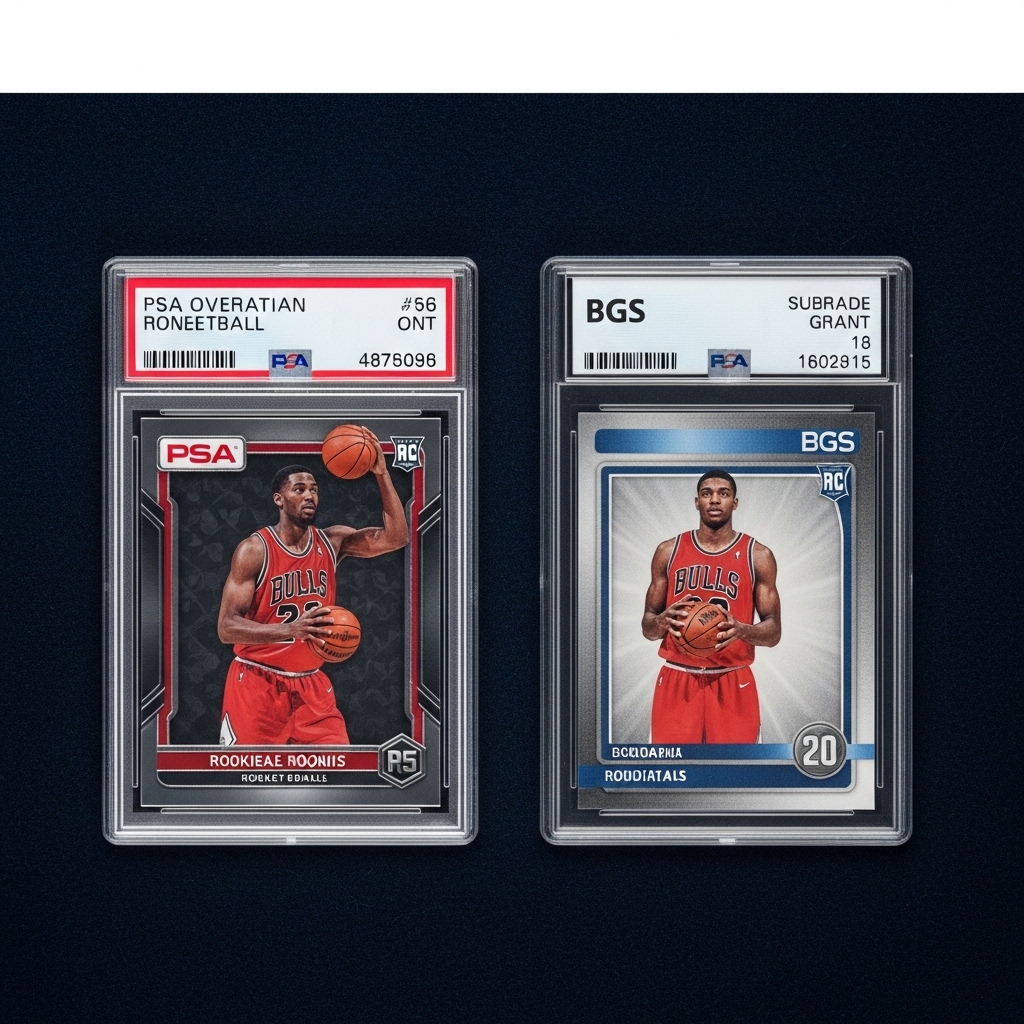
The subgrade distinction matters more than most collectors realize. A BGS 9.5 with subgrades of 10/10/9/9.5 tells you exactly where the card fell short. A PSA 9.5 tells you nothing about why.
For collectors who buy and sell based on condition detail, that information gap has real financial weight.
PSA vs BGS for Sports Cards (Football, Baseball, Basketball, Hockey)
For mainstream American sports cards — baseball, football, basketball, hockey — PSA is the default choice, and the data backs it up.
The PSA 10 carries a measurable liquidity premium in the sports card market. On eBay completed sales, a PSA 10 of the same card will typically sell for 20–40% more than a BGS 9.5 Gem Mint. Buyers trust the PSA pop report. Dealers trust the PSA holder. The market has standardized on it.
That said, there's a specific scenario where BGS makes more sense for sports cards: chasing the BGS Black Label on a genuinely pristine vintage card.
The BGS Black Label (BGS 10) requires all four subgrades to score a 10 — centering, corners, edges, and surface. It's exceptionally rare. On the right vintage card with documented scarcity, a Black Label commands a premium that can far exceed even a PSA 10. The analogy is a PSA 10 on a card where the pop report has 500 copies vs. a BGS Black Label where perhaps 15 exist.
The rule for sports cards:
- Grade with PSA for standard resale and portfolio liquidity
- Consider BGS only if: (a) the card is objectively pristine — not just “nice,” pristine — and (b) the BGS Black Label pop is low enough to matter
PSA vs BGS for TCG (Pokémon, Magic: The Gathering, Yu-Gi-Oh)
The TCG grading landscape is more nuanced, and this is where many guides get it wrong by treating sports cards and Pokémon cards as identical decisions.
Modern Pokémon (post-2000): PSA has become the dominant grader by volume after the 2020–2022 hobby boom. For modern sets — Celebrations, Crown Zenith, current sets — PSA is the liquidity leader. Most PSA 10 modern Pokémon sell at a significant premium over BGS 9.5.
Vintage Pokémon (pre-2000, Base Set through early Neo era): This is where it flips. BGS grades vintage Pokémon cards with a different eye toward centering, because the printing tolerances on 1998–2000 WOTC cards were inconsistent at the factory level. A Base Set Charizard with machine-induced off-center printing will be evaluated by BGS with that context in mind. PSA applies a stricter modern centering standard that doesn't account for WOTC print variance.
For vintage Pokémon at auction — especially Base Set Charizard 1st Edition, Base Set Blastoise, Base Set Venusaur — a BGS Black Label carries extraordinary auction premium. This is the prestige play in the TCG space.
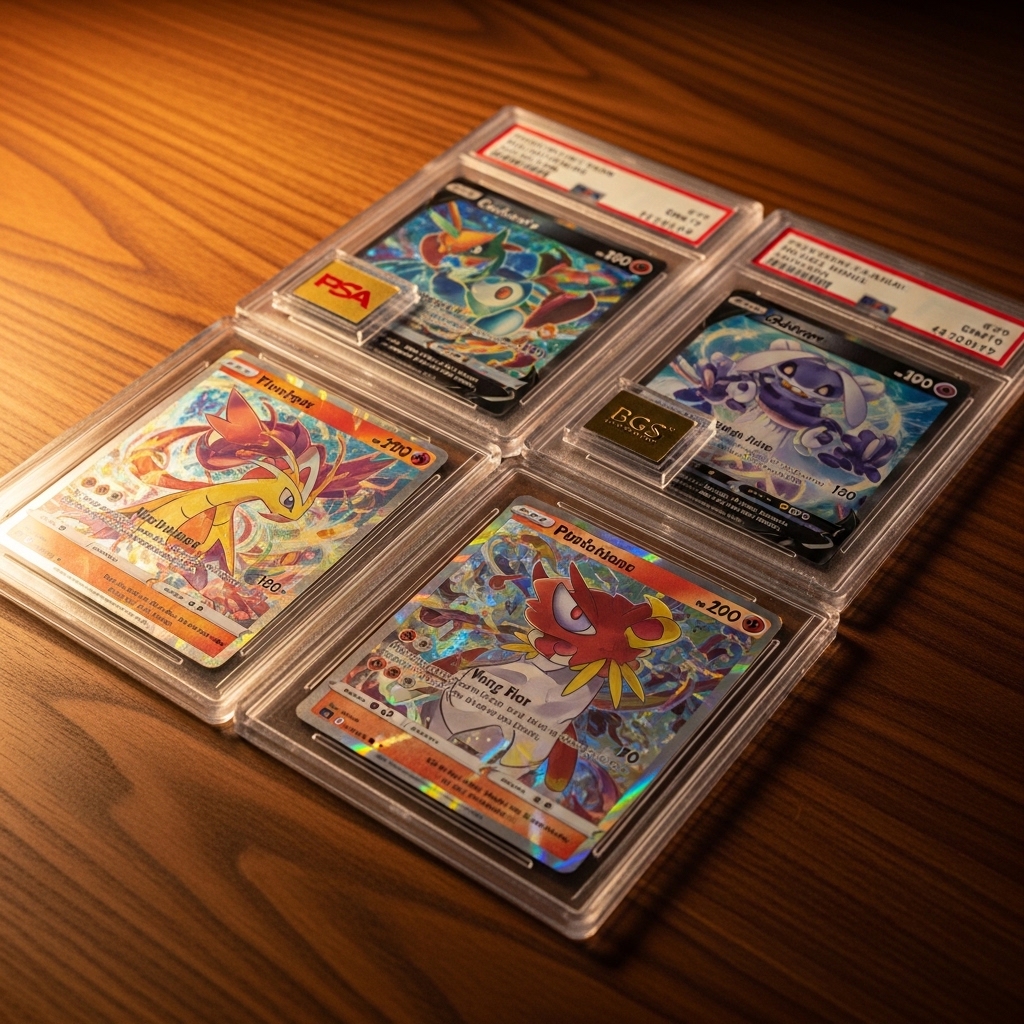
Magic: The Gathering: PSA has grown its MTG share but CGC (Certified Guaranty Company) is actually gaining ground in the MTG community. BGS has modest MTG market presence. For most MTG collectors, PSA or CGC is the better call.
The rule for TCG:
- Modern Pokémon and most TCG → PSA
- Vintage Pokémon, pre-2000, where a Black Label is a realistic target → BGS
- MTG → PSA or CGC
PSA 10 vs BGS 9.5 — The Critical Grading Comparison
This comparison comes up constantly, and understanding it correctly is worth real money.
A BGS 9.5 is often harder to achieve than a PSA 10. Yet on the open market, PSA 10s command higher prices. That paradox is the key to understanding the PSA vs BGS debate.
PSA grades holistically. One reviewer looks at the card, weighs the overall impression, and assigns a number. BGS grades analytically. Four separate criteria are each scored independently. A card needs a minimum subgrade of 9 across all four criteria to receive a 9.5 overall — and the lowest subgrade anchors the ceiling.
A card with perfect surface, corners, and edges but 8.5 centering will receive a BGS 9 or 9.5 at best, regardless of how flawless everything else is. The same card might walk into PSA and receive a PSA 10 if the overall impression reads as Gem Mint to the grader.
This creates a market paradox: PSA 10s are more common (because PSA grades more holistically), yet they command higher resale prices (because the market trusts the brand).
Where a BGS 9.5 can beat a PSA 10 on resale: Population management. If a card has a PSA 10 population of 1,200 and a BGS 9.5 population of 35, the BGS 9.5 with strong subgrades (10/10/9.5/9.5) may actually sell for more. Scarcity in the right holder, at the right grade, can flip the script.
Before submitting to either company: Check both pop reports at PSA.com and BGS.com. If a card is already flooded at PSA 10, BGS with a lower population is worth serious consideration.
BGS Black Label vs PSA 10 — When the Premium Slab Wins
The BGS Black Label is the grading world's version of a perfect 10 — but stricter. All four subgrades must score a legitimate 10. Centering must be essentially perfect. Corners must be pristine under magnification. Edges must show no chippage or whitening. Surface must be flawless.
Because of this, Black Labels are genuinely rare. On common modern cards, there may never be a Black Label. On vintage sports cards or vintage Pokémon, a Black Label can be worth multiples of a PSA 10 from the same run.
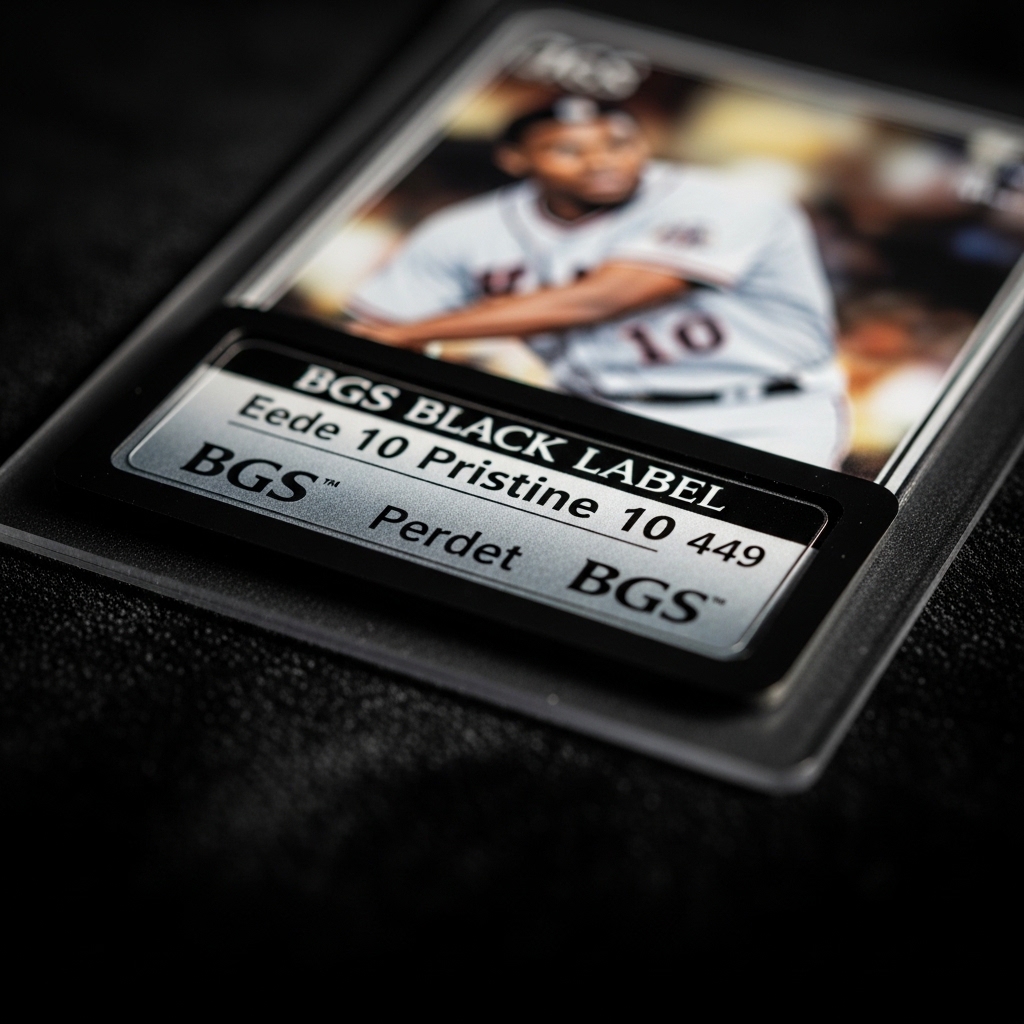
When to pursue a BGS Black Label:
- You've examined the card under a loupe or strong magnification
- Centering is near-perfect by eye (60/40 or better on both axes)
- The BGS Black Label population on that card is low enough that yours would add genuine scarcity
- You're comfortable with the possibility of receiving a BGS 9.5 instead — which means submitting to BGS is not a “grade and hope” exercise; it's a calculated bet on a card you've already evaluated as pristine
If you're grading a card with any visible wear, off-center printing beyond 65/35, or surface clouding, the Black Label is not your play. Submit to PSA for liquidity.
Grading Cost & Turnaround — PSA vs BGS in 2026
Pricing at both companies changes frequently, and any specific numbers in an article can become outdated between writing and reading. The up-to-date breakdown is covered in Sports Card Grading Costs 2026 — read that before committing to a service tier.
The structural difference worth knowing: BGS subgrades add information value that PSA doesn't provide. If you're grading a card to understand its exact condition profile — for a future sale where subgrade transparency commands a premium, or to decide whether to crack and resubmit — BGS gives you that data. PSA does not.
Should You Crack and Resubmit? The Real Question Behind “PSA vs BGS”
This is what collectors are actually asking when they search “PSA vs BGS” — especially collectors who already have a graded card. The scenario: you have a Luka Dončić rookie in a PSA 9. Should you crack it and resubmit to BGS hoping for a 9.5 or even a 10?
The answer requires three data points before you touch that case:
- Check the PSA population for your specific card. If PSA 9 pop is 4,000 and PSA 10 pop is 1,800, a PSA 10 upgrade would matter a lot. If PSA 10 pop is 8,000, the upgrade may not move the needle.
- Check the BGS population. If BGS 9.5 pop is 45 and BGS 10 pop is 12, a BGS 9.5 might command more than a PSA 10 depending on the card's current market.
- Examine the card before cracking it. If the reason for the PSA 9 is a visible surface scratch, no grading company will fix that. But if the PSA 9 seems aggressive — pristine-looking card, clean corners, good centering — it might be worth the bet. Just know: once it's cracked, you can't go back.
Once it's cracked, you can't go back. Crack-and-resubmit only makes sense when the condition issue isn't visible, the pop math works, and you can absorb the cost if it grades the same or lower.
The Bottom Line — Decision Framework
| Your Situation | Choose | Why |
|---|---|---|
| Sports card (any sport), grading for resale | PSA | Liquidity premium, market standard, PSA pop report is the reference |
| Modern Pokémon or TCG | PSA | Dominant volume post-2020, highest resale liquidity |
| Vintage Pokémon (pre-2000), card is genuinely pristine | BGS | Black Label upside, WOTC printing tolerance context |
| Vintage sports card, objectively mint, Black Label is realistic | BGS | Black Label premium can far exceed PSA 10 on right card |
| High-pop card where PSA 10 is flooded | Check BGS pop first | Low BGS 9.5 pop can beat flooded PSA 10 on resale |
| First-time grader, don't know what to expect | PSA | Simpler process, market standard, easier to resell |
| Need to understand exactly why a card graded a certain way | BGS | Subgrades give condition breakdown PSA doesn't provide |
| Crack and resubmit consideration | Check pop math first | Never crack without verifying upgrade is worth the risk |
FAQ
Is PSA or Beckett (BGS) better?
Neither is universally better. PSA dominates sports card resale and has higher market liquidity. BGS has a superior grading system for condition transparency (via subgrades) and is the better choice for vintage Pokémon and Black Label pursuits. The right company depends entirely on what you're grading and why.
Is a BGS 9.5 equivalent to a PSA 10?
Not in market value, and not in what they measure. A BGS 9.5 is often harder to achieve than a PSA 10 because all four subgrades must meet a minimum threshold. But on the open market, a PSA 10 typically sells for more than a BGS 9.5 on the same card — unless the BGS 9.5 population is significantly lower than the PSA 10 population, in which case scarcity can flip the equation.
What is a BGS Black Label?
A BGS Black Label (officially BGS 10 Pristine) is awarded when all four subgrades — centering, corners, edges, and surface — each score a 10. It is extremely rare and commands a significant premium over standard BGS 9.5 or PSA 10 grades on the right card. It is not a realistic target for most submissions and should only be pursued on cards you've already determined are genuinely pristine under magnification.
Which grading company has faster turnaround times?
Both PSA and BGS offer economy through walk-through service tiers with corresponding price increases for faster turnaround. Neither has a permanent advantage on speed — both have historically experienced backlogs during hobby booms. For current pricing and turnaround estimates, check Sports Card Grading Costs 2026 and each company's current service tier pricing directly.
Bottom Line
PSA is the market standard for sports cards and the default for most collectors. If you're grading for resale and you want liquidity, PSA is your answer.
BGS earns its place in specific situations: vintage Pokémon where printing variance matters, premium cards where the Black Label is a realistic target, and any scenario where you want subgrade transparency. The BGS subgrade system is genuinely superior as a grading instrument — it just doesn't always translate into superior resale value.
The one non-negotiable: check both pop reports before you submit anything. The difference between a PSA 10 in a 2,000-unit population and a BGS 9.5 in a 40-unit population isn't just academic — it's money left on the table.
Loading articles...